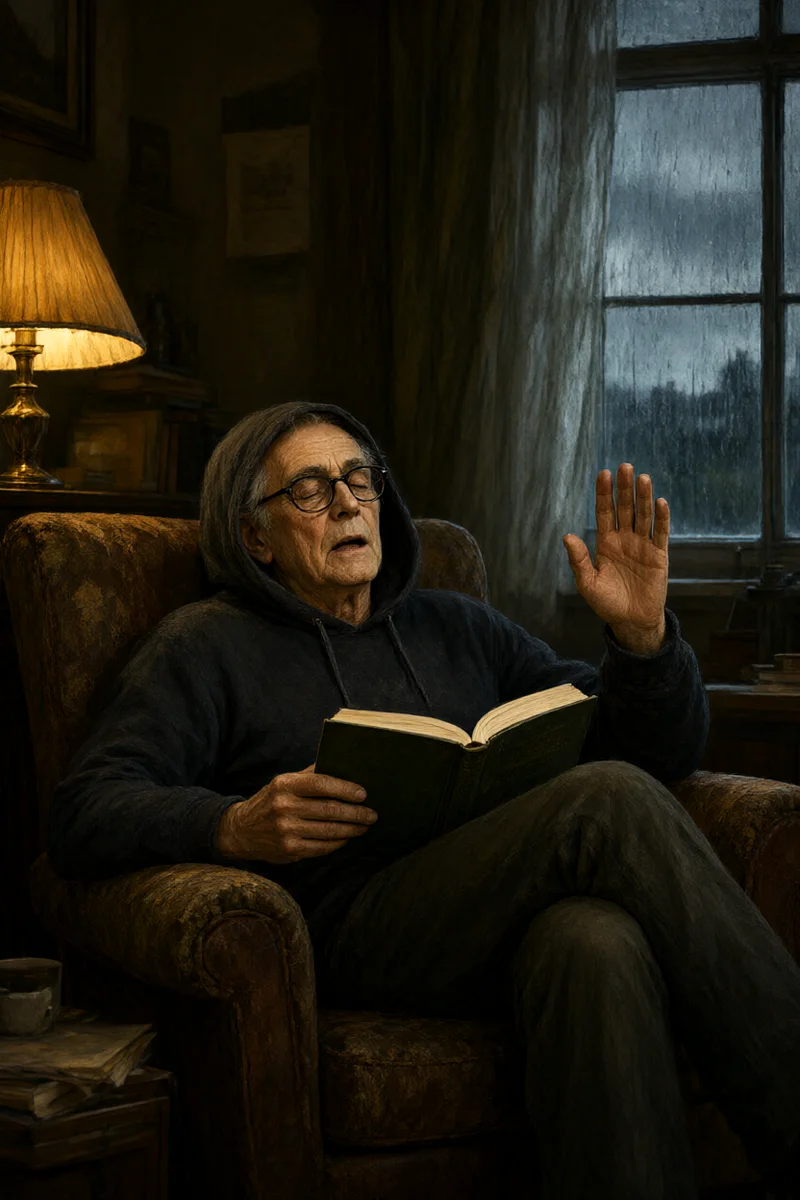
 Reading to Mr. Graff
Chapter 1
4C
The word Ansel Dunmore had painted across the front window of Szabo's Hardware was FUNNY, in red, with a question mark the size of a shopping cart. He had done it at eleven at night with a can bought at the same store, which the police officer mentioned twice.
He was sixteen. It was his first offense. The county offered him restorative justice instead of juvenile court, and his mother signed for it before he could open his mouth, which was how most things in his life got decided.
The terms were forty hours of community service and something called a circle. In six weeks, he would sit in a room at the community center with a facilitator, his mother, and Mr. Ferenc Szabo, and he would explain, out loud, in his own words, what he had done and why.
Out loud. That was the sentence. The forty hours were nothing.
“You're not getting out of it,” his mother said, in the kitchen, in her scrubs, already late for her shift. “And you're not sitting in this apartment all evening playing that game while I'm at work, either. I've found you something.”
“W-w-w—” Ansel stopped. Breathed. Switched words, the way he'd been doing since second grade. “Where?”
His mother didn't wait for him anymore, and didn't finish his sentences either, which a speech therapist had told her not to do in 2016. She simply waited with her face perfectly patient, which was worse. “Next door. Mr. Graff. He's lost his sight and he needs somebody to read to him. Six to eight, weeknights. I said yes.”
Ansel had lived in 4D of the Ormsby Arms his entire life and had exchanged perhaps nine words with the man in 4C. He knew him as a tall stooped shape with dark glasses and a white cane that tapped on the stairwell at exactly seven every morning, and as a voice through the wall, sometimes, singing in a language Ansel didn't recognize.
Reading aloud. To a stranger. For two hours. His mother might as well have signed him up to juggle knives.
But a blind man, he thought on the landing at five past six, couldn't see his face. Couldn't see his jaw lock or his eyes squeeze shut or the way his whole head jerked forward on a block like he was trying to shake a word loose. That was something.
He knocked. A voice said, “It's open, Mr. Dunmore,” as if he'd been expected to the minute.
4C smelled of coffee and old paper. There were books on every wall, two deep, and a reel-to-reel tape machine under a dust sheet. Mr. Graff sat in a high-backed chair by the window with a cardigan buttoned wrong. He was eighty-one, Ansel would learn, and had been fully blind for nine years.
“The green book on the table,” Mr. Graff said. “Page forty-four. Start at the top and keep going until I tell you to stop.”
It was poetry. Ansel hated poetry. He looked at the first line and felt the B in it coming at him like a truck.
“B-b-b-b—”
He stopped. His ears burned. He waited for the sigh, the shift in the chair, the kindly “take your time” that made him want to put his fist through drywall.
Instead, very quietly, the old man began to read along with him, from memory, his voice low and steady and half a beat ahead. “Bring round the boat at the bend of the river—”
And Ansel's voice, to his own astonishment, came with it. Every word. The whole first verse, without a single catch, the two of them together like a car being towed.
On the last line Mr. Graff stopped, abruptly, and left Ansel to finish alone. He did. Then he lowered the book and stared at the man in the chair.
“How did you know that would work?” Ansel said.
The End









