 The Smallest Coats
Chapter 5
Rocking
Elmfield House had a conservatory, a fish tank and a woman at the front desk expecting a Mr Bassi at noon.
He was in the car park when she arrived, standing beside a taxi with two suitcases and Lidia's dummy in the back seat with its seatbelt on.
“Constance,” he said. “You came to see me in. That is kind.”
“I've not come to see you in.” She held the van door open. “Get in. There's somebody waiting for you at Ashgrove at two.”
He looked at her, at the van, at the fish tank through the glass. “What have you done?”
“I've not looked after you,” she said. “I want that clear. I'll never do your buttons again unless you ask me nicely. I've built you a chair. That's not looking after; that's engineering. There's a difference, and I've been doing one for thirty-eight years and the other for six, and I know which I prefer.” He didn't move.
“When you need looking after,” she went on, and her voice did not hold as well as she wanted it to, “we'll pay somebody who's good at it, and I'll come round and argue with them about how they're doing it. That's what I'm offering. I'm not offering to be your nurse. I'm offering to be your mechanic.”
The taxi driver looked at his watch. The woman from the front desk had come out onto the step. Osvaldo Bassi stood in the car park of the care home where he had paid a deposit to make certain no one he loved would ever have to look after him, and laughed, helplessly, his hand shaking at his side.
“My deposit,” he said.
“They'll give you half. I asked. And nobody buys a flat in November, so ring your agent.”
He lifted Lidia's dummy out of the taxi and put it into the back of the depot van, and did up its seatbelt himself, which took a while. Connie did not help. Then he got in beside her.
The assessor from occupational health was a brisk young man with a clipboard who sat in the chair, tested the lever, checked the brake, and watched Osvaldo try the needle jig with his right hand, which got the thread through on the second attempt. He made a long note. He asked who had designed it and Connie said a mechanic had, and he wrote that down too.
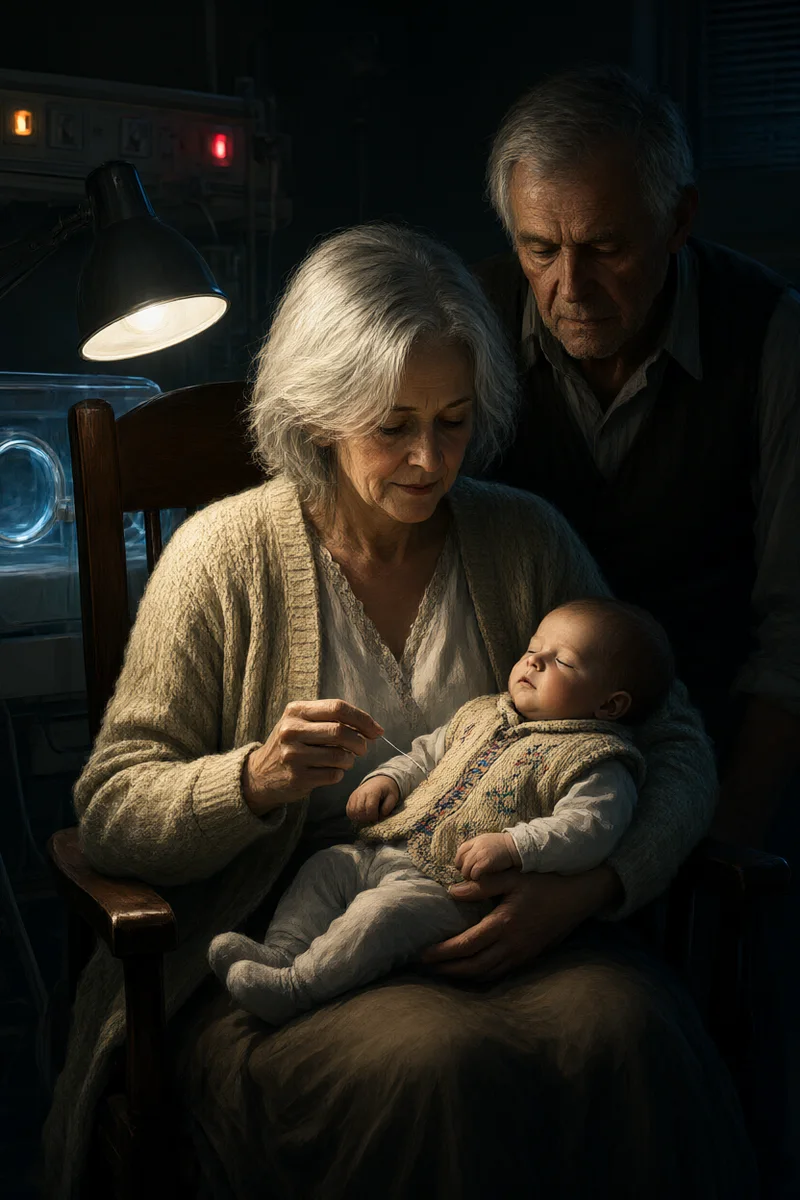
At ten past three Sister Akua lifted Ezra Okoro out of his incubator and laid him in the cradle-arm of Femi's mother's rocking chair, against the moss cardigan, and stood back.
Osvaldo's arms shook. The baby didn't. He lay in the curve of the arm, held by oak and padding and a lever cut from a bus part, and opened his eyes, grey-blue and enormous, and looked up at the old man's face.
Osvaldo started to sing. Badly, as always, and very low, and the line went up at the end like a question.
Connie sat down in the other rocking chair, the hospital one, and picked up the tin. She threaded twenty needles. She pushed them into the cushion in rows of five, like rivets, and when she'd finished she found she was humming along without the words.
“What's it about?” she asked, at about four, when the twins were asleep. “The song. You've never said.”
“It is a man asking a woman a question,” Osvaldo said, “at the end of every line. He is very persistent. Every verse, she says no.”
“And?”
“The last verse she says, ask me again in the morning.” He rocked, slowly, his hand in its tremor resting on the baby's back, safe. “Constance. Will you have breakfast with me?”
She put the needle tin down. Outside, the afternoon was already going dark.
“Ask me again in the morning,” she said.
The End









