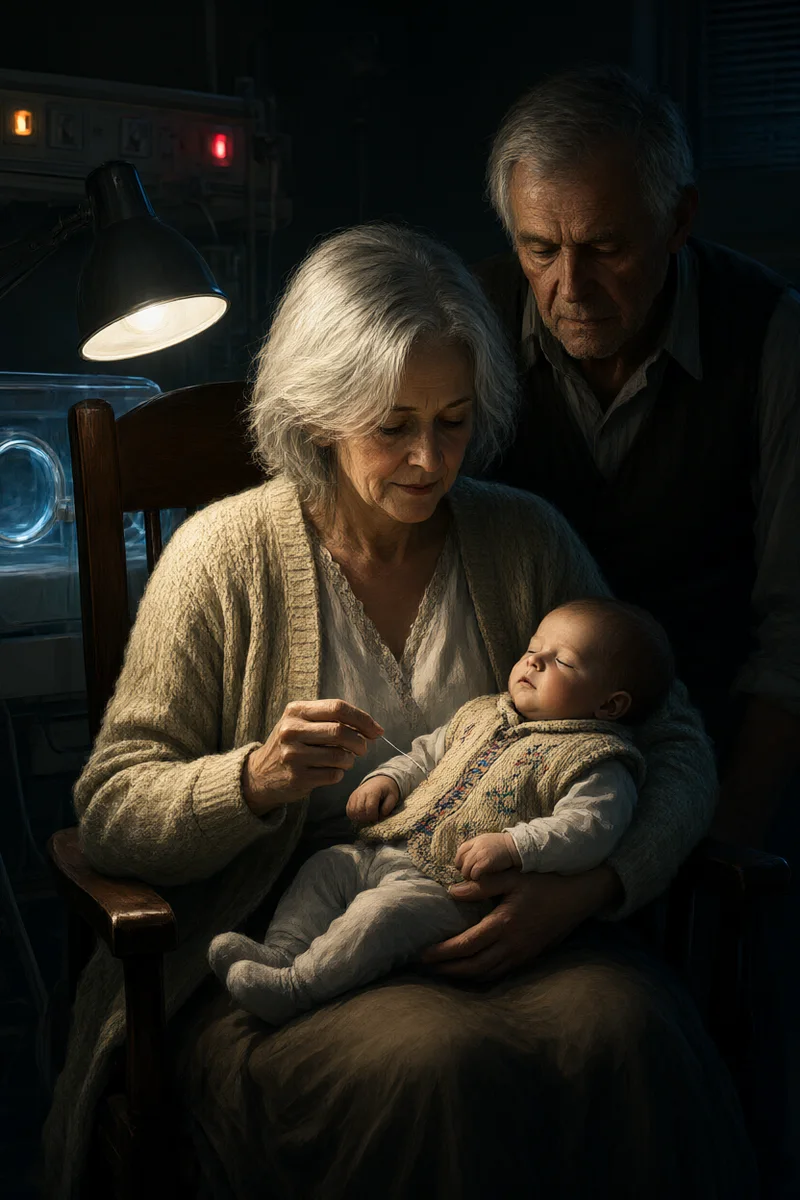
 The Smallest Coats
Chapter 2
Breakfast
She didn't tell the Sister. She told herself it was none of her business, which was a thing she had been trying to learn to say for four years.
But on her third night she arrived before him and threaded six needles from his tin, which he'd left in the drawer of the lamp table, and pushed them into the little pincushion in the lid in a neat row. She said nothing about it. Neither did he. The next night there was a paper bag on her chair with two almond biscuits inside.
After the second week they started having breakfast. It wasn't a decision. The shift ended at seven and the canteen opened at seven and they were both walking the same way.
He ate like a tailor: everything cut into squares, the egg left till last. She ate like a mechanic, fast, one hand round the mug.
He talked. Fifty-one years with a needle; a shop on Carver Street that had made suits for three mayors and a bishop; no children, which had been a grief and then just a fact. He'd started coming to the neonatal unit after Lidia died, because the nights were long and because, he said, someone ought to hold the ones whose parents lived three hours away and could only come at weekends.
Connie found she was talking too. About the depot. About Femi.
“Six years,” she said. “He was a big man. Very proud. By the end I was turning him every two hours and he couldn't tell me to stop. He hated it and I hated it and we did it anyway.” She put her mug down. “I loved him. I'm not saying I didn't. But at the funeral, my daughter said, you'll be lonely, Mum, you should get out there. And I said, I've done forty-one years of men and six of spoon-feeding one, and I'm never looking after another man as long as I live.”
Osvaldo cut his egg into four precise pieces.
“That seems very sensible,” he said.
“It is.”
“I'm only buying you breakfast.”
“I know you are.” She looked at his right hand, holding the fork. It was trembling, and he had his left hand on the table beside it, ready to steady it. “Osvaldo. Have you seen anyone about that?”
“Seen anyone about what?” he said, pleasantly, and asked if she wanted the last piece of toast.
She let it go. She threaded his needles every night. He sang to Florence until Florence went home, and then to a pair of boys called the Okoro twins who had arrived at twenty-six weeks and were each the length of a biro. She learned to hum the Italian song, roughly, without the words. One night, when he had trouble with the buttons of his overcoat in the cold of the car park, she did them up for him, all five, standing close in the orange light, and he looked down at her the whole time and said nothing.
In the sixth week she arrived at nine and his chair was empty. Sister Akua was waiting at the nurses' station with her coat still on.
“Can I have a word, Connie?”
They went into the little office with the box of tissues.
“This morning, at handover, one of my day staff saw Mr Bassi with Ezra Okoro.” She took a breath. “His arms were shaking so badly she took the baby off him. She thinks he nearly let go.”
Connie sat very still.
“I've had to take him off holding,” Sister Akua said, “until occupational health clears him. He's not to touch the babies. I thought you'd want to know before he came in.”
“Is he coming in?”
“He says he is,” Sister Akua said. “He says he'll sew.”
The End









