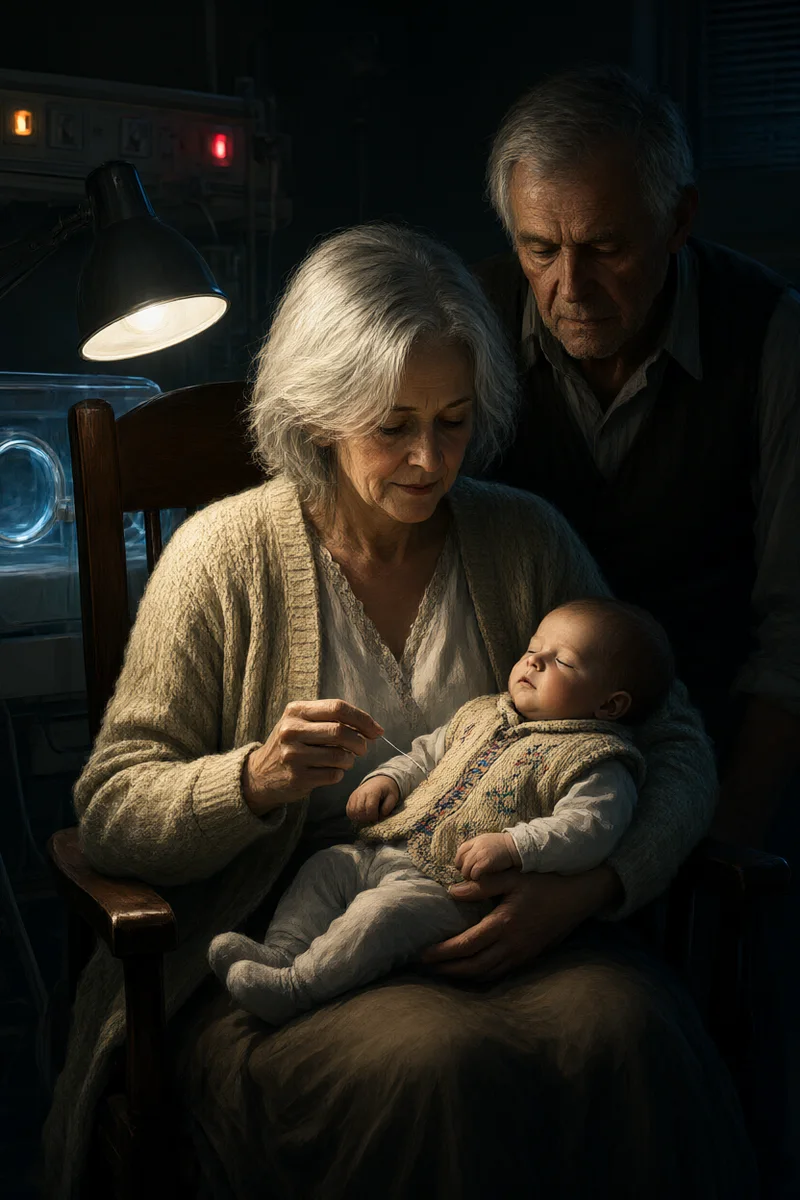
 The Smallest Coats
Chapter 3
Twenty Needles
He came in at ten past nine, with his tin and his moss cardigan, and sat down not in the rocking chair but at the small table in the parents' room with the door open so he could see the bay. He did not look at her. He opened the tin and took out the vest he was working on.
Connie sat with Ezra Okoro for two hours. Then she got up, against rule seven, and went into the parents' room and sat down opposite him.
“Parkinson's,” he said, before she could say anything. “Early. The consultant was very charming about it. It will get slower, he says, and it will get worse, and I will not be threading needles for very much longer.” He smiled without much in it. “I have been not threading needles for some time. You noticed.”
“I noticed.”
“You noticed, and you threaded them, and you said nothing.” He turned the vest over in his hands. “Lidia would have liked you. She hated a fuss.”
She didn't say anything to that. She held out her hand for the tin.
From then on it was the shape of their nights. Connie held a baby, and when the baby went back in its incubator she went into the parents' room and threaded needles. Not six now: twenty. She lined them up in the pincushion in rows of five like rivets. Osvaldo sewed. His stitches were slower than they had been, and sometimes he had to stop and press his right hand flat against the table until it quietened, but they were still beautiful. Tiny, even, invisible.
He made vests for the Okoro twins. He made a hat for a girl called Dellarose whose mother was nineteen. He made one, very small, in white with a single blue thread at the hem, for a boy who didn't go home, and Sister Akua took it away wrapped in tissue paper and said nothing to either of them for a long while afterward.
Connie had stopped pretending to herself about breakfast. She went because she wanted to. She liked the way he cut his egg. She liked that he called her Constance, which nobody had since her mother died.
One morning in the car park he got his coat buttons wrong again, two out of line, and before she could reach for them he put his hand over hers on the top button and kept it there.
“I know what you promised,” he said. “At the funeral.”
“That's my business.”
“Yes.” He looked at their hands. “I only want you to know that I heard it. I won't make you break it.”
She thought it was just an old man being gallant. She did up the buttons, all five, and went home, and slept all day better than she had in four years.
On the Thursday he didn't come in.
His chair in the parents' room was empty, but there was an envelope on it, cream, heavy paper, the sort a tailor might keep for bills. Constance, on the front, in handwriting that had once been elegant and now wandered.
She read it standing up.
“Dear Constance. I have given my notice to Sister Akua. I have also put the flat on Carver Street up for sale. In November, on the 21st, I move into Elmfield House, where there are nurses at all hours and a garden I shall not be able to see from my room.
“I am seventy-one, which they tell me is young for Elmfield. But I have watched what you did for six years, and I heard what you said about it, and I would rather be early than be your next six years.
“Please thread the needles for whoever comes next. Yours, with more affection than is sensible, O.B.”
The End









