 The Smallest Coats
Chapter 4
Elmfield
The flat on Carver Street was over what had been his shop. His name was still in gold on the window. Connie leaned on the bell until he came down.
Inside, every surface had a box on it. He'd been wrapping Lidia's dressmaker's dummy in bubble wrap.
“You decided,” she said. “About me. Without me.”
“I decided about me.” He was very calm, very courteous. He offered her a chair and she didn't take it. “You told me what you wanted. You were extremely clear. I have been married, Constance; I know how to listen when a woman is clear.”
“I said I'd never look after a man again. I didn't say I'd never...” She stopped. She found she didn't have the end of the sentence.
“You'd never what?” He waited. “You'd never sit next to one? Have breakfast with one? I know how this goes. I sat with Lidia's father at the end. First you thread the needles. Then you do the buttons. Then the shoes, then the dressing, then the bath, and one day you have spent six more years turning someone over in a bed and you are seventy-two and furious and it is too late. I would not do that to you. I would not let you do it to yourself.”
“That's my decision.”
“And Elmfield is mine.” He put the roll of bubble wrap down. His hand was shaking hard now, and he didn't try to hide it. “I've paid the deposit. I move in on the twenty-first. Please, let me be the one man in your life who didn't need you.”
She went home and sat in the kitchen with the lights off until two in the morning, as she had after Femi's diagnosis.
He was right. That was the problem. Everything he'd said was true, and she had said every word of it herself, and she knew precisely how the shoes and the bath went.
At two in the morning she got up and went into the garage.
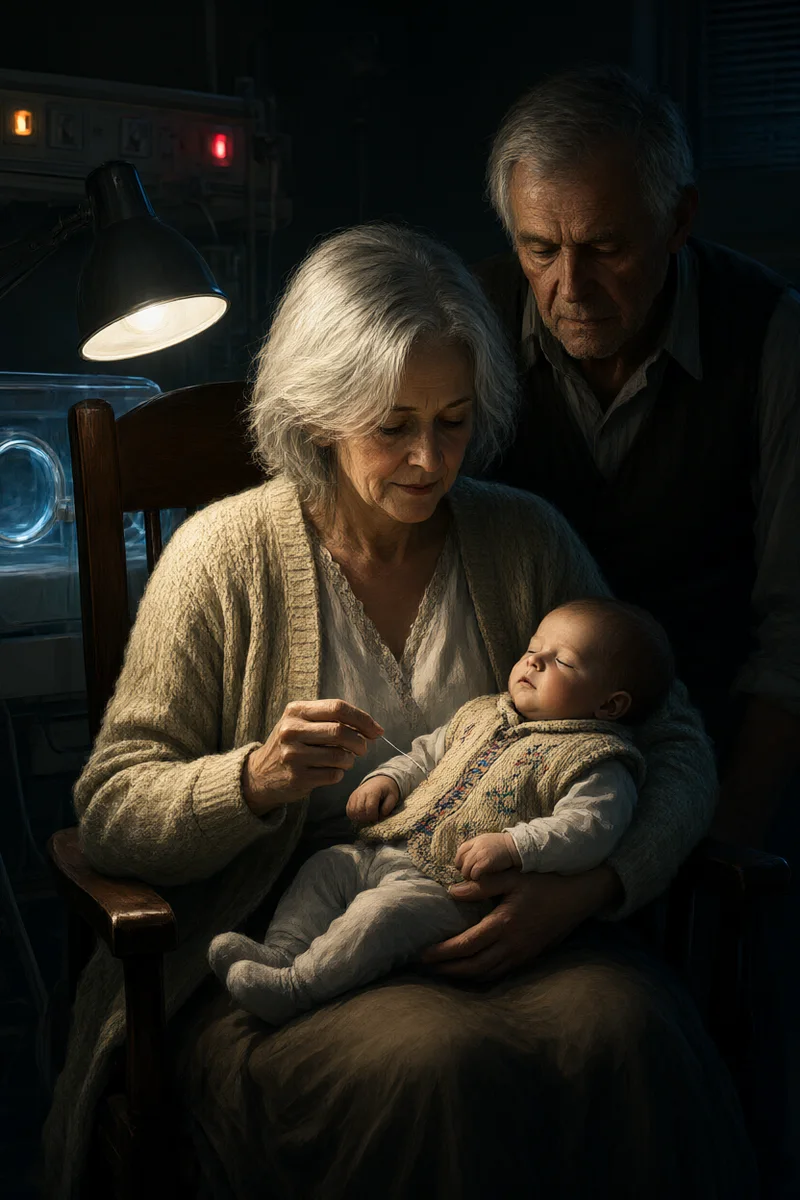
Femi's old rocking chair was in there, under a dust sheet, the solid oak one that had come from his mother's house in Ibadan. Connie had never been able to sit in it or get rid of it. She pulled the sheet off and stood looking at it with her hands on her hips, the way she used to look at an engine somebody else had given up on.
What he needed wasn't a nurse. It was a different machine.
It took her eleven days. She borrowed tools from a lad at the depot who owed her a favour. She built a padded cradle-arm that clamped to the right side of the chair and took the weight of a baby off the holder's arms entirely: the baby lay in the curve of it, against the chest, held by the chair. The arm locked with a lever you could work with a fist. She fitted a little brake to the rockers, so that it moved only when you meant it to. And she made a threading jig from a bicycle spoke and a clothes peg, that held the needle still and guided the thread through the eye if you pushed it the right way.
She took the chair to Ashgrove in a depot van on the nineteenth of November.
Sister Akua walked round it three times. She sat in it. She had a nurse place a weighted training doll in the cradle-arm, and then shook her own arms out sideways like a swimmer, and the doll didn't move.
“I'll have to get occupational health to look at it,” she said. Her voice had gone odd. “If they sign it off, he can hold again. But he has to be here for the assessment, Connie. In person. They only come on Fridays.”
Friday was the twenty-first.
The End









