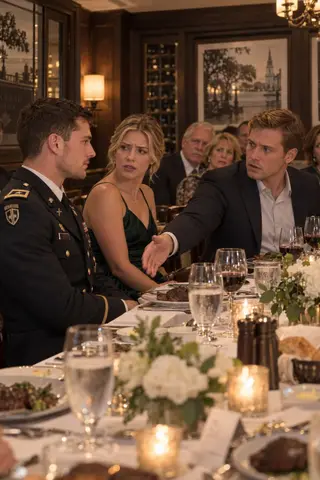
 My Sister Mocked My Uniform At Her Engagement Dinner
Chapter 9
The Ground Beneath the Boots
Spring came to coastal Georgia with an explosion of white dogwood blossoms and thick, heavy pollen that coated the roads in gold.
On a bright Tuesday morning in late March, the pine flats of the Townsend Bombing Range were vibrating with the low, thumping roar of approaching twin-rotor CH-47 Chinooks.
The air smelled of pulverized dirt, burnt jet fuel, and crushed sweetgum leaves. Out on the landing zone, three hundred soldiers from 3rd Infantry Division and a detachment from 1st Battalion, 75th Ranger Regiment were conducting the final phase of their joint multi-echelon trauma evaluation.
I was standing beside an M1133 Stryker Medical Evacuation Vehicle, wearing my dirty multicam kit, ballistic helmet, and eye protection. My hands were covered in nitrile gloves, holding a laminated evaluator’s clipboard.
Fifty meters away in the tree line, smoke grenades popped, spewing thick purple and yellow clouds into the pine canopy. Shouts echoed across the clearing:
“Incoming! Medic! Get the litters up!”
Leading the squad of infantrymen out of the scrub was Captain Liam Davis—recently promoted, his helmet dusted with white Georgia sand, his uniform soaked in sweat. He was barking fire-team commands with crisp, ruthless efficiency, moving his riflemen into a perimeter around two simulated mass-casualty dummies.
Behind the observation wire, fifty yards back in the designated VIP bleachers, sat an unusual group of spectators.
Hunter Army Airfield often invited family members and community leaders to observe joint training capstone events to build civilian understanding of readiness operations. Sitting in the center of the wooden bleachers, wearing ear protection and safety glasses, were my mother, my father, and Maya.
Beside them sat Colonel Thomas Davis, retired, pointing out troop movements with his walking stick, explaining the tactical mechanics to my father in low, measured tones.
Dad was watching through a pair of heavy binoculars. He wasn't looking at the helicopters. He wasn't looking at the smoke.
He was watching me.
Out on the lane, Liam’s squad laid down a suppressive line of fire with blank ammunition, the sharp crack-crack-crack of fifty rifles filling the swamp basin. I moved out from behind the Stryker, running low, my medical rucksack riding high on my shoulders.
I dropped to my knees beside a simulated casualty, assessing airway, breathing, and circulation with fluid, instinctive speed. Within forty seconds, I had placed a simulated chest decompression needle, secured a combat tourniquet to the high-and-tight standard, and prepped the litter team for extraction.
I looked up and caught Liam’s eyes through his dusty goggles.
He didn't say a word. He raised his right hand, gave a quick, decisive signal to his point man, and shifted his security sector to cover my team’s blind spot as we lifted the casualty. It was the seamless, wordless choreography of professionals who trusted each other with their lives.
When the exercise concluded two hours later, the engines powered down, leaving only the sound of cicadas and the heavy, ragged breathing of two hundred exhausted soldiers.
I unstrapped my helmet, wiped the grime from my forehead with the back of my sleeve, and walked toward the spectator perimeter.
My family was waiting near the support tent.
Mom stepped forward first. She looked older, her face softer, stripped of the tense, defensive social mask she had worn for thirty years. She reached out, taking both of my dirty, sweat-stained hands into hers without caring that the carbon and grease were transferring directly onto her clean linen cardigan.
“Christopher,” she said, her voice trembling as she looked at my face. “You do that... every day?”
“Not every day, Mom,” I smiled, squeezing her fingers. “Some days we just do paperwork.”
Dad walked up beside her. He didn't say anything at first. He reached out, placed his heavy palm against the back of my neck, and pulled my forehead down against his shoulder. He held me there for ten seconds, his grip fierce, his chest rising and falling against my body armor.
“I’m proud of you, son,” Dad whispered into my ear, his voice rough and thick with tears. “I’m so damn proud of you.”
Those were the words I had waited fifteen years to hear. And standing there in the dirt of the bombing range, covered in Georgia clay, I realized that I didn't need them to heal me anymore—but hearing them finally closed the circle.
Behind him, Maya was standing quietly beside Liam.
Liam had removed his helmet, his hair plastered to his scalp with sweat. He was looking at Maya with a cautious, thoughtful expression. Maya wasn't looking at the medals, the ribbons, or the officers with silver eagles on their collars.
She was looking at Liam’s dusty boots, and then at mine.
She stepped forward, handed me a cold bottle of water from the cooler, and gave me a small, shy, genuine smile.
“Good job, Chris,” she said softly.
“Thanks, Maya,” I said, taking the water. “You did good today too.”
The End









