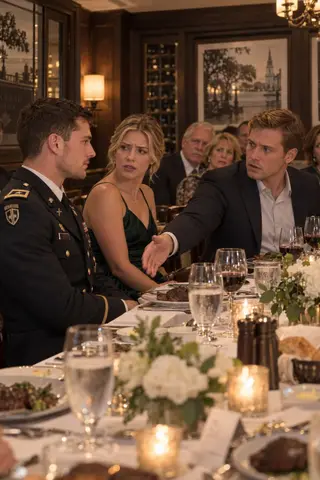
 My Sister Mocked My Uniform At Her Engagement Dinner
Chapter 8
The Mirror and the Mud
For the rest of January, the cold coastal rain settled over coastal Georgia, turning the pine woods into black swamps and keeping the marshes swollen with grey tides.
While Maya remained secluded in our parents’ house in Atlanta, life at Hunter Army Airfield moved at its usual relentless, uncompromising tempo. We were preparing for a three-week deployment cycle, running night-vision shooting packages, low-level static line drops, and live-tissue trauma simulations that left our hands smelling of surgical scrub and iron.
On the third Saturday of February, I walked into the battalion aid station early to finalize equipment manifests.
The building was mostly deserted, the fluorescent lights humming over the polished linoleum floors. I was signing off on a narcotics destruction log when the outer glass door buzzed.
I walked to the reception window.
Standing in the civilian waiting area, clutching a damp wool trench coat around herself, was Maya.
She had no makeup on. Her hair, usually blown out into immaculate, salon-crafted waves, was pulled back into a hasty, utilitarian ponytail. The sharp, cutting arrogance that had defined her posture at the steakhouse in December was completely gone. She looked smaller, thinner, her shoulders curled slightly inward as if she were trying to protect her ribs from an impact.
I stepped through the security door into the waiting room.
“You had to show ID to get through the Montgomery Gate,” I said, keeping my hands in the pockets of my combat uniform. “Who sponsored your pass?”
“Dad called a friend from the chamber of commerce who knows the garrison commander,” she said, her voice thin, stripped of all its theatrical power. “I didn't think you’d see me if I called.”
“You’re right. I wouldn't have.”
Maya swallowed hard. She looked around the sparse military clinic—the framed portraits of fallen Rangers on the wall, the stark safety posters, the smell of sterile gauze and floor wax.
“Liam won't speak to me, Chris,” she whispered.
“I know.”
“He sent the ring back in a registered parcel with a two-sentence note,” she said, tears immediately gathering in the corners of her eyes, but she didn't wipe them away. “He said he wished me peace, but that we lived in different universes.”
“He wasn't wrong, Maya.”
She flinched as if I had struck her across the face. For a moment, the old Maya flared in her eyes—the reflex to snap, to deflect, to accuse me of cruelty. But the spark flickered out, crushed beneath the weight of two months of total isolation.
“I hated you, you know,” she said, her voice dropping into a raw, ragged confession.
“I know.”
“Not because of the Army,” she said, hugging herself tighter. “Because Dad loved you without you having to perform. You never saw it, Chris, but he did. Whenever you were in the garage, Dad would look out the kitchen window and watch you. He never said it to your face, but he’d tell Mom, ‘That boy has his grandfather’s hands. He can fix anything.’”
I stared at her, caught completely off guard.
“I had to bring home straight A’s,” Maya wept, her voice trembling through the empty clinic. “I had to be the class president. I had to win the scholarship. I had to get the VP title before I was twenty-seven. Every single day of my life was terrifying because I thought that if I stopped achieving for five minutes, Dad would look at me the way he looked at broken lawnmowers—like something to throw a tarp over.”
She stepped closer to me, her breath catching in her throat.
“When you joined the Army, I told myself you were a loser. I told myself you were running away because you couldn't compete with me. Every joke I made... every time I cut you down at dinner... it was because I was terrified that if anyone looked too closely at you, they’d see that you were doing something real, and I was just... I was just selling corporate software and collecting shiny objects.”
She reached out, her hand hovering in the air between us, trembling violently, before she finally let it drop against the rough camouflage fabric of my sleeve.
“At that restaurant... when Liam looked at your uniform... I saw the truth in his eyes,” she sobbed, burying her face against my shoulder, her tears soaking through my uniform blouse. “He looked at you with respect. Real respect. The kind of respect nobody has ever had for me in my entire life. And I knew that no matter how many titles I got, or how much money I made, I would never be half the person you are.”
I didn't move for three seconds. The anger that had sat in my chest since December—the cold, defensive armor I had worn around my family for a decade—began to dissolve under the heat of her grief.
I raised my arms, wrapped them around my sister, and held her while she cried in the middle of the empty battalion aid station.
“You don't have to perform anymore, Maya,” I whispered into her hair. “The race is over. Nobody is keeping score.”
The End









