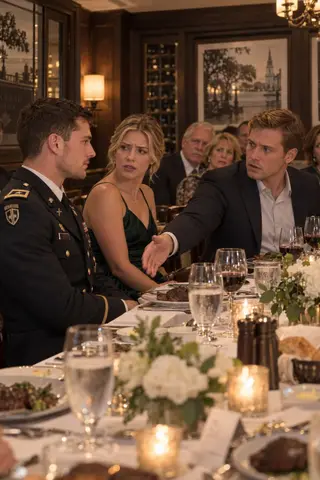
 My Sister Mocked My Uniform At Her Engagement Dinner
Chapter 7
The Shadowbox on Wilmington Island
Two weeks passed before anyone knocked on my door.
It was a rainy Thursday evening. The coastal storm was throwing sheets of grey water against the live oaks in my front yard, the moss dripping heavily under the low sky. I was sitting at my kitchen table with a mug of black coffee, cleaning the salt spray off my saltwater reel, when the headlights of a car cut through the rain and swept across my living room wall.
A sedan pulled into the gravel drive. A car door shut with a heavy thud.
A moment later, three slow, hesitant knocks sounded on my front door.
I set the reel down, walked to the foyer, and flipped on the exterior porch light. Through the rain-streaked glass, I saw my father. He was wearing an old canvas hunting jacket with the collar turned up against the downpour, his head bare, water dripping from the silver edges of his hair.
I unlocked the deadbolt and pulled the door open.
“Dad.”
He stood on the wooden deck, looking at me with bloodshot, exhausted eyes. “Can I come in, Chris?”
I stepped aside. “Get in out of the rain.”
Dad wiped his feet carefully on the bristled mat, took off his wet canvas coat, and looked around my house.
He had never been here. In the five years I had owned the small, two-bedroom cottage on Wilmington Island, my parents had visited Savannah at least twelve times to take Maya to upscale seafood restaurants or help her decorate her luxury condo in the historic district. Each time, Mom had texted me: “We’re in town seeing Maya! Let us know if you want to meet for lunch!”
I had always declined. I knew what those lunches looked like—two hours of listening to Maya’s quarterly bonuses while Dad checked his watch.
Dad walked slowly into my living room. There was no clutter. A leather couch, a sturdy coffee table made from reclaimed heart-pine, a small wood stove crackling in the corner, and bookshelves lined with medical textbooks, military history, and fishing logs.
Then his eyes stopped on the wall between the two front windows.
Hanging there in a dark walnut frame under museum glass was my shadowbox.
It was large, three feet by two feet, presented to me by the noncommissioned officers of 1st Battalion after my fifth combat deployment. Inside, mounted on deep green velvet, were the medals: the Bronze Star with the bronze "V," the Purple Heart, the Army Commendation Medals for Valor, the Combat Medical Badge with the combat star, the freefall jumpmaster wings, and my tan beret, its silver-bordered blue flash bearing the crest of the 75th Ranger Regiment.
Beneath the medals were three spent 5.56 brass casings, polished to a mirror shine, mounted above a small brass plaque engraved with five names.
Dad walked toward it like a man approaching an altar. He reached out a trembling hand, stopping his fingers an inch before touching the glass.
“What are the names, Chris?” Dad asked, his voice barely a whisper against the drumming of the rain on the tin roof.
“Men who didn't come back on the birds,” I said, standing behind him with a towel. “Two from my second rotation, three from my fourth.”
Dad stared at the brass plaque. His throat worked, swallowing hard.
“You carried them?”
“I carried them onto the ramp,” I said simply. “I closed the bags. I escorted them back to Dover when the rotation ended.”
Dad slowly turned around. His face crumpled into a mask of pure, unadulterated grief. He sat down heavily on the edge of the leather couch, buried his face in his calloused hands, and began to weep. It wasn't the polite, quiet crying of a suburban businessman; it was deep, guttural, chest-heaving sobs that shook his entire torso.
I stood there for a long moment, watching my father break apart in my living room. Then I walked into the kitchen, poured another mug of black coffee, brought it over, and set it on the table in front of him.
“Drink your coffee, Dad.”
He took a ragged, shuddering breath, pulling a handkerchief from his pocket to wipe his eyes. “I was so blind, Chris. I was so damn blind.”
“You saw what you wanted to see,” I replied, sitting in the armchair opposite him.
“No,” Dad said, shaking his head violently. “I saw what was easy. Maya... Maya was loud. She demanded attention. She needed praise like oxygen, and every time I gave it to her, she performed more. It was easy to manage. It made me feel like a successful father because her trophies were shiny and everyone at the club could understand them.”
He looked up at the shadowbox on the wall, his eyes red and raw.
“You never asked for a thing. From the time you were ten years old, you fixed your own bike, you handled your own scrapes, you never asked for praise. And like an idiot... like a terrible, lazy father... I assumed that meant you didn't need me. I thought your silence was apathy. I didn't see that your silence was strength.”
He leaned forward, resting his elbows on his knees, his hands trembling.
“Maya’s life is falling apart, Chris. Liam won't answer her calls. His father called me last week and told me that Liam dodged a bullet. Maya blames you. Your mother blames you. But yesterday, I finally told your mother the truth. I told her that we failed you. Both of us. For fifteen years.”
I looked at my father, the steam rising between us from the coffee mugs.
“Where is Maya now?” I asked.
“At our house,” Dad said. “Sitting on her old bed, staring at the wall. She doesn't have her fiancé. Half her friends from the club are whispering about why the wedding was canceled. For the first time in her life, she doesn't have a trophy to show anyone.”
“Good,” I said.
Dad blinked, surprised. “Good?”
“Failure is the first real thing that’s ever happened to her, Dad,” I said quietly. “Let her sit with it. That’s where the work actually begins.”
The End









