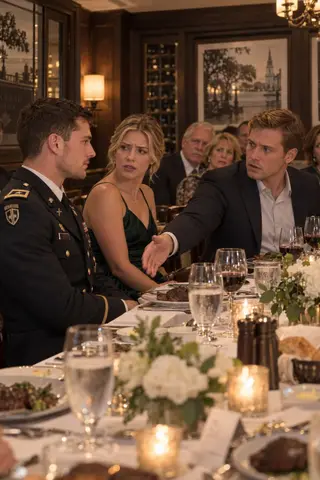
 My Sister Mocked My Uniform At Her Engagement Dinner
Chapter 5
The Driveway Reckoning
I didn't go back to the table.
I found our waiter in the hallway, handed him my corporate card, and covered the entire dinner bill—appetizers, sixteen-ounce ribeyes, three bottles of high-end wine, and an automatic twenty-five percent gratuity. It came to just over sixteen hundred dollars. I signed the merchant receipt, slipped my card back into my wallet, and headed straight for the front exit.
As I stepped onto the gravel driveway toward my truck, footsteps came hurrying behind me.
“Chris! Wait!”
It was my father. He had abandoned his overcoat inside, coming out into the December chill in just his dress shirt and wool vest. He was breathing heavily, his hands stuffed into his pockets, looking around the parking lot as if trying to find his bearings.
“Dad,” I said, stopping by the driver’s side of my Tacoma. “Go back inside. It’s freezing out here.”
“Did you pay the bill?” he asked, his voice raspy. “The waiter just told the table the tab was closed.”
“It’s handled,” I said. “Consider it an engagement gift for Maya and Liam.”
Dad stood there, five feet away, the gravel crunching under his leather shoes as he shifted his weight. For the first time in my life, I noticed how much my father had aged. The dark brown hair I remembered from my childhood was entirely silver, thinning at the crown. The confident, booming posture of the suburban patriarch had softened into something hesitant, almost frail.
“Your mother is in the bathroom crying,” Dad said quietly. “Maya won't come out.”
“I’m sorry dinner got ruined, Dad. Truly.”
“Is that all you have to say?” Dad’s voice suddenly cracked with an emotion I hadn't heard from him since my grandfather died twenty years ago. “You’re sorry dinner got ruined? Chris... what did we do to you?”
I looked at him, the keys cold in my hand. “What do you mean?”
“The scars,” Dad whispered, stepping closer, his eyes glassy in the glow of the parking lot lamps. “Colonel Davis... he pulled me aside while you were outside. He told me what those ribbons mean. He told me what the 'V' device means. He said you were awarded that for pulling two men out of a burning vehicle under machine-gun fire.”
Dad swallowed hard, his throat working violently.
“How did I not know that, Chris? How does a father not know his own son almost died three times before he turned twenty-eight?”
“Because you never asked, Dad,” I said, the truth coming out without malice, just plain and unvarnished. “When I graduated basic training, you asked if I made the rifle team, and when I said no, you changed the subject to Maya’s dean’s list. When I deployed, you told me to make sure I kept my head down and didn't lose my equipment. When I came home, all you and Mom ever talked about was Maya’s promotions, Maya’s condo, Maya’s networking events.”
“We thought you were fine,” Dad choked out, tears finally spilling over his eyelids. “You never complained! You always smiled, you always fixed whatever was broken around the house, you never asked for anything! We thought... God forgive me, we thought you just didn't have any ambition. We thought you were content just skating by.”
“Skating by?”
I let out a dry, humorless laugh that misted in the night air.
“Dad, I spent three years competing against the most driven, lethal, intelligent men in the United States military just to earn the right to wear this beret. I spent thousands of hours studying emergency pharmacology, advanced trauma surgery, ballistics, and tactical navigation. I didn't skate by. I worked until my bones ached every single day of my adult life.”
I reached out and placed a hand on my father’s shoulder. It felt smaller than I remembered.
“I didn't need a parade, Dad. I didn't need a seventy-person backyard party. But just once... just once over the last ten years, it would have been nice if you had looked at me and asked, ‘What did you learn this year, Chris?’ instead of asking me to mow the lawn.”
Dad bowed his head. His shoulders shook as he stood in the freezing Savannah driveway, an old man realizing that he had spent a decade treating gold like gravel while polishing glass.
“I’m going home, Dad,” I said gently, removing my hand. “Tell Mom I love her. Tell Maya I hope she and Liam figure things out.”
I climbed into the cab of my truck, turned the ignition, and drove out onto the highway toward Savannah, leaving my father standing alone under the live oaks.
The End









