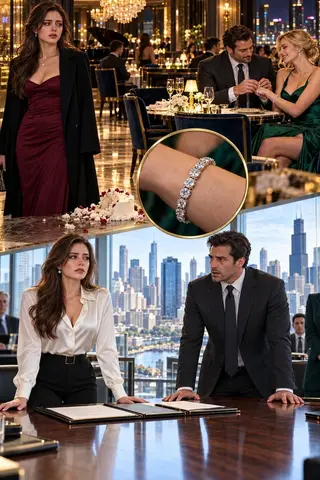
 His 27-Year-Old Mistress Laughed at Me in Manhattan's Most Expensive Restaurant
Chapter 55
The Boardroom at Liberty Street
At two o’clock that afternoon, the confrontation reached its institutional apex within the historic boardroom of the Federal Reserve Bank of New York on Liberty Street.
Seated at the long mahogany table were the Regional President of the Federal Reserve, senior enforcement directors from the Securities and Exchange Commission, and the United States Attorney for the Southern District. Marcus and I sat on the eastern side of the room, flanked by Clara and our chief forensic accountant.
Opposite us sat Arthur Pendleton IV, accompanied by four senior partners from Wall Street’s most expensive defense firms.
Pendleton looked shattered. His ninety-year-old aristocratic facade had crumbled into an exhausted, ashen mask. His hands, gripping a polished silver-topped walking cane, trembled continuously. He had spent the previous four hours watching his clearing brokers issue catastrophic margin calls that threatened to liquidate the entire capital base of Pendleton & Sons.
The Federal Reserve Regional President cleared his throat, breaking the heavy tension.
"We have convened this extraordinary session because an immediate systemic default threatens a historic private banking institution," the President stated gravely. "Pendleton & Sons faces a seven-hundred-and-forty-million-dollar capital shortfall at the close of trading today as a consequence of unhedged short exposure against Whitmore Capital’s sovereign instruments. Concurrently, the SEC and the Southern District have reviewed the evidentiary submission regarding the Cortlandt Street mortgage."
Marcus stood up, unbuttoning his tailored suit jacket with deliberate poise.
"The situation is mathematically and legally unequivocal," Marcus declared, placing a bound dossier on the center of the table. "Arthur Pendleton engaged in market manipulation based upon a fraudulent instrument he acquired from a known federal felon. The lis pendens filed against Whitmore Plaza was an extortionate ploy to force an institutional settlement. Under Rule 11 and Section 10(b) of the Exchange Act, Pendleton & Sons faces immediate receivership and criminal indictment."
Pendleton's lead counsel raised an unconvincing hand. "My client acted in good faith based on historical family archives—"
"Save your rhetoric for a jury, counselor," the U.S. Attorney interrupted sharply. "We have Sterling’s sworn deposition, bank wire routing numbers, and the forensic metadata from Pendleton’s private communications. Your client knew Sterling had no title. He bet the bank’s solvency on an illegal gambit."
Pendleton looked across the table at me, his eyes filled with an agonizing mixture of pride and despair.
"You have destroyed an institution that has stood for nearly two centuries, Ms. Whitmore," Pendleton whispered hoarsely.
"No, Mr. Pendleton," I answered, meeting his gaze with absolute, unyielding calm. "Your own arrogance destroyed your institution. You believed that an old name and an antique crest placed you above the law. You believed you could weaponize the remnants of Daniel Sterling’s petty theft against an architecture built on absolute integrity."
I slid our final settlement proposal across the table.
"You have twenty minutes before the closing bell," I said. "You will sign an unconditional vacatur of all claims against Whitmore Plaza, surrender your market-making licenses, and transfer your firm’s commercial real estate portfolio in lower Manhattan to the Whitmore Foundation for Urban Education. In exchange, Whitmore Capital will provide the emergency liquidity facility required to prevent an disorderly collapse of your client accounts."
Pendleton stared at the document, realizing that the sovereign woman he had tried to intimidate had just absorbed his entire legacy with the stroke of a pen.
Without uttering another word, he drew his pen and signed.
***
The End









