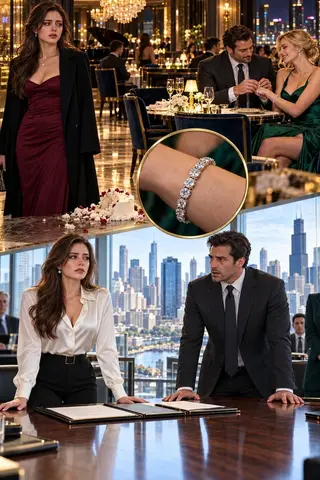
 His 27-Year-Old Mistress Laughed at Me in Manhattan's Most Expensive Restaurant
Chapter 102
The Whisper of the Old Guard
While the public markets celebrated an era of unprecedented transparency, the dying embers of the old patrician network stirred one last, feeble time in the paneled backrooms of Boston and Philadelphia.
Three days after the Hague invitation arrived, Marcus entered my conference room with an uncharacteristic frown creasing his brow. Behind him, Clara carried a slender, red-ribboned dossier bearing the seal of a historic Boston legal firm: *Houghton, Cabot & Winthrop, Counsellors at Law, Established 1842.*
"A late-filing probate petition?" I asked, looking up from the quarterly endowment disbursements for the Manhattan public libraries.
"Not a probate petition," Marcus replied, laying the document on the mahogany table. "A formal letter of inquiry and demand for private arbitration. It originates from the Beacon Hill Trust Syndicate, headed by one Thaddeus Houghton III."
I skimmed the opening clauses. The phrasing was dense, steeped in archaic nineteenth-century maritime equity language. "Explain the basis, Marcus."
"Thaddeus Houghton III was Harrison Sterling’s godfather and Daniel’s grand-uncle on his maternal grandmother's side," Marcus explained, stepping to the white board. "When the 1982 Sterling Dynastic Trust was liquidated under Chancellor Montgomery-Smith's decree, seventy million dollars in subordinate maritime debentures from 1968—long thought extinct—were unearthed in an iron safe deposit box in Boston. Houghton claims that before the Sterling family commingled illicit funds into the trust, thirty million of that seed capital was derived from an unrecorded patrician syndicate pool that was never Harrison’s to surrender."
"They want the Newport estate returned," Clara added, her voice tense. "They assert that the Sterling Manor was pledged as collateral to the Boston syndicate under a private covenant executed during the Nixon administration."
I sat back in my leather armchair, studying the document with complete, undisturbed calm. There was no racing pulse, no surge of anxiety. I had faced down sovereign short attacks from Tokyo to Frankfurt; I had unseated multi-generational Swiss private banks and forced the capitulation of entrenched British merchant houses. A collection of retired Beacon Hill trust lawyers attempting to resurrect a half-century-old paper trail was not a threat; it was merely an archaic echo.
"Marcus," I said quietly, "did Chancellor Montgomery-Smith's final order of summary dismissal include an absolute bar against derivative claims?"
"Paragraph forty-eight of the Wilmington decree," Marcus cited instantly, his eyes gleaming with professional certainty. "It explicitly bars any and all heirs, assignees, creditors, syndicates, and third-party beneficiaries from asserting claims against assets surrendered to the Whitmore European Educational Trust, under penalty of immediate federal civil contempt."
"Then why does Thaddeus Houghton write to us instead of filing with the Delaware Court of Chancery?" I asked.
"Because he knows Montgomery-Smith would sanction him within ten seconds," Marcus said. "This is an attempt at private extortion. Houghton knows that the International Working Group convenes in Europe next month. He believes we will pay seventy million dollars from our liquidity reserves simply to avoid an old-money headline questioning the absolute finality of the Sterling settlement."
I smiled—a cool, serene smile that had disarmed the most ruthless financiers from Wall Street to Lake Geneva.
"He misunderstands who we are, Marcus. We do not pay tribute to ghosts. Clara, arrange a private meeting with Mr. Houghton for tomorrow afternoon. But do not invite him to Liberty Street."
"Where would you like to receive him, Emily?" Clara inquired.
"At Table One at La Maison," I answered. "It is fitting that every vestige of Daniel Sterling's world receives its final closure at the very table where they believed I was nothing."
***
The End









