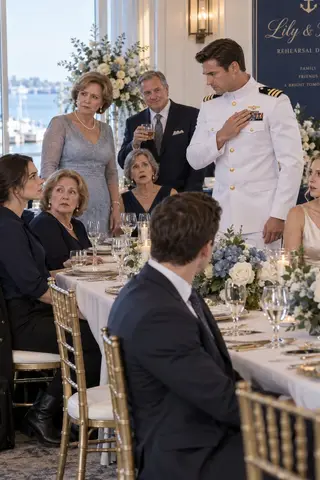
 Hidden at the End of the Table: How a Neglected Navy Daughter Stunned Her Snobby Family With One Word
Chapter 32
Foundations on Stone
The harbor breeze in Newport News smelled of diesel, sea salt, and wet cedar sawdust. Construction cranes swung massive steel girders over what used to be a derelict textile warehouse, now rapidly transforming into the Brooks Maritime Center—a thirty-unit transitional housing facility for wounded sailors and their dependents.
Standing near the perimeter fence in a high-visibility yellow vest and a white hard hat was Alan Brooks.
When he spotted my unmarked staff car pull up to the gravel staging area, he didn't wait for his driver to open his door. He walked briskly across the churned earth, removing his leather work gloves and offering an open, steady hand.
"Nora," he said, his voice husky. "Thank you for coming. I know your schedule doesn't belong to civilians."
"It belongs to the country, Alan," I answered, returning the handshake firmly. "And right now, this project serves that exact purpose. Walk me through it."
We walked along the reinforced concrete foundations. Alan pointed out the layout with an enthusiasm I had never seen in him, not even when he boasted about Brooks Financial hitting record quarterly yields. There was no arrogance in his posture; he carried blueprints like an apprentice eager to prove he had studied the master's lessons.
"The ground floor will house physical therapy suites," Alan explained, stopping by an exposed iron stanchion. "Lily helped draft the interior specs. She insisted on oversized elevator shafts and level thresholds for motorized wheelchairs. And here..." He stepped back, gesturing toward the entrance rotunda. "This is where the dedication plaque will sit."
He produced a brass plate from a velvet-lined case held by his project manager. Engraved across the polished surface were the words:
*Dedicated to the Unseen Watchers — Built in honor of Captain Eleanora Hayes, USN. Whose quiet strength guarded our nation while teaching our family what honor truly means.*
My throat tightened slightly, though my exterior remained disciplined and unyielding. "Alan, you didn't need to put my name on this."
"Yes, we did," Alan replied, turning to look directly into my eyes without flinching. "For ten years, Nora, I measured a person's worth by their portfolio and their dinner companions. When you stood in that foyer during the senator's medical crisis, and again when you stepped between our family and the Vance-Sterlings, you taught me that real value isn't something you inherit or display. It's something you carry inside your ribs when everything else collapses."
He looked toward the cranes lifting another beam against the noon sky. "Your mother cried when she saw this blueprint. She told me she spent twenty years wishing you had chosen a softer path, because she was too frightened to admit that her eldest daughter was braver than anyone she had ever known."
Before I could answer, my tactical comms unit chimed against my belt—an alert tone reserved exclusively for emergent operational anomalies.
Alan saw my expression change in an instant, the familial softness vanishing behind the iron curtain of naval command. He didn't ask questions; he simply nodded, stepping back with deferential respect.
"Duty calls, Captain?" he asked softly.
"Duty calls," I replied. "Build it strong, Alan. Build it so it can withstand any hurricane."
"On my life, Nora," he said. "It will stand forever."
The End









