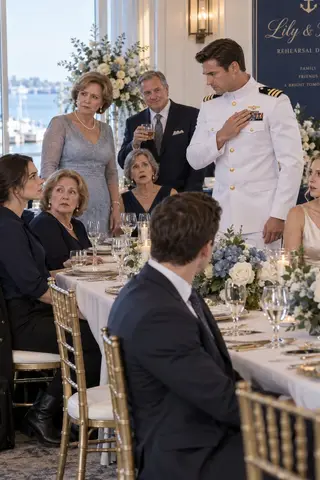
 Hidden at the End of the Table: How a Neglected Navy Daughter Stunned Her Snobby Family With One Word
Chapter 12
Whispers in the Shadows
When I stepped back into the glowing pavilion, the shift in energy was subtle, yet to my trained eyes, glaringly obvious.
A small cluster of guests near the entrance—well-dressed associates of Alan Brooks from the state commercial board—were muttering among themselves with furrowed brows. Among them was Richard Vance-Sterling, Alan’s primary business partner, a man known for his razor-sharp arrogance and inherited wealth. He had spent the first half of the evening glaring at me, clearly irritated that a woman he considered a social nobody had usurped the spotlight at a Brooks family gala.
As I walked past their circle, Richard’s voice carried just loud enough to cut through the soft saxophone solo.
"Impressive parlor tricks earlier, Alan," Richard said, swirling his vintage Scotch with a smirk. "Having a couple of young officers march in with a lockbox certainly spiced up the dinner. But really, dragging military theatrics into a high-society reception? It’s a bit dramatic for an administrative coordinator, don't you think?"
Alan, who was standing nearby refilling his glass, froze. The old Alan would have chuckled along to save face among his wealthy peers. But tonight, Alan’s spine stiffened.
"Richard, that wasn't theater," Alan said, his tone surprisingly firm, lacking any of his usual fawning deference. "Nora holds a critical command post. She doesn't play games."
"Oh, come now, Alan," Richard scoffed, his gaze drifting lazily toward me as I approached. "We all know how government bureaucracy works. You put a woman in a uniform behind a desk in Virginia, give her an impressive title, and suddenly she’s running the free world. It makes for good dinner table conversation, but let’s not pretend she’s actually making decisions that matter."
Before Alan could respond, I stopped directly behind Richard’s right shoulder. The temperature around our small cluster seemed to plummet instantly.
"Mr. Vance-Sterling," I spoke, my tone quiet, level, and entirely devoid of anger.
Richard turned, offering a condescending, patronizing half-smile. "Ah, the guest of honor. Tell me, Commander, does the Navy teach you to always listen in on private conversations?"
"The Navy teaches us situational awareness, Mr. Vance-Sterling," I replied, holding his gaze until his smile began to waver. "It also teaches us to recognize supply-chain vulnerabilities. For instance, your maritime shipping firm, Vance-Sterling Logistics, currently has three container vessels transiting the Bab-el-Mandeb strait under naval escort."
The color drained slowly from Richard’s cheeks. His glass remained frozen in mid-air.
"Two hours ago," I continued, stepping half an inch closer so that only our circle could hear, "I personally authorized the rerouting grid that keeps those three multi-million-dollar vessels out of range of anti-ship ballistic strikes. If I were merely an administrative clerk, your board of directors would currently be holding an emergency bankruptcy session. Next time you decide to evaluate someone’s authority, make sure your own assets aren't relying on her signature."
Richard looked at Alan, then at me, his mouth parting slightly in sheer humiliation. He tried to muster a retort, but the cold, unyielding reality of my words choked him into silence. He took a hasty step back, mumbled an incoherent apology, and disappeared toward the garden terrace.
Alan let out a long breath, staring at me with genuine, unmasked admiration. "Nora... remind me never to cross you in business."
"I don't play business, Alan," I said softly, touching his arm. "I protect lives. And right now, I need to speak to Ryan and Lily."
The End









