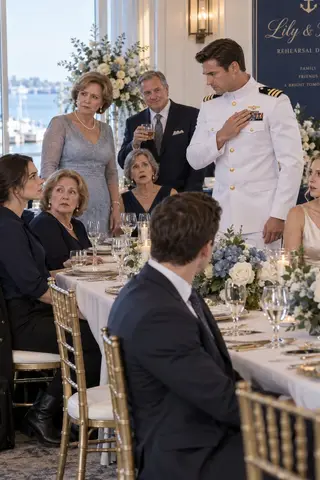
 Hidden at the End of the Table: How a Neglected Navy Daughter Stunned Her Snobby Family With One Word
Chapter 23
The Senate Hearing
Three weeks after my mother's visit, my administrative bubble burst when an urgent summons directed me to Capitol Hill.
A closed-door hearing of the Senate Armed Services Committee had been convened to review commercial defense expenditures in the Atlantic and Mediterranean corridors. Sitting at the witness table under the bright glare of television-grade studio lights, I faced a horseshoe panel of twelve United States Senators.
Sitting directly in the front row of the public gallery was George Vance-Sterling, accompanied by two high-priced Washington defense lobbyists. Despite backing down at Lily’s gala, George had clearly pulled political strings to test my newly minted command authority on federal ground.
Senator Harold Higgins, a senior committee member known for his close financial ties to private commercial shipping conglomerates, leaned into his microphone.
"Captain Hayes," Higgins began, his tone oozing rehearsed skepticism. "We have reviewed your recent operational logs for the Red Sea and the GIUK gap. Your aggressive rerouting mandates cost private American maritime logistics firms upwards of twelve million dollars in secondary transit delays over the last quarter alone. Critics argue that naval logistics officers are overreaching, using hypothetical security threats to justify burdensome military oversight."
Higgins paused, glancing toward George Vance-Sterling with an approving nod before fixing his cold gaze back on me. "How do you justify imposing such severe economic penalties on American private enterprise during peacetime, Captain?"
The gallery fell silent, waiting for an evasive bureaucratic defense. I didn't give them one.
I reached into my briefcase, pulled out a single red classified folder, and opened it before the microphone.
"Senator Higgins," I began, my voice ringing out with crystal-clear resonance that commanded the entire committee room. "With the Chairman's permission, I submit into the record the acoustic sensor telemetry recovered by the guided-missile destroyer USS Mason seventy-two hours ago."
Higgins frowned, adjusting his reading glasses. "What telemetry?"
"The acoustic signature of three separate subsurface naval mines laid along the precise coordinates Mr. Vance-Sterling's company petitioned this committee to keep open," I stated with absolute precision. "Had my command prioritized corporate transit efficiency over strategic defense, three commercial freighters carrying over eighteen thousand tons of volatile chemical cargo would have struck that minefield."
Murmurs erupted across the senate gallery. Several aides hurried to distribute copies of my declassified summary to the committee members.
"Furthermore, Senator," I continued, turning my head to look directly at George Vance-Sterling in the gallery, "the total federal expenditure to clear that corridor and secure allied sea lanes was less than three percent of the economic loss a single shipping catastrophe would have inflicted upon the American economy. My mandate as Director of Strategic Sea Lift is not to ensure corporate convenience; it is to ensure that American sailors and American commerce return to port intact."
Senator Higgins skimmed the tactical report, the color draining rapidly from his face as the indisputable mathematical and acoustic data dismantled his prepared attack.
The Committee Chairman, a decorated veteran from Texas, slammed his gavel down, cutting off the gallery murmurs with a booming strike.
"The committee thanks Captain Hayes for her exemplary vigilance," the Chairman announced, glaring down at Higgins. "Her strategic decisions have proven not only justified, but essential to national security. This inquiry is adjourned with the highest commendation of this panel."
As the room stood, George Vance-Sterling gathered his briefing papers in hasty, humiliated silence, avoiding my gaze entirely as he slipped out through the side exit.
The End









