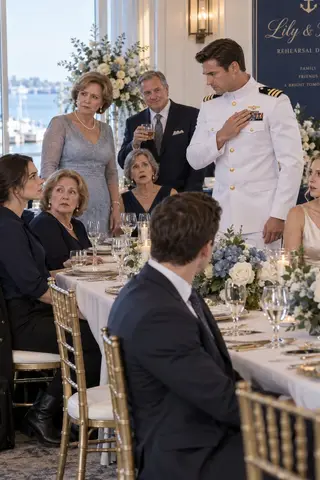
 Hidden at the End of the Table: How a Neglected Navy Daughter Stunned Her Snobby Family With One Word
Chapter 26
The Shadows of Norfolk
The tranquil salt breeze of Virginia Beach was replaced by the stinging chill of early December when an urgent intelligence cable disrupted my morning briefing at Norfolk headquarters.
On the central holographic display, three red warning triangles blinked erratically along the coast of the mid-Atlantic shipping channel. Commander David Chen adjusted the display settings, pulling up high-resolution thermal imaging captured by our low-orbit reconnaissance satellites six hours prior.
"Captain Hayes, we have a pattern anomaly," Chen said, tapping a stylus against the northern shipping choke point. "Over the past forty-eight hours, two independent commercial bulk freighters transiting toward the Chesapeake Bay reported temporary electronic spoofing on their Automated Identification Systems. For twelve minutes, their GPS coordinates placed them three miles inland before resetting."
I leaned over the terminal, my eyes narrowing as I traced the vector paths. Peacetime navigation errors were common, but symmetric spoofing on dual-channel civilian transponders was a trademark signature of coordinated electronic warfare.
"What ships were operating in that maritime corridor during the outage?" I asked, my fingers entering my biometric override key to access classified naval traffic logs.
"Only private commercial traffic, Ma'am," Chen answered, bringing up the manifest. "Except for one chartered container vessel: the Northern Horizon. Owned by a Panamanian shell corporation, but financed entirely through secondary credit facilities tied to Vance-Sterling Global Logistics."
A cold, familiar instinct tightened in my gut. George Vance-Sterling had failed in the Senate hearing, but men who controlled multibillion-dollar maritime cartels did not simply accept defeat and vanish. They redirected their leverage into the dark.
"Who chartered the cargo space on that vessel, David?"
"It’s registered as heavy industrial pipeline equipment destined for Baltimore," Chen said, reading off the manifest. "Customs pre-clearance was rubber-stamped yesterday afternoon under a priority commercial waiver."
"A waiver?" I straightened up, adjusting the collar of my service uniform. "Under whose authority?"
"The regional maritime commercial liaison board, Ma'am. The signature belongs to an executive director recently appointed to fill Richard Vance-Sterling's vacated seat."
I stared at the blinking transponder marker of the Northern Horizon. The ship was twenty nautical miles outside the mouth of the bay, entering our territorial waters under the cover of a dense coastal fog bank.
"Pull their automated ballast logs," I commanded quietly, the operational calculus crystallizing in my mind. "A ship carrying forty thousand tons of steel piping shouldn't be riding eight feet above its standard waterline. They aren't hauling industrial machinery into our ports, David. They’re hauling something light enough to bypass acoustic scrutiny—or someone who doesn't want their cargo weighed."
Chen looked up from his screen, the color draining from his face as the implication registered. "What are your orders, Captain?"
"Scramble a Coast Guard tactical interdiction detachment and put the port patrol on Class-Two alert," I said, my voice cutting through the hum of the servers like steel. "We’re going out there to inspect that ship ourselves."
The End









