 Fifty-Two Dog-Ears
Chapter 3
The Raised E
On Friday morning I was at the library when Searle unlocked it, which he took personally.
"You're not on the schedule until Thursday, Mavis."
"I'm not volunteering. I'm a patron. I'd like the microfilm for the Wittenmyer Beacon, November 1979."
He looked at the yellow legal sheet folded in my hand and decided, wisely, not to ask. The microfilm reader lives in the local history room at the back, a machine the size of a chest freezer that hums in B-flat. Searle threaded the reel for me because the last time I did it myself I made a small, terrible noise and he heard it from the front desk.
The Beacon had run the note on the front page on November 8. Some editor with a flair for melodrama had printed a photograph of it beside Ilona's senior picture. I turned the magnifier up until the letters swam.
Every lowercase e in that note sat a hair higher than the letters around it. Don't look for me. I've gone. Love. Each e hopped, like a child who can't stand still in a line.
A typewriter with a bent type bar does that. It does it every time, on every page, for as long as the machine lives.
"Mavis." Searle was in the doorway. "Chess club's starting. They want to know if you're playing or just glaring."
Tuesdays and Fridays the chess club takes the reading room by the front windows. It is four retired men and a board that predates them. Imre Zuehlke plays with a heating pad on his lower back. Eskil Beckwith, of the bacon, plays badly and narrates. And Delmer Hallimore plays well and brings lemon drops in a paper sack, which he hands around like a priest with communion.
"Madam Dewey Decimal, you look like you've seen a ghost," Delmer said. He calls me Madam Dewey Decimal. He thinks it's funny. He has thought so since 1971.
"Microfilm," I said. "It's hard on the eyes."
"Sit. I'll go easy on you." He was eighty-three, tall and pink and courtly, and he had been the library board president for nineteen years and on the town board for longer than that. He had owned the drugstore until he sold it in 1998. The men at that counter called him Doc for so long that the whole town did too, though he is a pharmacist and has never so much as taken a pulse. In Wittenmyer, anyone who can spell amoxicillin gets the title.
Out the window, past his shoulder, the Hallimore Bandstand sat in the square in the thin November sun, its little bronze plaque gone green. Donated by Delmer and Ardis Hallimore, 1979. I had looked at that bandstand from that window for forty-seven years.
He beat me in nineteen moves and gave me two lemon drops for my trouble.
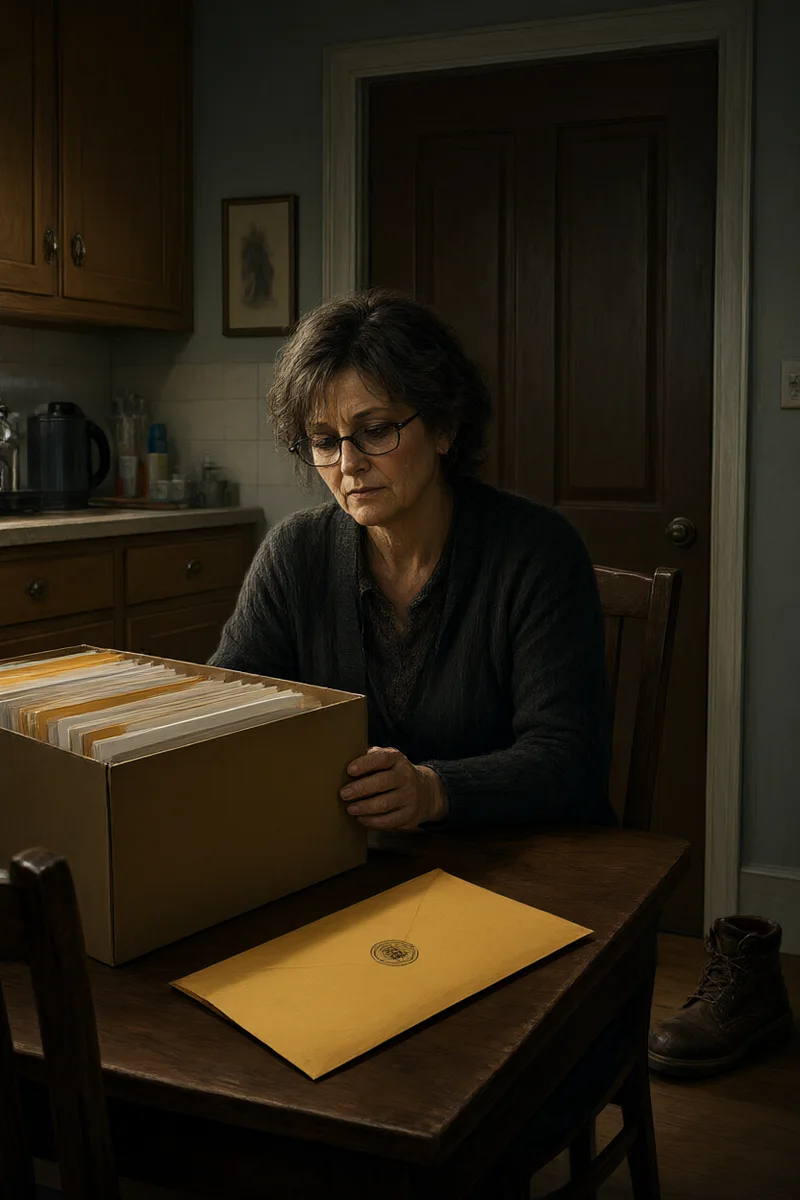
When they had gone back to bickering I went to the cabinet where we keep the Friends of the Library community cookbooks. In 1985 the Friends had asked for recipes typed on index cards, and in a fit of foresight I had kept the originals in a shoebox labeled DO NOT THROW OUT, SEARLE.
D. Dask. Rhubarb Custard Bars.
Two cups rhubarb, diced. One cup sugar. Three eggs, beaten.
Every lowercase e hopped.
I sat on the floor of the local history room with my knees complaining, holding a card that smelled faintly of vanilla, and I did not hear the door.
"Ilona Sterrett," said Delmer Hallimore, above me. He had come back for his sack. He was looking at the microfilm screen, at that senior picture, glowing gray. "Now there's a name nobody's said in a while."
The End