 Effie's Recipe Tin
Chapter 5
Needs Salt
They both looked at the card. Then, slowly, at each other. “What's the last step?” Cormac said.
“How should I know? I've never made the thing in my life. I've never made anything in my life. I made toast for seven weeks.”
“Well, she thought you knew.”
“She thought a lot of things.” Lorcan picked up the card and read it again, as though it might have changed. You can't do it without him. He turned it over and read the recipe on the front, every word, looking for a gap. There wasn't one. Beef, onions, stout, walnuts, the slow oven. Serve hot. It was complete.
The stew sat on the board between them and steamed.
Cormac sat down at the kitchen table, suddenly, as if his legs had gone. “I thought it was going to be a secret ingredient,” he said. “Something you'd brought her once. I've been carrying that card around since April thinking you knew something. I thought it would be something I could—I don't know. Use. To get in the door.”
“You got in the door.”
“Because she made you.”
“Because she made both of us,” Lorcan said. “Don't flatter yourself.”
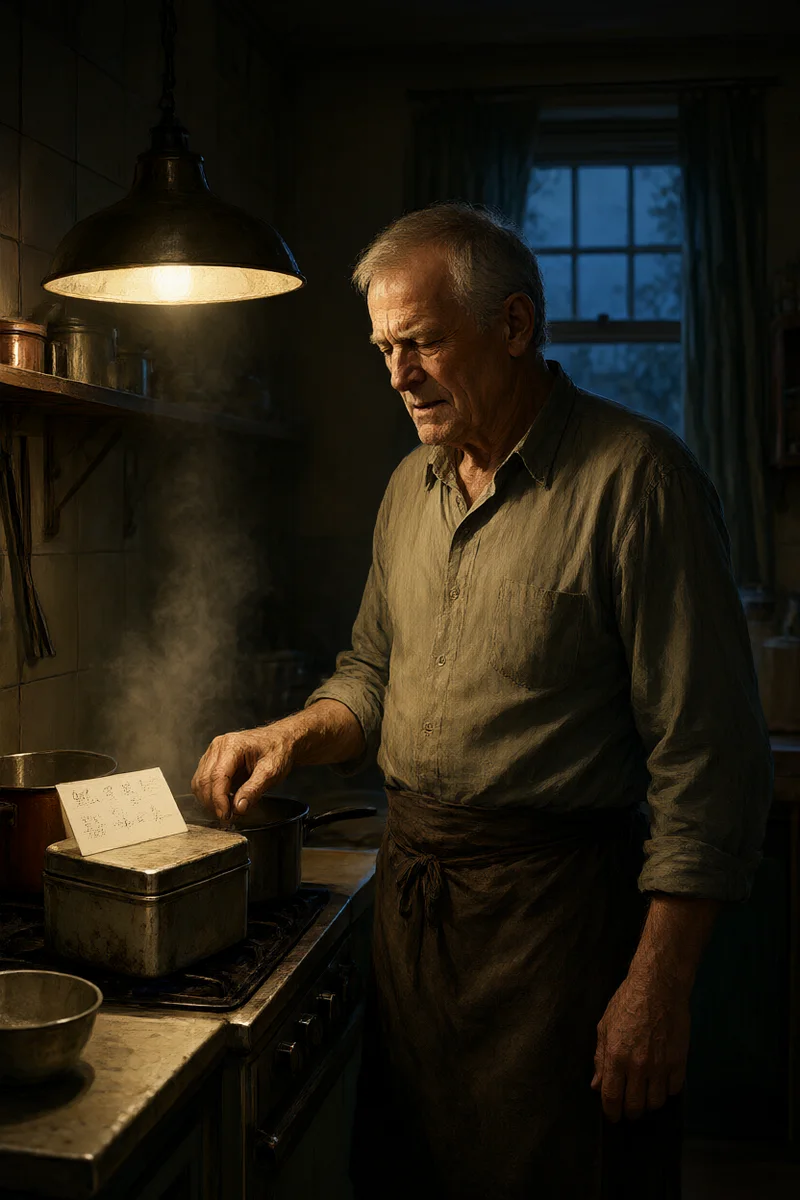
And he did then what he had done every Sunday for fifty-one years, without thinking, because the kitchen smelled the way it smelled, and the lid was off, and the steam was rising into the lamp. He took a spoon from the drawer. He dipped it into the pot, and blew on it, and tasted it, and frowned.
“Needs salt,” he said.
He heard it as he said it. Every Sunday. Every single Sunday since 1975. Effie at the stove, Lorcan leaning in with a spoon, the frown, needs salt. And Effie, every time, taking the salt cellar from the shelf and turning her back to him and doing something over the pot with a great deal of wrist, and saying, “There, you old goat. Better?” And he'd taste it again and say yes, much better, and they would sit down. He stood very still with the spoon in his hand.
“Dad?”
“She never added anything,” Lorcan said. “Fifty-one years. She never put salt in it. She just turned round and pretended.” He started to laugh, and it hurt, and he couldn't stop. “I'm sure of it. She knew I'd say it. She just wanted me to taste the thing and have an opinion, so I'd feel I'd had a hand in it. That's the last step. Me, standing at the stove, being wrong about the salt.”
Cormac was looking at him with an expression Lorcan had last seen on a nine-year-old, a long time ago, at the top of a very tall slide.
“Show me,” Cormac said.
So Lorcan handed him the spoon. Cormac tasted the stew, and frowned, the same frown, and said, “Needs salt.” And Lorcan took the salt cellar down from the shelf, turned his back, did something over the pot with a great deal of wrist, and added nothing at all.
“There,” he said. “Better?”
Cormac tasted it again. “Much,” he said, and his voice went.
They ate at the kitchen table, from Effie's blue bowls, with the last of the soda bread, which had improved. They did not talk much. Cormac missed the last train to Leeds and slept in his old room, under a ceiling still covered in plastic stars.
In the morning Lorcan put the stew card into the red tin, at the very back, behind Z, facing the right way.
The next Sunday, at four o'clock, he rang his son's number. Cormac picked up on the first ring, with the onions already on.
The End









