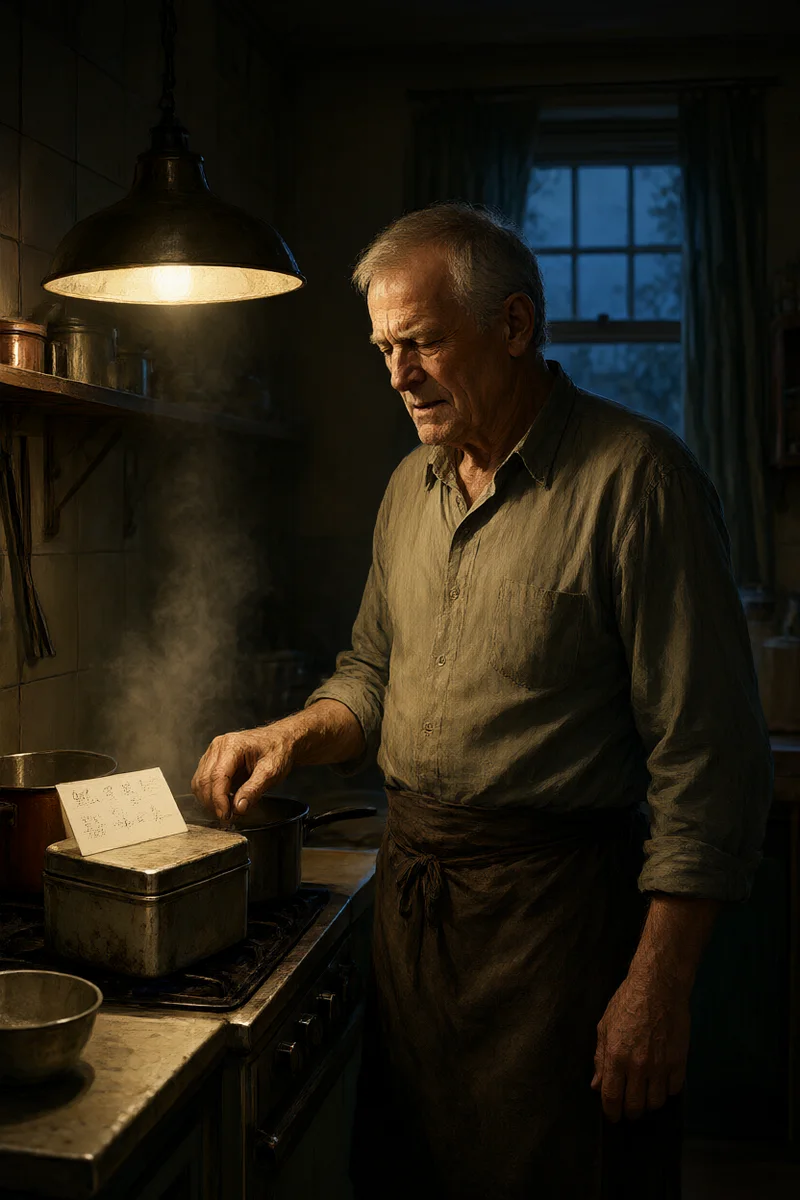
 Effie's Recipe Tin
Chapter 3
Sundays at Four
He put the card face down on the table and left it there for two days.
Cormac was forty-six. Cormac had been nine years gone. The last time Lorcan had seen his son was through the glass panel of a courtroom door, after he had stood up in the witness box and said yes, that was his son, and yes, the three thousand pounds had been taken from the joint account without permission, and no, he did not wish to withdraw the complaint.
Effie had begged him to. Effie had said the boy was ill, that the drink and the pills were an illness, that you did not put a sick person in front of a judge. Lorcan had said a thief was a thief. He had been right, too. He had been right for nine years. Being right had a great deal of room in it, he had found. You could live in it for a long time and never see anyone.
Cormac had not come to the funeral. Lorcan had been glad, and then, lying awake, ashamed of being glad, and then glad again.
Ask Cormac. As if it were the stem ginger.
On the Tuesday he tried to make the stew without him. He had eaten it every Sunday for half a century; how hard could it be? Beef, onions, carrots, stock, the long slow oven. He made it three times that week. It was fine, each time. It was brown and hot and edible. It was not hers. Something was missing from it, some note, and he could not for the life of him think what.
On the Friday, Sunniva found him in the back garden in the rain, scraping the third attempt into the compost.
“You're ruining good beef,” she said over the fence. “What's wrong with it?”
“It's not right. It's never right. She left me a card that says ask my son.”
Sunniva had lived at number 31 for twenty years. She looked at him for a while, rain dripping off the hood of her coat. “Lorcan,” she said. “You know Effie charged her phone in my kitchen. Every Sunday.”
“What?”
“Your wifi doesn't reach the back bedroom. Mine does. Every Sunday at four, for six years, she came round with her phone and her charger and sat at my kitchen table for an hour with the door shut.” Sunniva paused. “I thought you knew. I thought you were being stubborn about it.”
Effie's phone was in the drawer of her bedside table, where the nurse had put it in May. It was dead. He found the charger, and sat on her side of the bed while it came back to life, and when it asked for a code he tried their wedding anniversary, and it opened.
There were three hundred and some video calls in the log. Sundays, four o'clock, nearly every week, going back six years and two months. Forty minutes. An hour. Seventy minutes on Christmas.
All to one number. The contact was saved as a single initial, the way you might hide something from someone who never looked: C.
The last call was on a Sunday in April, three weeks before she died. It was only four minutes long.
Below it, unplayed, sat a voicemail from the same number, dated the day after her funeral.
Lorcan's thumb hung over it for a long time. Then he pressed play.
His son's voice was deeper than he remembered, and rougher, and perfectly steady.
“Dad. If you're hearing this, she must have told you to look. I'm not going to ring the house. That's up to you. But she made me promise, so I'm telling you. I've got the other half.”
The End









