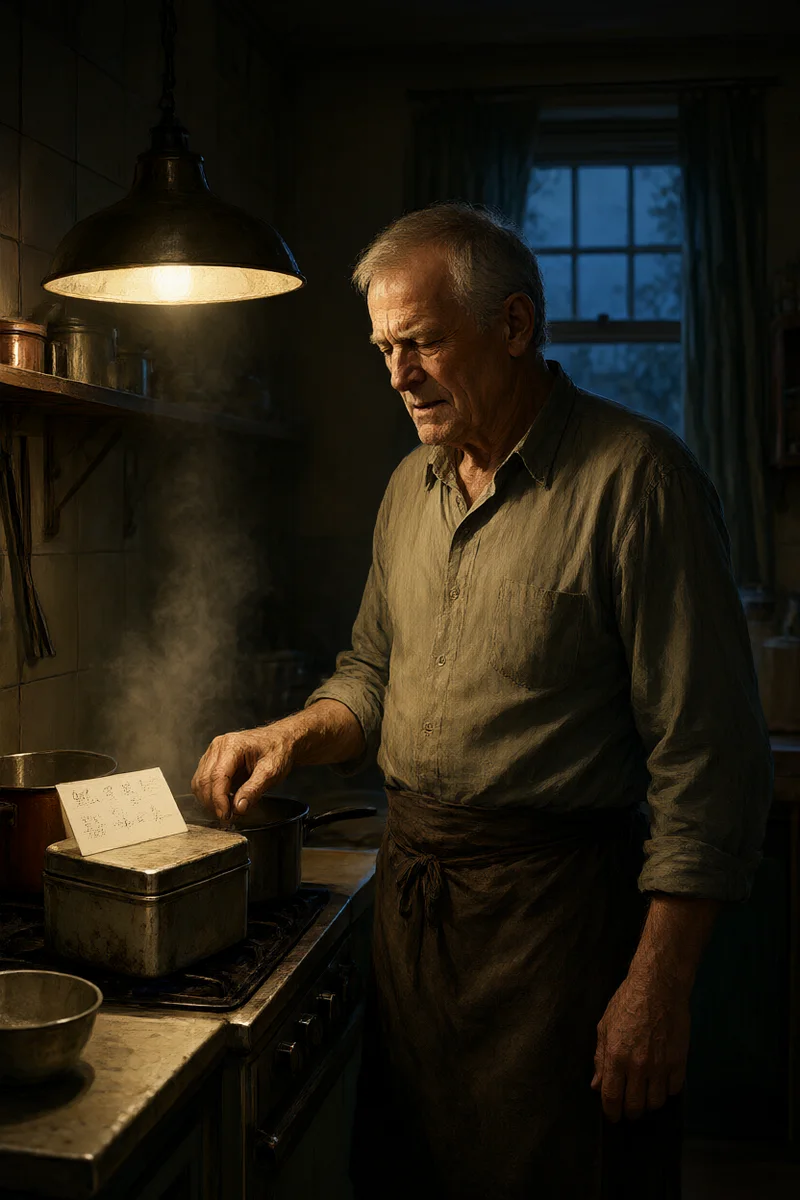
 Effie's Recipe Tin
Chapter 4
The Other Half
It took Lorcan another week to ring the number. When he did, he said, “It's your father,” and nothing else, and Cormac said, “I know,” and there was a long silence on the line like a road with no traffic on it.
“Sunday,” Lorcan said eventually. “Four o'clock. If you want.”
Cormac came on the train from Leeds. He stood on the step at four exactly, in a dark wool coat, holding a canvas shopping bag, and he looked like Effie around the eyes so much that Lorcan had to hold the door frame. He was thinner than he had been at thirty-seven. His hair was going gray at the sides.
“Dad.”
“You'd better come in.”
They did not embrace. They did not shake hands. They went into the kitchen, which was the only room in the house Lorcan felt equal to, and Cormac began unpacking his bag onto the counter, and Lorcan leaned against the sink with his arms folded and watched him do it.
Shin of beef. Onions. Carrots, ugly ones. A bottle of stout. A jar of something dark that Lorcan did not recognize.
“Pickled walnuts,” Cormac said. “She put three in. Chopped. That's half of it.”
“That's what was missing?”
“That's one of the things.” Cormac rolled up his sleeves. There was a small blue tattoo on the inside of his left wrist, a date. Lorcan looked at it and didn't ask. “She taught me on the phone. Every Sunday. She'd sit at Sunniva's table with her cards, and I'd make it in my flat, and she'd talk me through it, step by step, and then go home and make yours. Took me about a year to stop burning the onions.”
“Six years,” Lorcan said. “Every Sunday. And she never said.”
“You'd have stopped her.”
Lorcan opened his mouth. He shut it again. They both knew it was true.
“I'm seven years sober,” Cormac said, to the onions. “Since you ask. Which you didn't. I paid the three thousand back to her, two years in, fifty quid a month. She put it in an account in your name. She said you'd want to know it had come back, one day, more than you'd want the money.”
Lorcan said nothing. He watched his son's hands, which were steady, and quick, and had been taught by Effie, and moved the knife just the way hers had, rocking it on the board.
They worked badly together at first. Lorcan stood too close and Cormac said so. Cormac used the wrong pan and Lorcan said so. They argued about the oven. But the stew went together, step by step, the browning and the onions and the stout and the walnuts, and the kitchen began to smell the way it had smelled every Sunday of Lorcan's adult life, and around the time it went into the oven both of them had stopped talking entirely.
Two and a half hours later, Cormac took it out and set it on the board and lifted the lid. Steam rolled up into the lamp.
Then he reached into his coat pocket and took out an index card. Soft and stained, with the same red tin's worth of years on it. SUNDAY STEW, it said across the top, in Effie's round young handwriting, and beneath that, the whole recipe, every step, ending at serve hot.
He turned it over. On the back, in the shaking blue ballpoint, she had written to her son:
Last step. You can't do it without him. Ask your father.
The End









