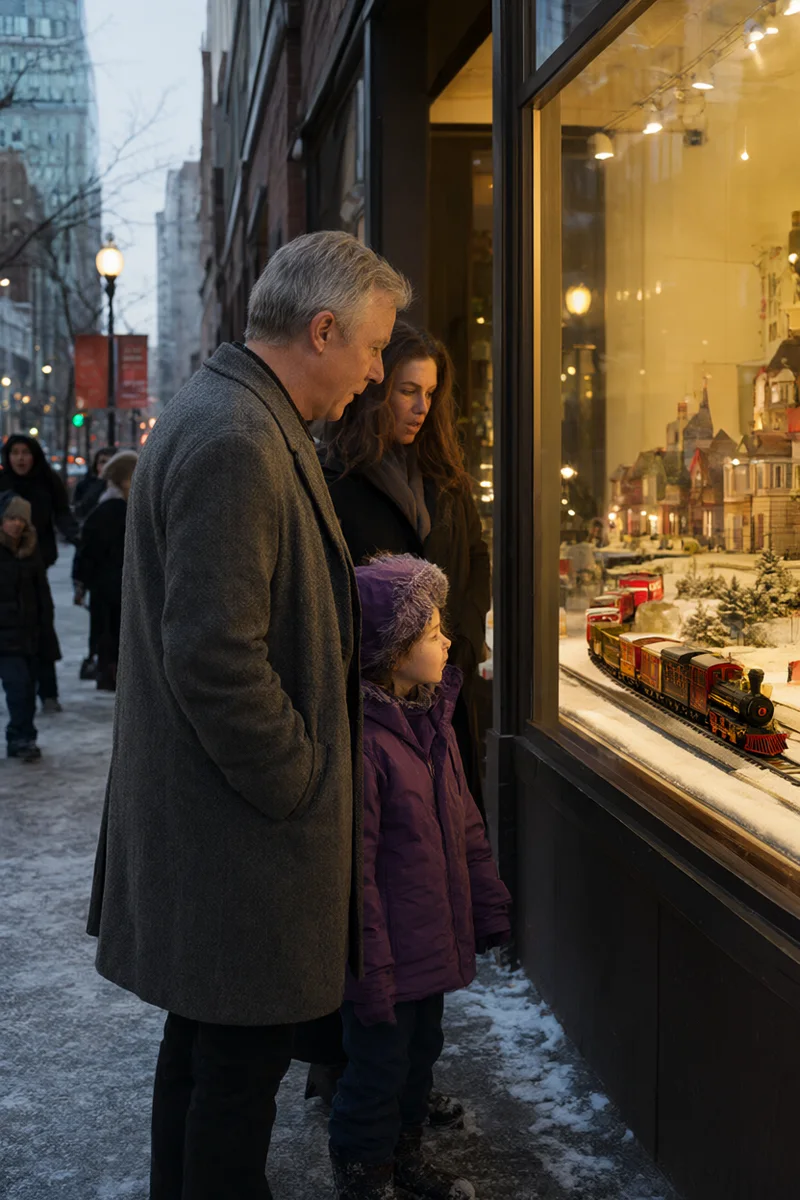
 Care of Langstrom's
Chapter 7
The Ribbon Fold
He had been at it since eight and had produced four packages, one of which Verna had quietly taken away.
Josie stood on the customer side of the counter with her coat still buttoned. Behind him, six women who had wrapped beside her for years were pretending to straighten tissue.
"You came to tell me where to put it," he said.
"I had it worked out."
"Go ahead. And then would you show me the corners? There's a line, and I'm told I'm the reason."
She looked at the line. It was eleven people long, and the woman at the head of it was watching him the way one watches a surgeon consult the manual. Josie unbuttoned her coat. He understood that it had nothing to do with him. Forty other people needed that counter to work, and so did she.
"Crease it first. Thumbnail, not the tape gun. You don't tape air." She took the box, and her hands did in nine seconds what his had failed to do in ten minutes. "And don't talk to me unless it's about paper."
So he talked about paper. By Wednesday he was established as the worst employee on the Corliss Street payroll and was told so, with relish, by a woman named Bernice in fine jewelry who had been there since 1989. He learned the corners. He did not learn the ribbon fold. Josie did those herself, and he handed her the short lengths.
At noon on Wednesday he climbed to the third floor, where the mannequins stood about under plastic like guests at a party that had gone wrong, and sat on a folding chair in front of everyone who could be spared from the floor, and let them say it. A man from receiving wanted to know where he had been. A woman from cosmetics read the email of November 17 aloud, slowly. He wrote it all in a notebook. When they asked what he meant to do, he said he had not signed the sale, that the bank wanted real numbers by the twenty-third, and that he did not have them yet.
"There's an idea about the upper floors," he said. "It isn't mine. It belongs to Ms. Delacroix at gift wrap, and she can tell it or not."
Josie, at the back by the freight elevator with her arms crossed, looked at him as if he had handed her a live bird. "I work here till the twenty-fourth," she said. "That's all I've agreed to."
But she told it, in four sentences. Then Iggy Wojcik, whom Verna had brought back at Everett's request, stood up in his suspenders and said the fourth floor had better wiring than people thought, because he had run it himself in 2002.
Lyman telephoned at three. He did not call it a napkin now. He called it a concept, which from Lyman was close to applause, and he said the bank had confirmed the twenty-third at nine. "They'll want a personal guarantee, Everett. The house, most likely. Think about that before you get attached."
"I've thought."
When he came back down to the counter, Tilly was there, her mittens on a string and her chin level with the countertop. Her mother was ten feet away tying a bow and listening with her whole back.
"I have questions," Tilly said. "Are you the boss of the train?"
"Yes."
"Then why is the lady still lying down?"
"Because I haven't been able to make myself open that window." "I'm going to. I'd like you to be there, if your mother allows it."
Tilly took this under advisement. Then she asked the other one, the one he had been waiting four days to hear. "My letter was for Santa. Did he give it to you? Or did you take it?"
The End









