 Care of Langstrom's
Chapter 10
The Twenty-Sixth
Josie had not planned to speak. She had the lunch shift at eleven.
"Nurses," she said. "The hospital is four blocks up and the shift changes at three. They come down for pie, and they'd come for shoes if anybody kept that store open past six. And there's the window." She took Tilly's notebook from her apron pocket. "My daughter counted. Saturday the fifth, noon to four. Two hundred and twelve people stopped at that train. She's seven. She doesn't round."
"And how many went in?" Ms. Greaves said.
"Thirty-one. She counted that too. That part is his to fix."
Ms. Greaves looked at the notebook longer than she had looked at any of the thirty-one pages. The terms were not a rescue and nobody called them one: eighteen months, the numbers reviewed every quarter, the house behind all of it. Everett uncapped the blue pen. Then he did a thing that made Lyman Stuyvesant shut his eyes. He read it, every page. It took forty minutes. Josie was late for lunch and stayed anyway. On the bank steps Lyman said he would move his own desk downtown, but he wanted a window, and not the one with the train.
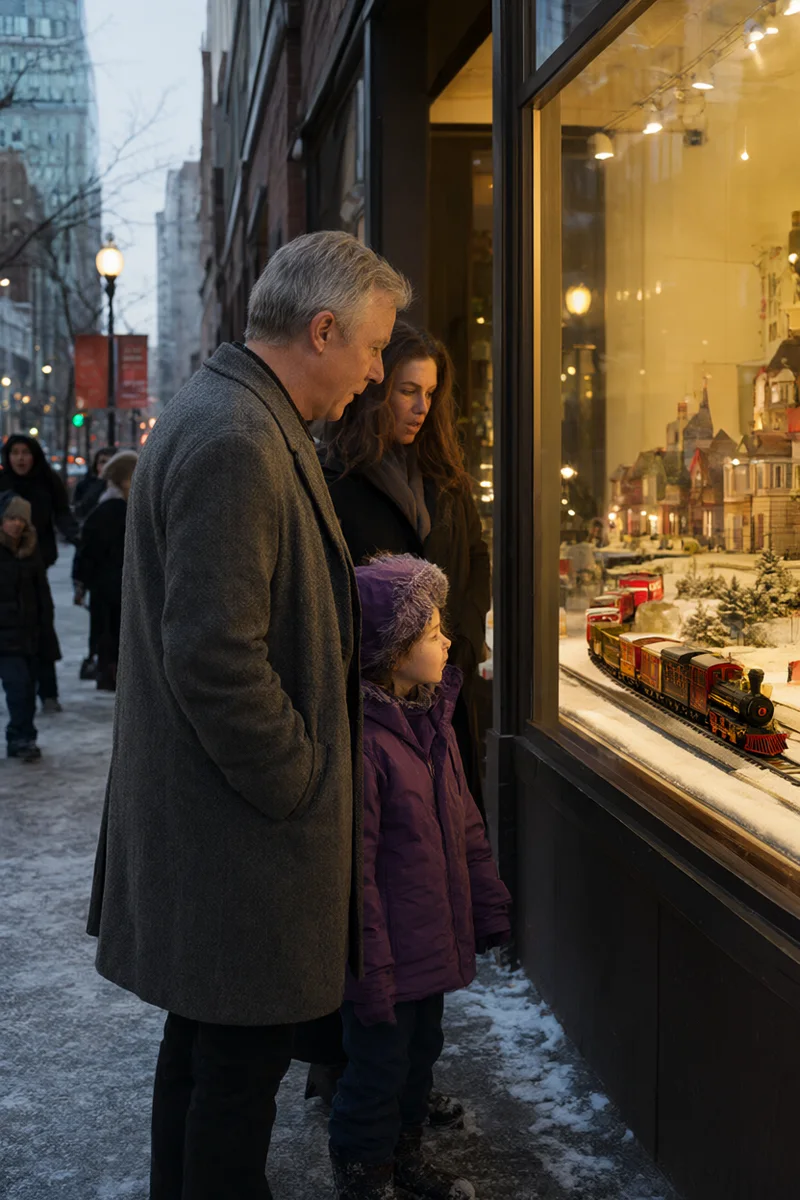
On Christmas Eve the store closed at five. Everett unlocked the back of the corner window with a key from his ring. It took him two tries, and Josie, standing behind him with Tilly, did not pretend she hadn't seen his hand.
Iggy went under the platform to oil the caboose. His boots stuck out. Tilly looked at the boots, and at Iggy's face when he slid back out, and then at her mother with terrible patience. "I'm going to keep thinking it," she said. "I know. But I'm going to."
Everett reached behind the depot and stood the lady in the red scarf on the platform beside the gray man with the watch. His thumb stayed on her a second. Then he gave Tilly the throttle, and the 4:15 went out over the mirror pond at a speed Iggy called criminal.
He had an envelope for Tilly. She read it aloud with her finger under the words. "Dear Tilly. One. Running, for eighteen months, and after that it depends on your counting. Two. Done. Your mother has paid forty dollars and is not late. Three. He hadn't asked. That was the trouble. He has now."
"What did you ask for?"
"Three things. Exact."
"Tell."
"That's between me and the box," Everett said. He looked at Josie when he said it, and then at the floor, like a boy.
Tilly had brought something too: a tree a foot high, cut from a green placemat and taped. "It's for your table. It doesn't have to start."
Josie walked him to the employee door. "I don't work for you as of five o'clock," she said. "So if a person had something to ask me, the twenty-sixth would be the day for it. Not before. I want one whole Christmas where you're nobody."
"I can be nobody," he said. "I've had practice."
On the morning of the twenty-sixth the Corolla started on the first turn. She sat in it a minute, in the dark, just listening to it run.
At half past three she was behind the Lantern's counter when the gray coat came down Corliss Street and stopped at the window. Tilly knelt up in booth four and fogged the glass. "He's doing it again."
"Wait," Josie said.
He stayed for one lap. Then he crossed the street. The bell rang, and he hung the coat on the hook by booth four, and Lucinda looked at Josie, looked at the clock, and took the coffee pot out of her hand.
Josie carried two cups to the booth and, for the first time in six years of working that floor, sat down.
The End









