 The Clocks on Vesper Street
Chapter 4
What Glenys Kept
Glenys Pardoe was unloading a drier when Maud came in, and she took one look at her face and switched the sign on the door to Closed.
“You've been up at Bartholomew's,” she said. “I saw you. You've got the look of somebody who's been told something.” She sat down on the slatted bench under the change machine. “Go on, then.”
“He thinks you wrote the note on the vestry door.”
Glenys closed her eyes. “Course he does. Forty-three years, and he's always crossed the road rather than walk past my window.” She opened them again. “I didn't write it, love. I found it.”
She had been nineteen and doing the church flowers, which meant getting there at seven on a Sunday. The note had been pinned to the vestry door with a drawing pin. She had read it, and taken it down, and put it in her coat pocket.
“I thought that was the end of it. I thought I'd been clever. I didn't know there was a second one, gone to the school.” She shook her head. “Then the Wednesday, the shouting in the car park. I was outside with the vicar and I watched Bartholomew Quince shout at Lucian Abernathy that he never wanted to see his face again, and I watched his hands while he did it. They were shaking so hard he had to put them in his pockets. And I thought, that's not a man who hates somebody. That's a man who's being made to leave.”
“So you started the story about the woman.”
“Somebody had to give the street something to chew on, or they'd have chewed on the truth.” Glenys smiled, very slightly. “A soprano from another parish who'd thrown them both over. I made her up out of nothing. You'd be amazed how many people have told me since that they knew her.”
Maud laughed, and then found she wasn't laughing.
“You never told them?”
“What was I going to say? I took your hate mail off the door and I've been lying for you ever since?” Glenys got up, went into the back room, and came out with an old biscuit tin. Inside was a square of lined paper, gone yellow, with a rusty pinhole in the top. She held it out without unfolding it. “I kept it so nobody else could ever pin it up anywhere. Give it to them. They can burn it, or frame it, I don't care. Just tell Bartholomew it wasn't me.”
Maud took it. It weighed nothing.
“The surgery's Wednesday,” she said. “The hospital asked Mr. Abernathy for a next of kin. He told them there wasn't anyone.”
Glenys swore under her breath, quite inventively for a woman who did the church flowers.
On Tuesday Maud went up to number 31 and put the folded paper through the letterbox with a note in her own handwriting: Glenys found this on the door and took it down before anyone saw. She has kept it ever since, so nobody else could use it. Surgery is at ten tomorrow. Ward 6.
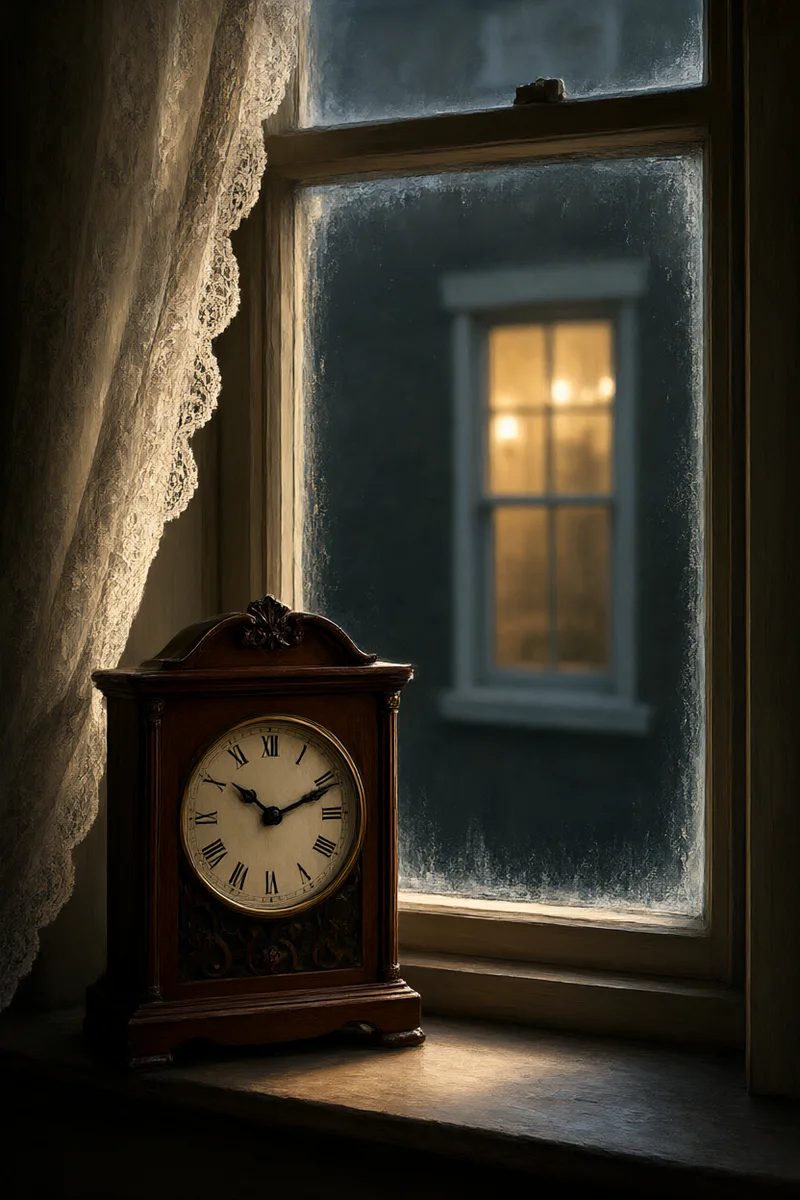
Nobody came to the door. The clock in the window still said 5:14.
She hardly slept. At twenty to eight on Wednesday morning she opened her curtains, meaning only to look at number 18's window, and instead looked straight down at the pavement in front of the launderette.
Mr. Quince was standing there in his tweed coat and a hat she had never seen, with a bunch of yellow roses wrapped in newspaper. He was looking up at her window.
And when she leaned out to look up the hill, she saw that the clock in the window of number 31 had been wound. Its pendulum was swinging. For the first time in forty-three years, it was telling the right time.
The End









