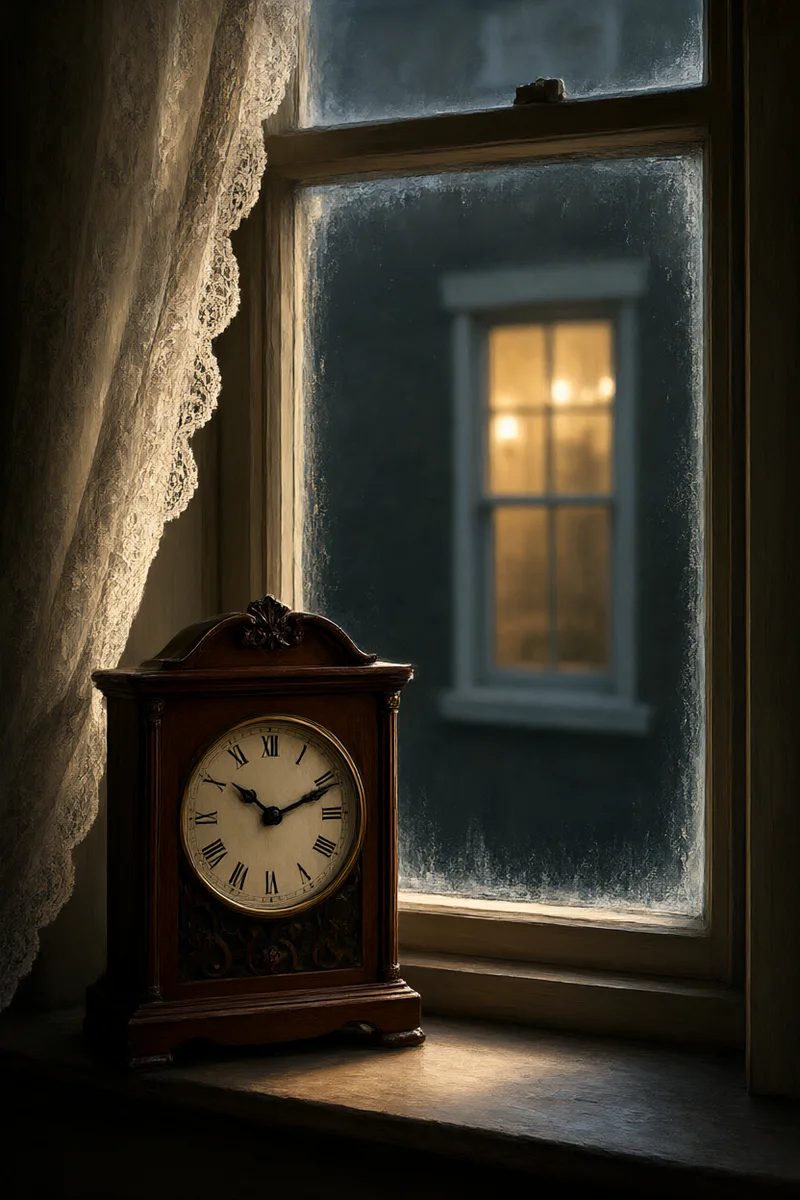
 The Clocks on Vesper Street
Chapter 1
Before Seven
Maud Kerrigan typed what other people said for a living, and the first thing she noticed about Vesper Street was that it said nothing at all.
Her new flat sat above a launderette at the bottom of the hill, and the machines thudded underneath her like a second heartbeat. She transcribed court recordings at a desk in the front window, and when her eyes needed a rest, she looked across the road at number 18.
It was a narrow brick terrace with a black door and a pale yellow rose by the step. In the front window stood a wooden mantel clock with its face turned to the street. It wasn't going. The pendulum hung dead behind its little glass door.
On her first Monday the hands said 6:47. On Tuesday morning they said 1:12.
Eleven years of writing down timestamps had made her notice things like that. On Wednesday it said 4:52. By Thursday she had started a column on the back page of her notepad.
The next week, going up the hill for milk, she saw the second clock.
Number 31 was on her own side of the street, two doors up, out of sight of her desk. It had a green door and the same pale yellow rose. In the window, facing out, stood a mantel clock, also stopped, set to 2:08. She started a second column.
“Oh, those two,” said Glenys Pardoe, who ran the launderette and took Maud's rent in an envelope on the first of the month. Glenys was sixty-two and knew, as far as Maud could tell, everything. “Mr. Abernathy at 18 and Mr. Quince at 31. Sang in the choir at St. Aldric's together for donkey's years. Then in '83 they had a falling-out at choir practice that you could hear in the car park, and they haven't spoken a word since. Over a woman, people said.” She folded a pillowcase into a perfect square. “They both still go of a Sunday. Sit on opposite sides.”
“And the clocks?”
“Always been there. Stubborn old so-and-sos. Probably both too mean to buy batteries.”
Maud kept writing the times down. Her columns grew to three weeks long. Every morning before eight, both clocks moved. Number 18 first, number 31 after, usually within the hour. The times were never the real time and they never repeated. And none of them, she noticed, on a grey Sunday with her coffee going cold, was ever later than seven o'clock.
On the first Friday in November, number 18's clock didn't move.
At eight it still said yesterday's 3:05. At nine it said 3:05. At half past nine she went up the hill and number 31's clock had changed three times in an hour: 4:41, then 6:02, then 4:41 again. She stood on the pavement and looked at it, and the net curtain behind it twitched and fell still.
She went back down and crossed the road and knocked at number 18. Nobody came. She knocked again, then crouched and pushed open the letterbox.
“Hello?” she said into the hall. “Mr. Abernathy?”
From somewhere at the back of the house, a thin voice said, “Kitchen floor. Since last night. I'd be very grateful.”
The back door was unlocked. He was on the tiles by the cooker, a long, white-haired man in a striped dressing gown, with his hip at an angle that made her look away. She rang for an ambulance and put a coat over him, and he thanked her with great formality, as if she had passed him the salt.
When the paramedics lifted him onto the stretcher, his hand came out from under the blanket and found her wrist.
“The clock in the front window,” he said. “Would you set it to three twenty-six? Please. Before you lock up.” His grip was surprisingly strong. “He'll be watching for it.”
The End









