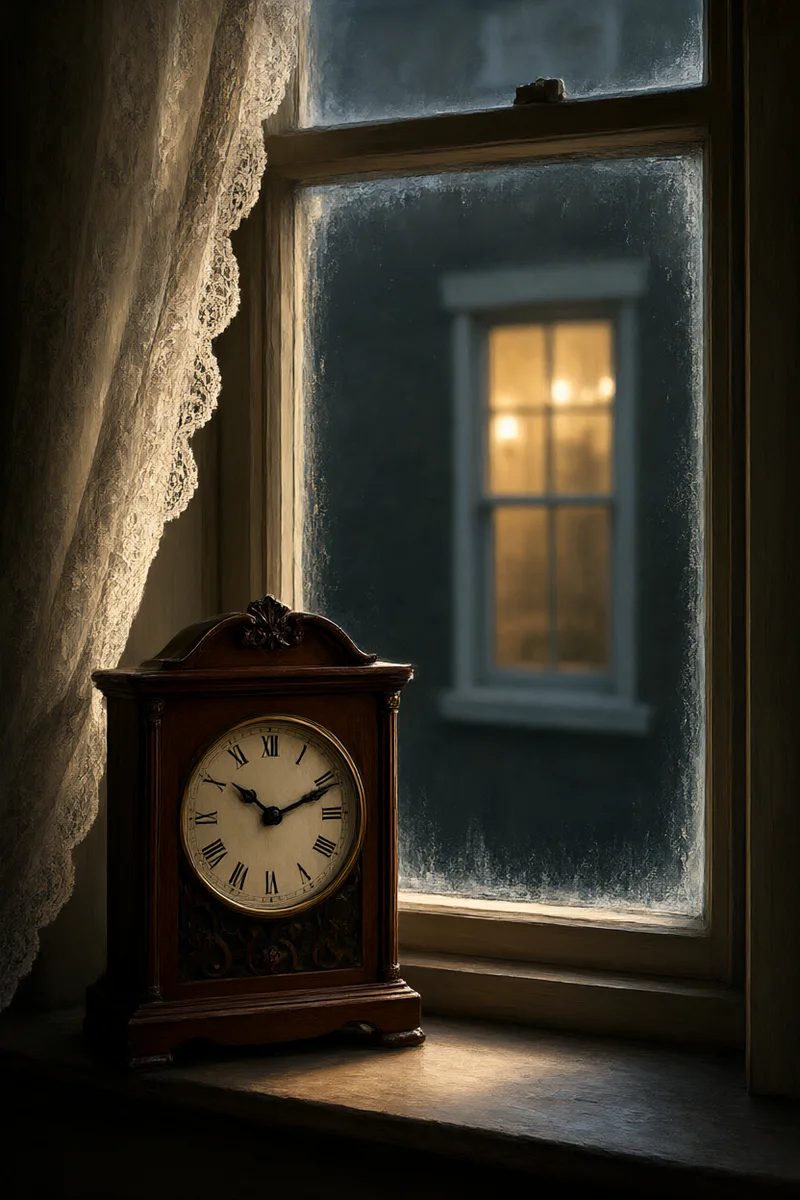
 The Clocks on Vesper Street
Chapter 3
Opposite Sides
Mr. Abernathy was in Ward 6 at the county hospital with a broken hip, a chest infection from a night on cold tiles, and a surgery date of Wednesday, once the antibiotics had done their work. He was sitting up against a stack of pillows with a crossword, and he looked at Maud over his glasses as if she were a pupil who had arrived late without a note.
“Miss Kerrigan. You set the clock. Thank you.”
“He answered,” she said. “This morning. Five fourteen.”
Mr. Abernathy put down his pen. For a moment his long face did nothing at all, and then it did a great deal, and he turned it to the window until it had finished.
“You've worked it out, then,” he said at last. “I was a schoolmaster for thirty-eight years. I always knew the clever ones would be trouble.”
“Do you want me to tell him anything?”
He thought about it. Then he took the pen and wrote a number in the margin of the newspaper, tore it off and folded it twice and gave it to her. “Only that,” he said. “He'll know.”
She didn't unfold it until she was on the bus. 407. She looked it up on her phone. Love divine, all loves excelling.
Mr. Quince opened the green door of number 31 three inches and looked at her through the gap.
“I'm not buying anything and I'm not changing my electricity.”
“I'm Maud. From over the launderette. I've been to see Mr. Abernathy.” She held out the scrap of newspaper. “He asked me to bring you this.”
He looked at it in her hand for a long time without taking it. Then he opened the door the rest of the way.
His front room was very neat and very full: books floor to ceiling, a piano with sheet music on it, two armchairs by the fire. Only one of them looked as though it had ever been sat in. He unfolded the scrap of paper, read the number, and sat down in the used chair very suddenly.
“How bad?”
“Hip. They're operating on Wednesday. He says he's fine.”
“He would.” Mr. Quince looked at the cold fireplace. “He'd say that from the bottom of a well.”
“Mr. Quince, the falling-out. In 1983. That wasn't real, was it?”
He was quiet for so long she thought he would show her the door. Then he said, “Lucian was deputy head at the boys' grammar. I taught piano to other people's children, which nobody cared about. We'd shared number 18 for eleven years and called it lodging.” His voice was flat, as if he were giving the measurements of a room. “One Sunday in May there was a note pinned on the vestry door. Two words about what we were. And a copy of it went to his headmaster on the Monday.”
“So you staged a fight.”
“At choir practice, on the Wednesday, loud enough for the car park. I moved out on the Friday. My mother had left me a bit, and number 31 was for sale. The headmaster decided he'd been sent a spiteful lie about two men who couldn't stand the sight of each other.” He smoothed the scrap of newspaper on his knee. “The clocks were Lucian's idea. He said if we couldn't speak, we could at least sing.”
“Did you ever find out who wrote the note?”
“Lucian always thought it was the vicar's wife.” Mr. Quince glanced towards the window, down the hill, at the launderette sign. “I always thought it was the girl who did the church flowers. The one who's been telling this street for forty years that we fell out over a woman.”
The End









