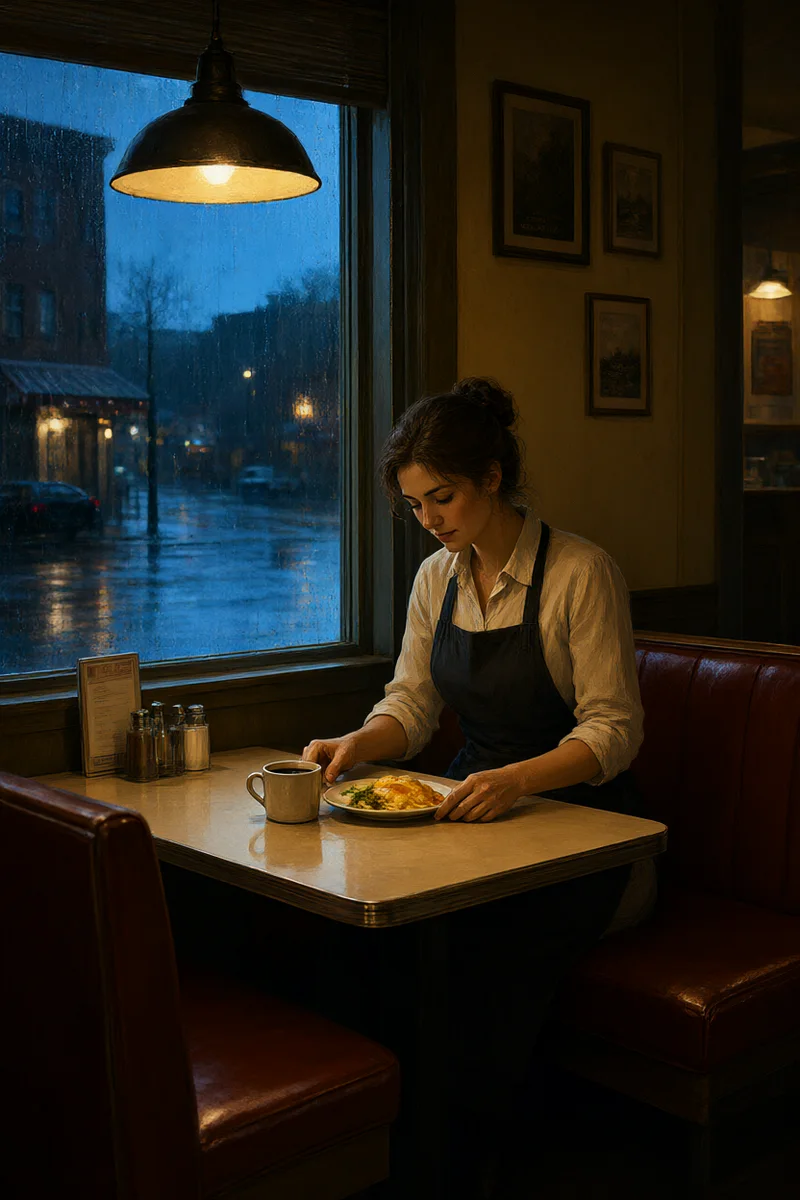
 Tuesdays at Table Nine
Chapter 3
Tuesdays in the Kitchen
June did not pick up the pen. She asked for until tomorrow, and Lorraine Asch, who seemed to have expected worse, left a card and a second envelope that June put in her apron without opening. Then she went through the swinging door.
Marv Dunleavy was standing at the flat-top with nothing on it. He was sixty-one, with forearms like a longshoreman, and he couldn't look at her.
“You heard,” she said. He nodded. “And you knew who he was.”
“First day he walked in.” Marv scraped at a clean patch of steel. “Lost fifty pounds and grew that beard, and I knew him by how he looked at the pie case. He trained me, June. I washed dishes for that man when I was sixteen.”
“That's why you never come out front on Tuesdays.”
“I kept thinking I'd have something to bring him. A month's worth. Two. I wasn't going to walk out there with my hands empty and say hello, Otto.” He jerked his head toward the back lot, where the food truck sat on blocks with MARV'S ON THE MOVE fading along its side. “Forty thousand dollars. I was going to do the county fairs. I can cook for two hundred people, and I can't add.”
“He's been living at the Crossing on a pension. Did you know he comes in here with five dollars?”
Marv's face did something she had not seen it do in nineteen years.
“I've been covering the rest out of my tips,” she said. “In your restaurant. For the man you owe.”
He put the scraper down. For a while the only sound was the cooler.
“You've got the pen now,” he said at last. “Call it off. One word from you and Friday goes away. Jeannie's been here eleven years. Luis has two kids. You'd be putting yourself out on the road along with us.”
“And then what does he live on, Marv?” He had no answer, and to his credit he didn't pretend to.
She drove to Dunmore after close. The lawyer had been plain about it on the phone: an agent acts for the old man and nobody else. Not for Jeannie, not for herself. Friday's sale would bring Otto Brandt his $58,400. The rehabilitation wing at Dunmore General cost sixty-five hundred a month.
He was in a bed by the window, smaller than he had looked in the booth. The scarf was gone. For the first time she saw his throat, the neat opening at the base of it, and understood that for a year he had been hiding it from his breakfast.
His left hand lay on the blanket. His eyes found her, and went to her empty hands, and she could have sworn he was looking for the coffeepot.
“It's Tuesday,” she said. “You stood me up.”
His mouth pulled to one side. She put a pad from the nurses' station under his good hand, and a pencil, and told him all of it: the lawyer, the pen, Friday.
“I need you to tell me what you want. Sell it or stop it.” He held the pencil a long time. Then he let it roll out of his fingers and turned his face to the window.
In the parking structure she sat with the engine off and remembered the second envelope. His effects, Ms. Asch had said; the hospital had found them in his coat. She tore it open. Guest checks slid into her lap, dozens of them, soft from handling, rubber-banded in order. Every one was hers. And every one had pencil on the back.
The End









