 Tuesdays at Table Nine
Chapter 1
Table Nine
The notice had been on the front door of the Signal Diner for three weeks, in a plastic sleeve, and June Tackett could have said it by heart. Notice of Sale. Friday, ten o'clock, the courthouse steps in Dunmore.
Marv had told the three of them in the kitchen the morning it went up, with his apron still on. He said he was sorry. He said he'd thought the truck would turn it around. Then he went back to the grill, because the lunch rush didn't care, and June refilled the ketchup bottles with hands that were not quite steady.
Nineteen years she had worked that floor. She was forty-four. Hobart Junction had one other place to eat, and it was a gas station.
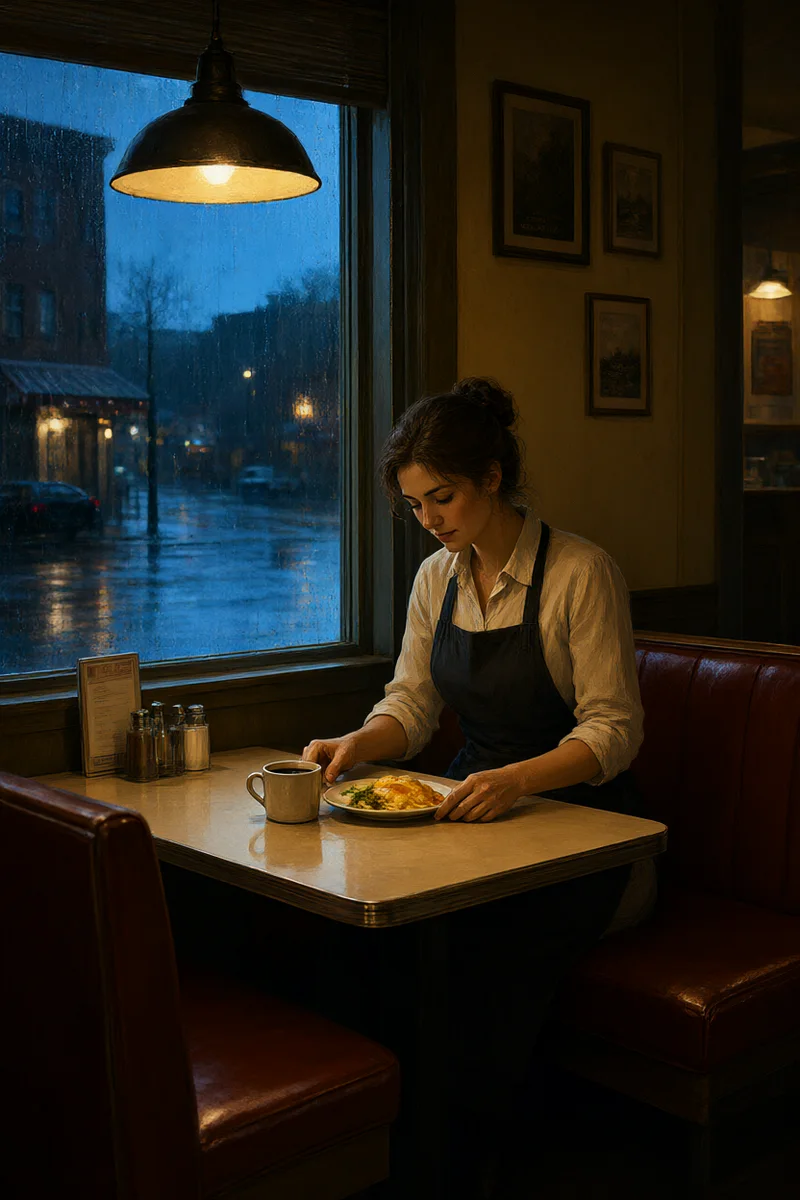
Tuesday she unlocked at six, same as ever. At six-thirty she poured a coffee and set it on table nine, the two-seat booth by the door, with the handle turned to the left.
He was left-handed. That was one of perhaps six things she knew about him.
He had first come in a year ago this month: a tall old man gone narrow, white beard clipped close, a wool scarf wound to his chin in every weather. He had never said a word to her. He tapped the menu. Two eggs over, rye toast, coffee. He ate slowly and watched the room as though he were counting it, the stools, the pie case, the pass-through where Marv's arms came and went.
The check came to $7.85. That first Tuesday he had laid a five on the table, then gone through his coat pockets one after another, and she had watched an old man's ears turn red.
She had picked up the five. “You're all set, hon,” she'd said, and gone to the register and made up the $2.85 out of her apron.
He came back the next Tuesday with exactly five dollars: four ones and four quarters, stacked. He had brought exactly five dollars every Tuesday since, and carried the check off with him in his coat, which she put down to tidiness. She never mentioned the money. Neither did he. Marv never knew, because on Tuesday mornings Marv did not come out from behind the grill for anything.
Fifty-two Tuesdays. She had not done the multiplication. She didn't want to know.
At six-forty the bell on the door stayed quiet.
At seven she poured the coffee out and set down a fresh one. At seven-thirty Vern from the grain co-op asked who she was saving the booth for, and she said nobody, and left the cup where it was.
She had no telephone number for him. She didn't know his name. It occurred to her, wiping down a counter that was rumoured to be going to a truck-stop outfit by the weekend, that she had picked a strange week to be worrying about somebody else's breakfast.
At a quarter past nine the bell rang. A woman in a grey suit came in carrying a document case, and stood on the mat looking at the stools, the pie case, the booth by the door with its cold coffee. It was not how a customer looked at a diner. It was how you looked at an inventory.
June took her a menu. The woman didn't take it.
“I'm looking for June Tackett,” she said.
“That's me.”
The woman glanced at table nine, and back.
“Is that where Mr. Brandt sits?”
The End









