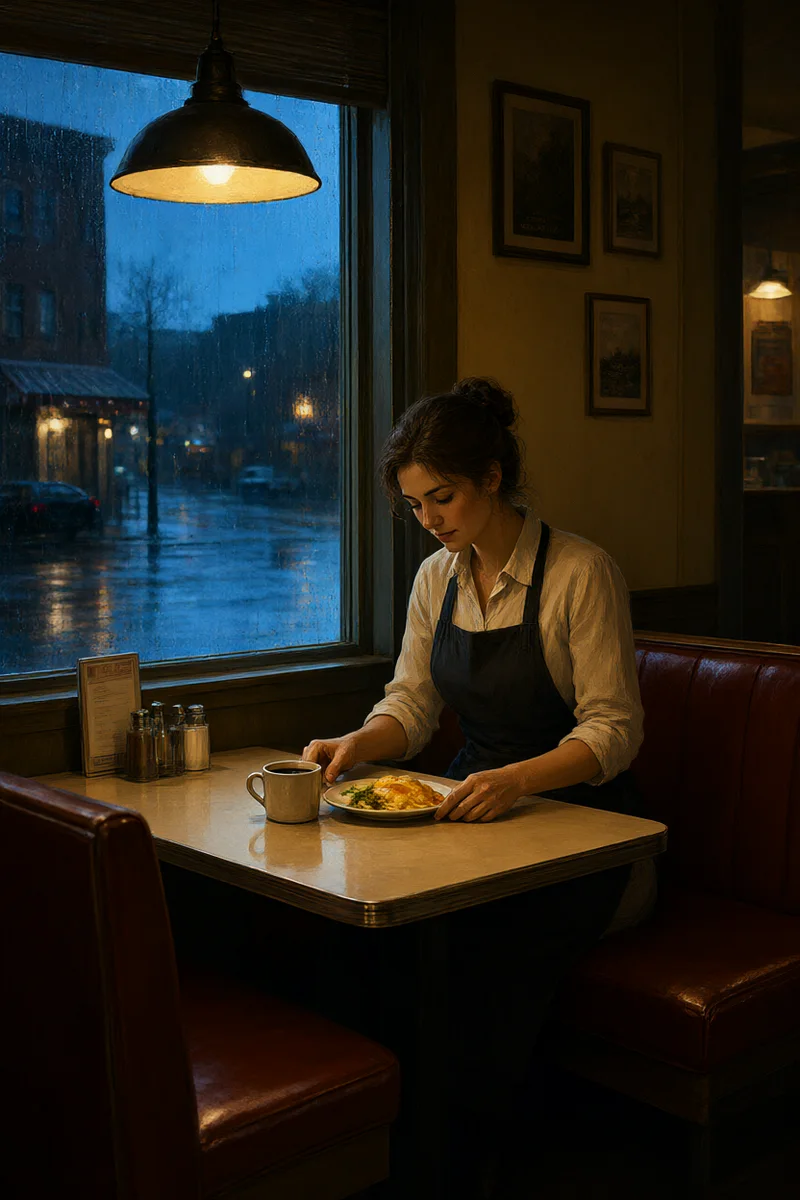
 Tuesdays at Table Nine
Chapter 2
The Back of a Guest Check
Her name was Lorraine Asch, she practised in Dunmore, and she would not sit at table nine. She took the booth behind it. June sat across from her with the coffeepot still in her hand.
“Otto Brandt had a stroke last Thursday night. His landlady at the Crossing Motel found him Friday morning. He's alive. He's at Dunmore General. His right side is weak, and they don't know yet how much will come back.”
June set the pot down. “Brandt. I never knew his name.”
“He never told you?”
“He never told me anything. He doesn't talk.”
“He can't. He had his larynx removed four years ago. Cancer. There's a device that would let him speak, and he owns one, and it stays in a drawer because he says it makes him sound like a kitchen appliance.” Ms. Asch unzipped the case. “He writes notes. He's written me quite a few about you.”
“About me.”
“Miss Tackett, in March Mr. Brandt signed a durable power of attorney. It names one person to manage his affairs if he ever can't. He has no children. His wife died in 2019. He named you.”
June laughed, one short breath, because it was ridiculous. “I'm his waitress.”
“I pointed that out. He wrote back. I have it here.” She slid a guest check across the table. It was one of June's own, with her Thank you! and the looped J at the bottom. On the back, in pencil, in capitals that leaned to the left: SHE KNOWS WHAT A THING COSTS.
June looked at it for some time.
“You can decline,” Ms. Asch said. “Then I petition the court for a guardian, which takes weeks, and in the meantime everything already in motion carries on by itself.”
“What's in motion? He lives in a motel. He can't cover two eggs and toast.”
“No. He has two hundred and twelve dollars in a checking account and a pension that covers the room.” The lawyer folded her hands. “He has one asset. In 2008 he sold a business and the building it stands in, and rather than have the buyer go to a bank, he let the man pay him direct. Six hundred and twelve dollars a month for twenty-five years. It was what he and his wife meant to live on downstate.”
Behind the pass-through, the scrape of Marv's spatula had stopped.
“The payments stopped fourteen months ago,” Ms. Asch said. “Mr. Brandt wrote to the buyer four times. He came back to town to see about it himself, and then, as far as I can tell, could not make himself walk into the kitchen. In July he instructed me to foreclose. Then he instructed me to wait. Then to go ahead.”
June had turned to look at the front door, at the back of the notice in its plastic sleeve, the print showing through in reverse.
“He built this place,” she said.
“In 1971. He and Greta. He is owed fifty-eight thousand four hundred dollars on it, and on Friday morning it will be sold to pay him.” Ms. Asch laid a pen beside the guest check. “Unless his agent says otherwise. As of last Thursday, Miss Tackett, the person foreclosing on this diner is you.”
The End









