 Two Boys in the Photograph
Chapter 5
Veterans Day
Zee knocked on the door over the garage at eight o'clock on the night before the assembly. Kasim opened it in a T-shirt with a towel over his shoulder. Behind him the little apartment was so neat it looked like nobody lived there.
“Can I play you something?” she said.
He looked surprised, and then wary, and then stepped aside.
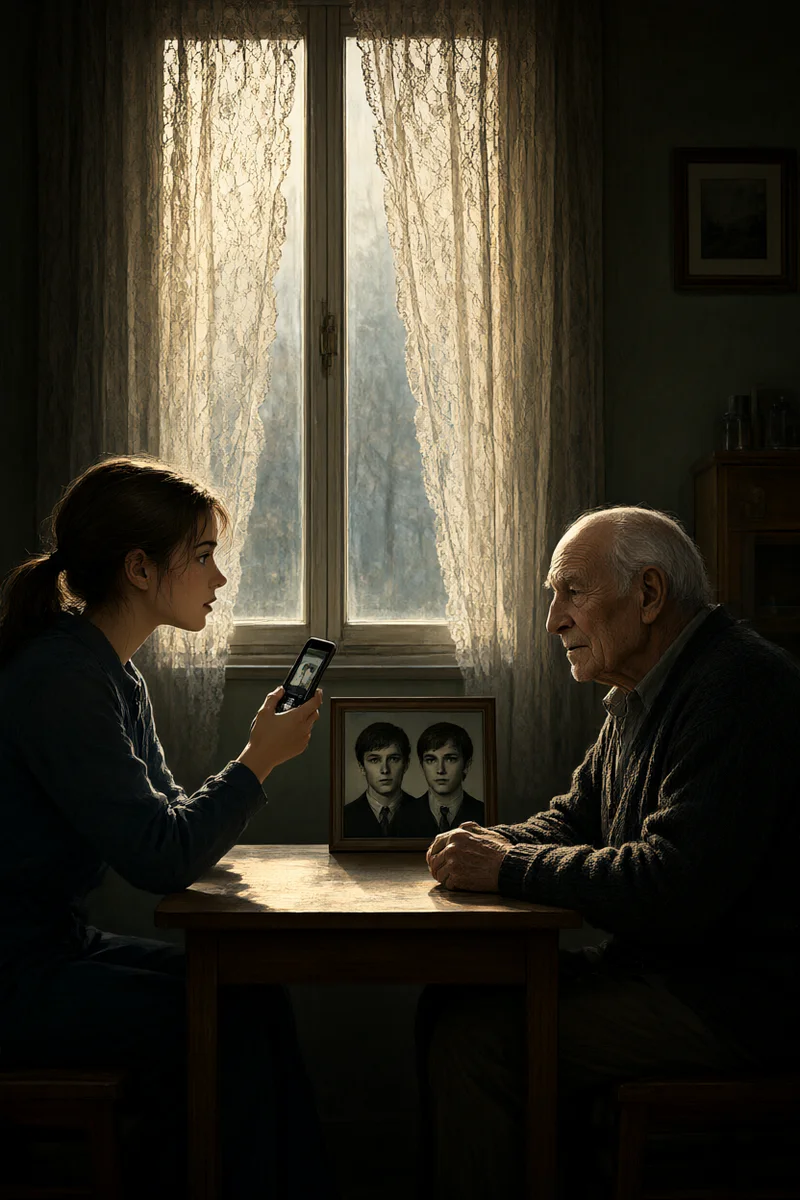
She sat on the edge of his bed and played him eleven minutes of Ezra Belcourt. Not the reservoir. The other part. Building 6, the gray typewriter, the address on Fenwick Road, I typed it because it would make it faster. She had recorded it the second time he told it, with his permission.
Kasim listened with his elbows on his knees and his eyes on the floor.
When it finished he did not say anything for a long time. Then he said, without looking up, “Play that part again. Where the sergeant asks if he's all right.” She played it. He rubbed his face. “Mom used to sit up every night, you know that? Watching the news with the sound off. You used to sit up with her.”
“I didn't think you knew that.”
“I knew.” He looked at her finally. “What time's this thing?”
The gym at Lorne Valley High held nine hundred people. A high school band. Flags. A row of veterans in the front in ball caps and old jackets with patches. Ezra sat at the end of the row in his jacket and tie, very small, with Rosalind beside him and a cane across his knees. Kasim sat in the third row, in a collared shirt, with his arms folded.
When Mr. Pemberton called her name, Zee walked up to the microphone with an index card she did not look at.
“I was assigned to interview Mr. Ezra Belcourt,” she said. Her voice came back at her from the far wall, too loud. “He told me a lot of stories about Korea. About the cold at the Chosin Reservoir, in 1950. They were true stories. But they weren't his.”
The gym went very quiet.
“They were his twin brother's. Abel Belcourt was killed in Korea when he was nineteen. Mr. Belcourt was a clerk in Virginia. His job was to type the telegrams that told families their sons had died.” She took a breath. “And one morning in January, he typed his own brother's name.”
She turned and looked at the end of the front row. “He's carried both of their stories for seventy-six years. Today he's going to tell you his.”
Ezra got up with the cane and Rosalind's elbow and came to the microphone, and it took a long time, and nobody in nine hundred people made a sound while he did it.
He did not talk long. He talked about Abel. He talked about the letters, and the ginger snaps that arrived as crumbs, and the sticky E. He said, “I was at a desk in Virginia with the radiator on. That was my war. I'd like it written down right, for once.”
He looked out at the bleachers.
“My brother's name was Abel,” he said. “He sang in his sleep.”
Afterward, in the parking lot, Kasim drove Zee home. They were halfway there before he spoke.
“Second deployment,” he said, eyes on the road. “There was a guy in my unit who used to do card tricks. Really bad ones.”
Zee did not reach for her phone. She did not say anything. She turned in her seat and listened, the way she had learned to, as if there were nobody else in the world she was waiting for.
The End









