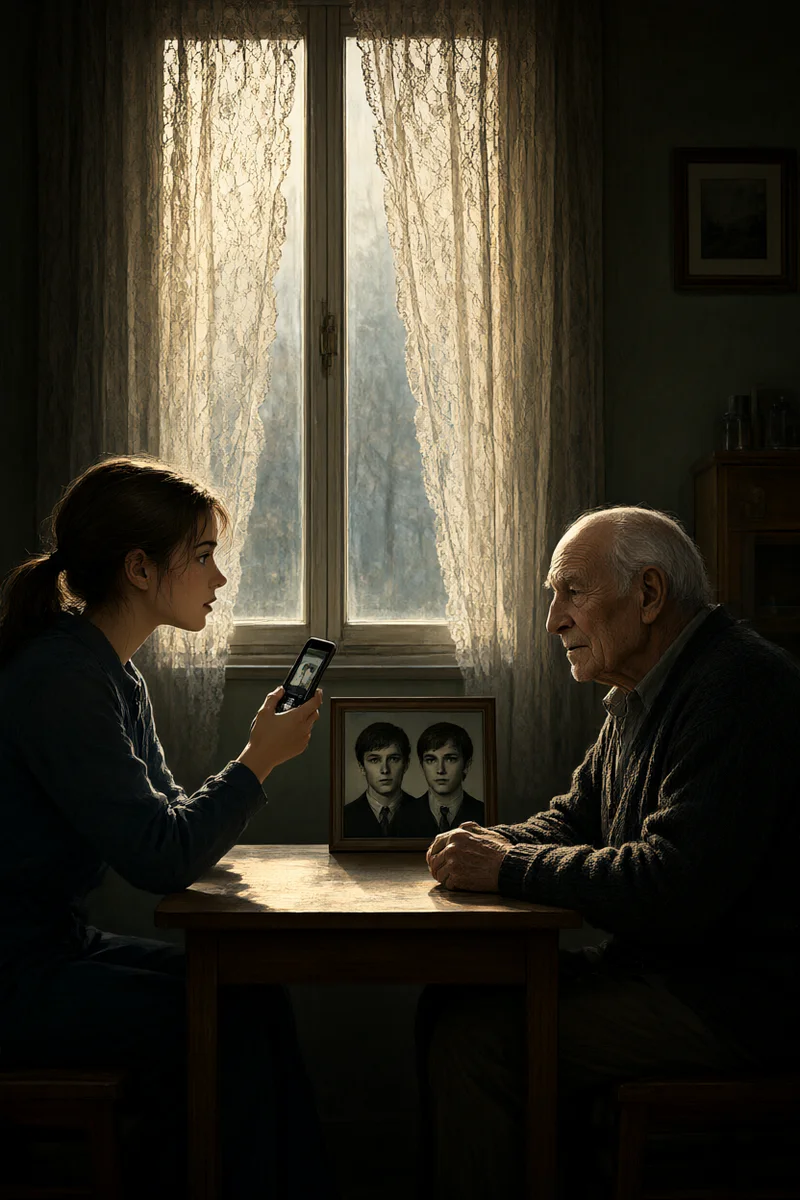
 Two Boys in the Photograph
Chapter 3
Microfilm
The public library kept the old county newspaper on microfilm in a back room with a single humming reader and a sign that said Please Rewind. A librarian named Mr. Ojukwu showed her how to thread the reel. He did not ask what she was looking for, which she appreciated, because she was not sure she could have said.
She started at December 1950 and went forward, a week at a time, the gray pages sliding past under the glass.
She found it on page three of the January 11, 1951 edition. A column under a small photograph.
Two young men in the photograph, side by side, in identical haircuts. One was in an Army uniform. The other was in a white shirt and tie. They had the same nose, the same ears, the same pale eyes that showed even in old newsprint. They were plainly, perfectly, the same person twice.
LOCAL SOLDIER KILLED IN KOREA, the headline said. Private First Class Abel Belcourt, 19, of Fenwick Road, had died of wounds on January 4 at an Army hospital in Japan, after his evacuation from the Chosin Reservoir. He had previously been reported injured by frostbite. He was survived by his mother, Mrs. Clara Belcourt, and by his twin brother, Ezra, who was serving with the Army at Camp Harrow, Virginia, in the post's personnel office.
Zee sat back in the plastic chair.
Personnel office. Virginia.
She read it three more times. Then she paid Mr. Ojukwu fifty cents to print the page, and folded it into her backpack, and took the bus to Cedar Hollow without calling first.
Ezra answered the door in his slippers. He looked at her face and then at the paper in her hand, and he did not say anything at all. He stepped back and let her in, and went and sat down at the kitchen table, slowly, the way he always did, as if his knees had to be consulted.
Zee put the printout on the table between them, next to the sugar bowl.
“You were never there,” she said. “You were in an office in Virginia.”
He looked at the photograph of two boys for a long time.
“Camp Harrow,” he said. “Building 6. Second floor. I had a desk by the window. You could see the parade ground.”
“So all of it. The cold. The hymns. The fingers.” Her voice was shaking, which made her angrier. “None of that was you. You let me record three hours of somebody else's war. I was going to hand it in. I was going to stand up in front of the whole school.”
“Abel had the fingers,” Ezra said. “Abel had all of it. He wrote it all down for me, most of it from that hospital bed, with his good hand. Twenty-six letters. I've got every one in a cigar box in that closet, and I've read them so many times I can't tell any more where his words stop and mine start.”
He reached over and turned the framed photograph on the windowsill around, so that it faced the room for the first time. It was the same picture as in the newspaper. Two boys. One in a uniform.
“You want to know what I did in the war, young lady?” he said. “I typed.”
He pressed one finger to the newsprint, to the line about the personnel office.
“And do you know what they had us typing at Camp Harrow that winter? Washington couldn't keep up with the casualty lists, so the overflow went out to any post with a typing pool. The telegrams that went to the families.” His voice did not change at all. “On January 6th, I typed one with my own mother's address on it.”
The End









