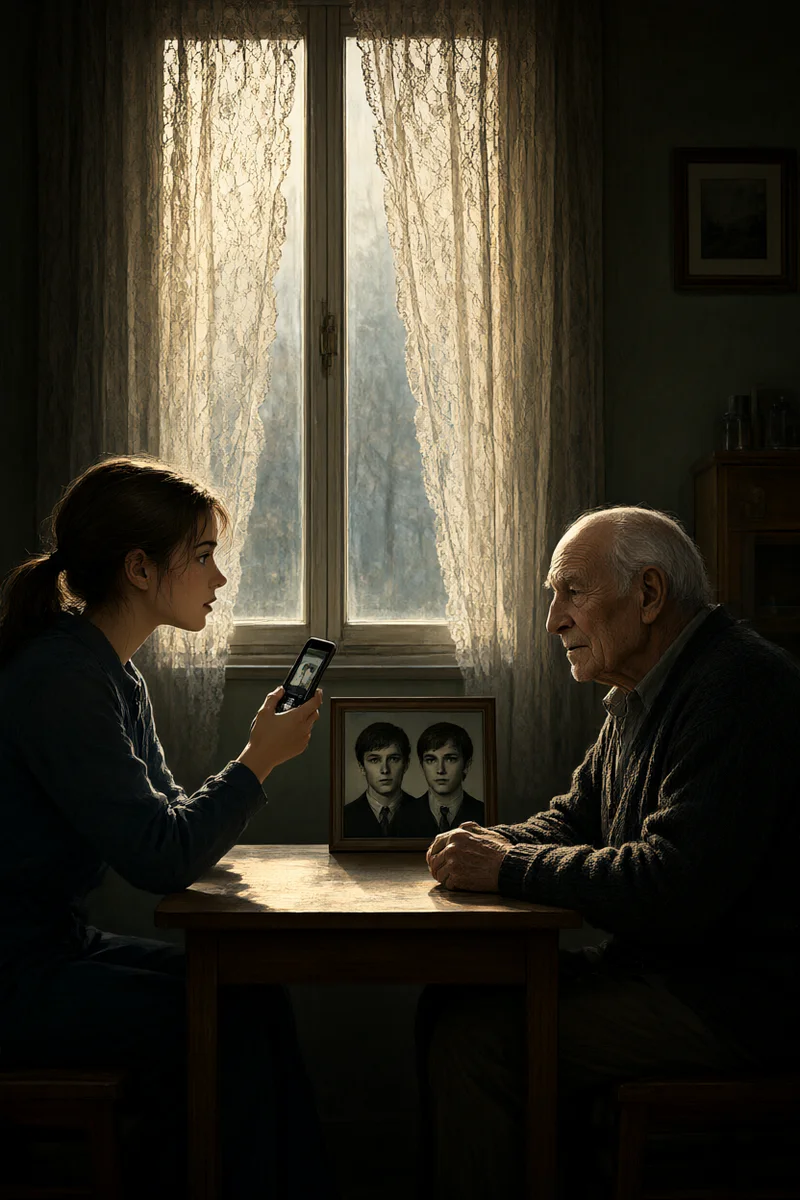
 Two Boys in the Photograph
Chapter 2
Kasim
Her brother had been home for fourteen months.
Kasim was twenty-four. He had enlisted at nineteen, against their father's wishes and with their mother's quiet, terrified pride, and he had done two deployments and come home with a duffel bag and a sand-colored backpack and a stillness that had not been there before. He had moved into the apartment over the garage. He worked days at a tire shop on Route 9. He ate dinner with the family on Sundays and said please pass the rice and thank you and very little else.
Zee used to be able to make him laugh by doing an impression of their aunt. She had tried it once since he came back. He had smiled politely, the way you smile at a stranger's kid.
She was not going to bring Kasim to Cedar Hollow. She was not going to bring him anywhere. It wasn't her business and it wasn't Ezra Belcourt's business and the whole idea made her feel hot and furious in a way she couldn't explain.
She went back on Thursday alone.
“You didn't bring him,” Ezra said, opening the door.
“He's busy.”
He grunted, as though this were roughly what he had expected, and let her in anyway.
He did not tell her the rest. But he told her more. He told her about the retreat down the mountain road in the snow, and the trucks, and a Korean family who had walked beside the column for two days with a goat. He told her about writing letters home with a pencil stub, and about how his mother had sent ginger snaps that arrived as crumbs. Zee recorded it all. That night she sat up until one transcribing it, typing with her headphones on, his dry voice in her ears.
On Saturday she went over again, with a draft printed out, to check spellings of places. He corrected four of them without looking up. His memory was enormous and exact. He knew the date of everything.
Rosalind, walking her out, said, “He's eating better since you started coming. I don't know what you're doing. Keep doing it.”
Zee was halfway to the bus stop when she stopped walking in the middle of the sidewalk.
She had been looking at his hands for three visits. She had watched him pour tea. She had watched him correct her printed draft with a red pen. She had watched him tap the phone with one finger and button his cardigan wrong.
She took out her phone and found the recording from the first day and scrubbed forward until she heard it. His left hand had gone white and then gray. The last two fingers of it, to the frostbite, in an aid tent in December.
She turned around and looked back at the beige building and the window of number 114.
Ezra Belcourt had ten fingers. Every one of them. She had seen him use them all.
That night she lay in bed and listened to the recordings again, from the beginning, all three hours, and for the first time she noticed something else that had been there all along.
He never said his own name. Not once, in any story. The other soldiers called him Belcourt. His mother wrote to Belcourt. The medic in the aid tent said, hold still, Belcourt.
But nobody ever called him Ezra.
The End









