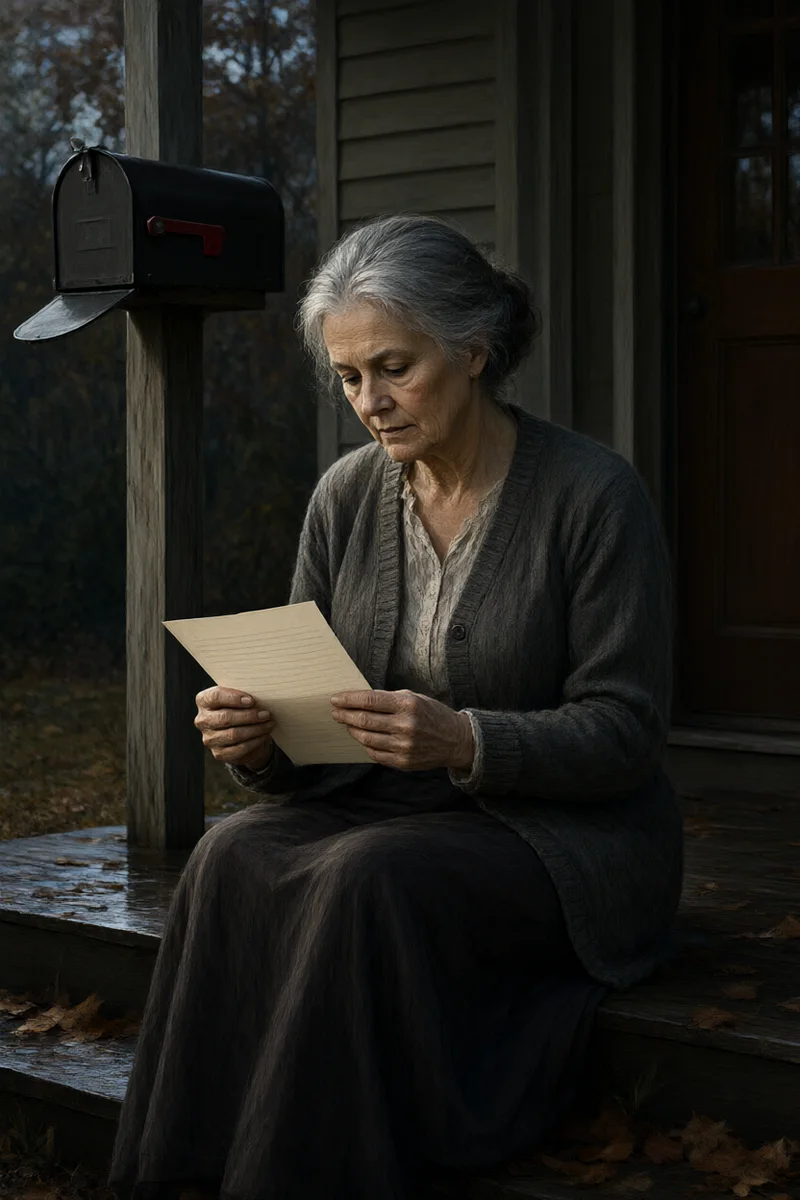
 The Unfinished Letter
Chapter 5
In His Own Hand
The drawer held a clear plastic bag with a hospital label. Inside were a watch with a cracked face, a tin of lip balm, a pencil stub, and a sheet of lined paper folded in four, brown along one edge where something had scorched it.
She unfolded it standing up. The letters were big and pressed hard, in pencil. They leaned both ways. Each line began on the ruled margin and had wandered up off it by the end.
“Mom. I dint rite the other leters. Marsh rote them. I said them tho. Evry word I said is mine and I ment it.”
“I coud not stand you fixing them. I no you ment good. I am 23 and I still see the red.”
“I am lerning now. Marsh is a hard techer like you. This is my 7 try. Dont fix this one. Just read it.”
“I will do the porch in March. Your son, Wes.”
The d in “coud” was backward. He had gone over the W of his name until the pencil shone.
Thirty-three years rose up in her right hand. She knew precisely where each mark would go. She closed the hand and read the page again, and then a third time, moving her lips, and she did not fix it.
“I couldn't ask him,” Toby said behind her. “Mine he'd heard read back and passed. That one I didn't know about.”
“He signed it,” Lorraine said. “He never signed a thing he wasn't finished with.” She had to wait before she could go on. “It's the best letter I ever got. You may tell anyone I said so.”
She sat down in the hard chair with the page in her lap. After a time she looked at him properly: the scrape on his jaw, the gauze, the water jug with a bent straw that somebody else had to hold.
“You were behind him in the truck. And your hands.”
He looked at the ceiling. “The door was hot. I didn't get it open.” That was all he said, then or later, and she never asked him for more.
A nurse came to change a drip and went away again.
“Who writes to your grandmother?” Lorraine said.
“Nobody, ma'am. The Army called her. She don't hear well on a telephone. I can't—” He lifted the white arms an inch off the pillow. “The doctors say spring, maybe, for a pen. They don't promise the same hand.”
Lorraine opened her handbag. She took out the pad she kept for grocery lists and felt along the bottom for a pen. It was red. She looked at it, put it back, and found a blue one.
“I'm at the motel on the river road until Sunday,” she said. “I have a fair hand. Not as good as yours.” She pulled the bed table across and squared the pad on it. “You say it. I'll put down what you say and nothing else. Then I'll read it back, and you'll tell me where I've got it wrong.”
Toby Marsh stared at her. His eyes had filled and he had no way to wipe them, so she did it, with a tissue from the box, briskly, as she had done for a thousand children. Then she sat back down and picked up the pen.
He cleared his throat. He looked out at the river.
“Dear Gran,” he said. “Don't be scared when you see this ain't my writing.”
Lorraine wrote ain't.
The End









