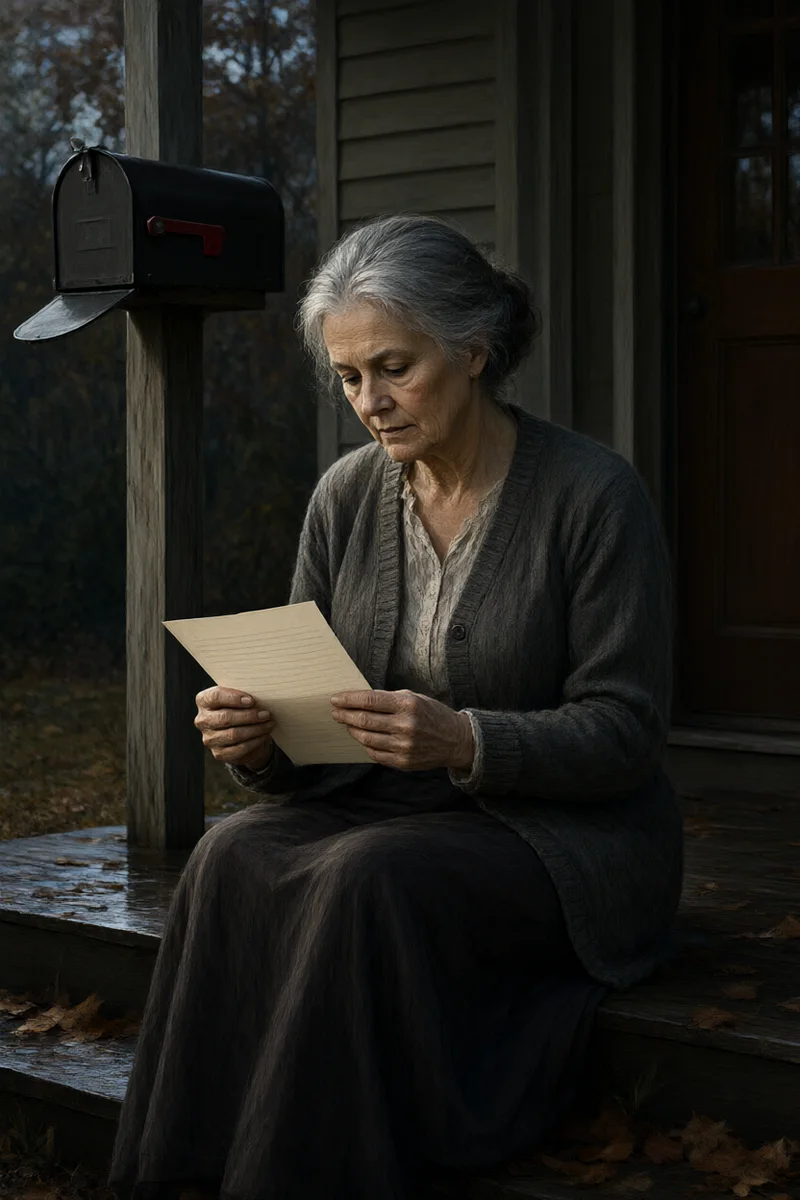
 The Unfinished Letter
Chapter 3
Marsh
“Mrs. Pike,” the boy said. He did not ask. He tried to sit up straighter and couldn't manage it without his hands. “Ma'am. I'm Toby Marsh. Private First Class. I was hoping you'd write. I didn't think you'd come.”
“You mailed me a letter.”
“Yes, ma'am. The chaplain did, for me. I told him where the stamp went.”
Lorraine stayed standing. She had the boot box under one arm like a class register. “Where did you get it?”
“It was in my pocket.” His accent was hill country, further south than hers; pocket had most of three syllables. “Left leg, cargo pocket, with the envelope already done. They cut my uniform off me in the helicopter and bagged what was in it, and the bag went one place and I went another. It caught up with me here on the thirtieth. A nurse held it open so I could see. I had her put it in the drawer, and I looked at that drawer for three days.”
“And then sent it. Unfinished. Without a word of explanation.”
“I couldn't write you one.” He glanced at the gauze, not for pity; he was only naming the difficulty. “And I couldn't see saying it out loud to a chaplain for him to put down. It wasn't mine to keep. I thought you'd rather have a piece than not.”
She found that she had sat in the visitor's chair. The room smelled of ointment and floor polish. Out the window the river was the color of a nickel.
“You were in the truck.”
“Yes, ma'am. Riding behind him.”
She looked at his arms and did not ask how, and he did not say. A cart went by in the hall.
“Why was my son's letter to me in your pocket, Private Marsh?”
He had known it was coming. She had watched nine-year-olds wait for a question exactly that way, eyes on the middle distance.
“Because it wasn't done yet. We got called to load up. I put it in my pocket to see to that night.”
Lorraine opened the box on her knees. She took out the top letter and the bottom one and held them up, one in each hand, facing him. “These.”
He looked at them the way a person looks at his own front door. “That bottom one's from basic, two Octobers back. It got rained on. I did the address over.”
“All forty-one.”
“Forty-two, with the one you got Friday.” He swallowed. “My gran taught me my letters with a ruler laid under the line. She said a clear hand was the one thing nobody could take off a poor man. It's about all I'm good at.”
Lorraine put the letters back in the box in their right order. Her hands were steady, which surprised her. She set the lid on.
“So for two years,” she said, “I have been writing back, and sending socks, and reading aloud at the church supper, to a boy I never met.”
“No, ma'am—”
“I have nothing of his.” Her voice had gone quiet and exact, the voice that had emptied playgrounds. “I thought I had forty-one letters from my son. I have forty-one samples of your penmanship.”
The End









