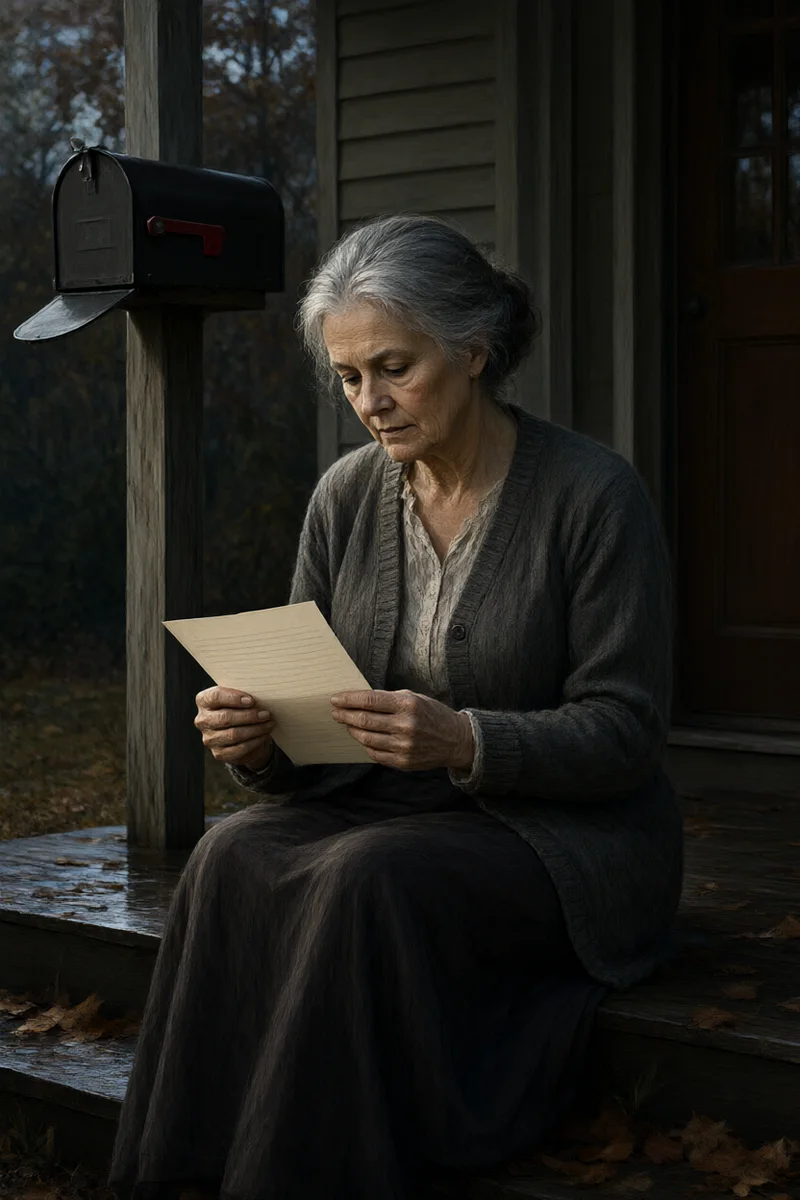
 The Unfinished Letter
Chapter 1
Postmark
The letter came on a Friday, in with the electric bill and a seed catalogue, and Lorraine Pike knew the handwriting before she knew she was looking at it.
Neat blue ballpoint, slanted a little to the right, every t crossed as level as a shelf. The capital L of her name had a loop at its foot like a cast fishing line.
She had forty-one envelopes addressed in that hand in a boot box on her dresser. She had buried the boy who sent them on the thirteenth of October, in the plot beside his father, with a bugler who had driven up from the county seat.
She put the electric bill and the catalogue on the porch rail. She sat down on the top step, though it was wet.
The postmark was a clean black ring. NOV 3. Three weeks to the day after the funeral.
Lorraine was sixty-one and had taught third grade at Marrow Creek Elementary for thirty-three years. She did not believe in signs. She believed in late buses and lost mittens and mail that sat in a sack. Wes had been killed on the second of October, when the truck he was riding in went over a mine on a supply road, in a place the Army's letter spelled one way and the newspaper another. A letter could take a month to cross the world. That was all this was.
She told herself so for as long as it took the kettle to boil. Then she slit the envelope with the paring knife, properly, along the top.
One sheet, lined, torn from a pad. No date. He never dated them.
“Dear Mom. Nothing to report, which is how I like it. There's a yellow dog that's adopted the motor pool and we're not supposed to feed her and everybody does. I named her Mrs. Abbot because she watches everything and says nothing nice about it. Don't tell Mrs. Abbot.”
Lorraine laughed, one short bark, alone in her kitchen, and put her hand over her mouth.
“Could you send socks. The thick grey kind, not the kind from last time, no offense. And the newspaper when the Creek plays Dunmore, even if they lose, especially if they lose.”
“I've been thinking about the porch. When I'm home in March I'll do the steps and the rail both. Don't let Mr. Teague do it, he'll charge you and use nails.”
She read slowly, the way she used to make children read aloud, one finger under the line. It was her son's voice to the life. It was Wes at this table with his chair tipped back.
Near the bottom of the page the writing closed up, as if he had leaned in.
“Mom, there's one thing I have to tell you before I come home. I should have said it two years ago. I'd rather you heard it from me than—”
That was the end of the page.
She turned it over. The back was blank. She looked inside the envelope, held it open to the window, shook it over the table. She went out and searched the porch step and the mailbox on its post.
There was no second sheet. There was no signature, and Wes had signed every one of the forty-one, “Your son, Wes,” as though she might have him confused with somebody.
It was nearly dark before she thought to look at the stamp, and then at the name of the town inside the black ring, and understood that this letter had never crossed an ocean at all.
The End









