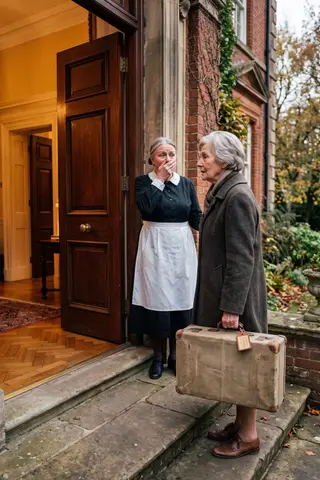
 The Son Who Kicked Out His Newly Widowed Mom Just Inherited the Ultimate Karma When She Bought His Entire Neighborhood!
Chapter 3
The Mahogany Four-Poster
The interior of the Sterling mansion had not changed in half a century, save for the faint patina of age that settles over things left untouched by children or modern redecorating. The walls of the grand parlor were still lined with dark cherry wainscoting and heavy oil portraits of men in stiff collars who had built their fortunes on pig iron, river barges, and the coal seams of the Appalachian foothills. As Clara led me down the wide central corridor, past the grandfather clock that still ticked with the same deep, resonant chime I had heard the night my father threw me out, the past didn't feel like a memory; it felt like a heavy woolen blanket being dropped over my shoulders after a long freeze. We entered the library—a two-story room walled with leather-bound volumes that smelled of vanilla and decaying paper—where a single hospital bed had been dragged in to replace the Victorian settee. The room was warm, too warm, scented with eucalyptus and the faint, chemical hiss of an oxygen concentrator sitting in the corner by the hearth.
Propped up against a stack of embroidered goose-down pillows in the center of the massive mahogany four-poster bed was my Uncle Jonathan. He looked like an ancient parchment map left out in the sun—his skin translucent and mapped with a fine web of blue veins, his white beard trimmed close to his jawline, and his eyes... those were the Sterling eyes, the same piercing, slate-gray color that had stared down union leaders and railroad barons across boardroom tables for six decades. On the heavy oak lap-desk resting across his thighs sat a stack of thick legal ledgers bound in pigskin, their pages covered in the sharp, sloping handwriting of a man who still wrote contracts by fountain pen. When his cloudy, failing eyes found my face in the doorway, the stern, weathered lines of his mouth didn't tighten; they broke. A ragged, wet sob tore out of his chest, and he reached out a thin, spotted hand with fingers like dry twigs, clawing at the air between us as if he were trying to pull me across the room by sheer willpower.
"You came home," he rasped, his voice sounding like dry leaves sliding across concrete. "Oh, my God, Eleanor... you actually came home." I walked slowly across the Persian rug, my boots feeling clumsy and heavy on the wool, and knelt beside the high wooden frame of the bed. When I placed my hand inside his skeleton-like grip, his fingers clamped around mine with a surprising, desperate strength. "Your father... Arthur never knew peace after the night he turned you away," Jonathan whispered, tears leaking from the corners of his eyes and disappearing into his white beard. "He sat in this very room every evening after the foundry whistle blew, staring at the empty chair across the hearth where you used to read your poetry books. He tried to rewrite the will three times, but his lawyers told him he couldn't touch the primary entailment without your signature or proof of your passing. When he died, he left the entire estate—every acre of commercial real estate along the river front, the foundry shares, the timber tracts in Michigan, and this house—locked in a testamentary trust that could only be dissolved by the direct blood heir stepping back across this threshold."
Jonathan reached beneath his heavy wool blanket and pulled out a thick leather folio tied with a faded red ribbon. He laid it gently across my knees. "We couldn't find you, Eleanor. Charles was a stubborn man—God rest his soul—and he protected you like a fortress. He changed your last name on the county marriage registry in a small town two counties over, enrolled you under a cousin's maiden name for insurance purposes, and kept you entirely off the digital grid. No credit cards, no mortgage listings in your name, nothing. You were a ghost by design." He paused, coughing softly into a white linen handkerchief that came away stained with a faint trace of pink. "The estate is valued at twenty-seven million dollars in liquid assets alone, not counting the property holdings and the industrial portfolio. It doesn't belong to a board of directors, Eleanor. It doesn't belong to the state. It belongs to you. Every single brick of it."
I sat there on the Persian rug with the heavy leather folio resting on my skirt, listening to the rhythmic hiss-click of the oxygen machine and the distant sound of rain beginning to tap against the leaded glass windows of the library. Fifty years of scrubbing linoleum floors, of stretching a mechanic’s weekly pay envelope to cover groceries, of listening to Bradley complain about the price of gasoline, of standing quietly in the corner of a split-level guest room while my daughter-in-law talked about her delicate nervous system—all of it dissolved into the warm, silent air of the room. I wasn't an old widow pushed out into the cold by an ungrateful son who saw me as an economic burden. I was the last living Sterling, and the keys to the kingdom were sitting in my lap. I looked up at my uncle, whose chest was heaving with the effort of the long speech, and squeezed his fragile hand. "I'm home, Uncle Jonathan," I said softly, my voice steady and clear in the quiet room. "And we have a great deal of paperwork to catch up on."
The End









