 The Son Who Kicked Out His Newly Widowed Mom Just Inherited the Ultimate Karma When She Bought His Entire Neighborhood!
Chapter 1
The Ash of a Forty-Year Vow
The rain over the cemetery in Columbus did not fall; it hung in the air like a damp, heavy shroud, graying the asphalt, soaking through wool trousers, and turning the freshly churned earth of the hillside plot into a dark, sliding mire. Forty-one years of marriage, of shared toast and quiet kitchen table conversations, of mortgages paid five dollars early and midnight feuds over medical bills, ended under a black umbrella that leaked right at the main seam. Charles lay beneath three feet of Ohio clay. I stood beside the hole, my shoes squelching against the sod, holding a single damp program with a photograph of Charles from twenty years back, when his hair still held the color of toasted wheat and his hands were strong enough to lift an engine block out of a chassis. Beside me, my son Bradley shifted his weight from one foot to the other, his black overcoat unbuttoned because he was warm, or because he was bored, or because his phone—vibrating quietly in his breast pocket—was demanding an attention that a buried father could never quite match. He looked down at his watch, a heavy steel chronograph I had bought him for his thirtieth birthday, and sighed. The sound was small, but in the hush of the cemetery, it cut through the drone of the distant interstate like a dull blade. I saw it, but I said nothing. Grief makes cowards of us all, or saints, and for that hour under the gray sky, I chose to be neither. I was simply an empty vessel waiting for the tide to turn.
We drove back to Bradley’s split-level house in a silence so thick you could have sliced it with a butcher knife. The house sat in a subdivision of identical brown-brick boxes built in the late eighties, where every lawn looked like an identical swatch of green carpet and every driveway held a mid-sized SUV and a recycling bin. In the guest room upstairs, the air smelled faintly of dust and hot rubber from the unused treadmill that crowded the north wall. Plastic bins filled with Christmas ornaments—fake pine garlands, blinking reindeer, and glass baubles shaped like Santas—were stacked ceiling-high in the closet, crowding out the small metal rod where I had hung my two black dresses and my raincoat. The bedside lamp, a hideous thing made of ceramic brass with a pleated shade that leaned to the left, buzzed like an angry hornet whenever the toggle switch was pushed past the first click. Every morning at five, before the automatic sprinkler system outside began its rhythmic thud against the aluminum siding, I was up. I padded down the carpeted stairs in my bare feet to avoid waking them, filled the ceramic kettle, and waited for the water to boil while I scrubbed the grease film off the back burners of the stove.
Melissa, my daughter-in-law, came down around seven-thirty each morning wrapped in a quilted bathrobe that looked like an expensive sleeping bag. She would stand by the kitchen island, her eyes half-closed against the fluorescent light, waiting for the coffee to drip while she massaged her temples. "The morning light is just too sharp today, Eleanor," she would murmur, her voice flat with a permanent, low-grade exhaustion that seemed to infect every room she entered. "My nervous system just can’t handle the glare." I would quietly twist the vertical blinds half an inch to the left, soften the light falling across the quartz countertops, and slide a frozen waffle into the toaster for their seven-year-old daughter, Chloe, who ate her breakfast in front of an iPad playing silent cartoons. I folded the laundry they left in baskets by the dryer, matched the unmatched socks, wiped down the fingerprints on the stainless steel refrigerator doors, and listened to Bradley complain about his regional sales quotas while he buttered his toast with the aggressive strokes of a man who believed the world owed him a commission check just for showing up. Nobody called any of that work. To them, I was just background furniture—a piece of upholstered inheritance that had come with the spare room, an old domestic appliance that didn't require electricity but took up space in the pantry.
Then came the Monday in March. The wind outside was rattling the loose aluminum flashing on the roof, and the sky had the dirty, curdled look of dishwater left in the sink too long. Bradley stood across from me in the kitchen, his phone in one hand—its screen still glowing with an unread email—and a mug of coffee in the other. He didn't look at my face; he looked at the space just above my left ear, the way men look at a service technician when they are about to explain why the repair bill is going to be higher than estimated. "Mom," he said, clearing his throat with a dry, practiced rasp. "We need to talk about your situation." The word situation hung in the air like a foul smell. Not my widowhood. Not my forty-one years of keeping a roof over his head through orthodontic bills, college application fees, and his brief, disastrous attempt at opening a lawn-care franchise that went bankrupt in six months. Just situation. He told me the adjustable-rate mortgage on the split-level had jumped three hundred dollars a month. He told me that ground beef was nine dollars a pound at the Kroger down the road and that everyone in the household had to pull their own weight.
Melissa stood at the sink, her hands plunged into soapy water, pretending to rinse a mug that was already as clean as a whistle. She didn't turn around, but her shoulders were stiff, locked into a posture of defensive martyrdom. I looked down at the crumb of burnt toast sitting on the black granite counter—the very toast I had buttered for my son thirty minutes before—and felt something inside my chest snap. It wasn't a loud snap; it was the sound of dry pine twig breaking under a heavy boot in the middle of a silent forest. Then Bradley delivered the line he must have rehearsed three times in the master bathroom mirror while brushing his teeth. "You need to get a job, or you need to find somewhere else to live." I kept looking at my son, waiting for the micro-expression, the slight twitch of the eyelid or the sheepish drop of the chin that would indicate he realized the monumental obscenity of what he had just uttered to a woman who had buried her husband four days after the ground thawed. But there was nothing. Only an irritated crease between his eyebrows, the look of a project manager whose spreadsheet was off by two decimal points.
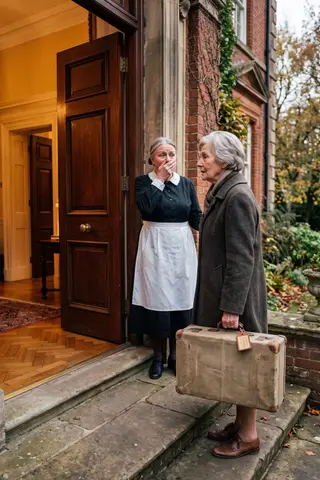
Melissa turned around then, wiping her hands on a linen dish towel with a pattern of faded blue cornflowers. "It’s not personal, Eleanor," she said, her voice dripping with the condescending grease of self-help seminars. "It’s just boundaries." Boundaries. Such a clean, modern word for an iron gate with the lock turned from the inside. I didn't cry. Tears are for people who believe the person standing across from them still possesses a heart capable of breaking. I simply turned on my heel, walked up the stairs past the humming treadmill, and pulled my old canvas suitcase from the dark cavern beneath it. The zipper was stuck on a piece of frayed nylon, and I had to yank it twice before the metal teeth parted with a dry hiss. I packed with the clinical detachment of a woman packing for a hospital stay she knew she wouldn't return from: two wool sweaters smelling faintly of mothballs, my church shoes with the slightly scuffed heels, Charles’s gray cardigan—the one with the leather buttons he had worn while tinkering with his old Ford tractor in the driveway—and a small framed photograph from our fiftieth-state trip to Lake Erie, back when the world was wide and my husband’s hair was still the color of dark rye.
My granddaughter Chloe found me in the hallway as I dragged the heavy canvas bag toward the top of the stairs. Her small fingers clutched the edge of my cardigan sleeve. "Grandma? Are you coming back?" she asked, her big, round eyes filled with the pure, uncorrupted confusion of a child who didn't yet understand that adults could be cruel without raising their voices. I knelt down on the worn beige carpet, touched her soft cheek with my thumb, and told her to be good, knowing full well that in that house, goodness was a currency spent long before she was born. Bradley never walked me to the door. He stayed in the kitchen, the sound of his spoon clinking against his cereal bowl echoing through the drywall. Melissa walked me down, but she didn't step outside into the gray drizzle. She opened the front door just wide enough for my shoulders to pass through, her polished pink nails curved neatly around the brass handle like claws. "I hope you understand why we had to do this," she said, her voice dropping into that register of faux-sympathy that makes the skin crawl. I looked at her nails, then up into her eyes, which were as empty and flat as two gray buttons. "I understand more than you think, Melissa," I said. Then I stepped out into the cold March wind, and the heavy oak door clicked shut behind me with the finality of a prison gate.
The End









