 The Son Who Kicked Out His Newly Widowed Mom Just Inherited the Ultimate Karma When She Bought His Entire Neighborhood!
Chapter 2
The Ghost of the Sterling Foundry
For two blocks, I walked down the suburban sidewalk with my canvas suitcase bumping against my shins, the rubber wheels rattling over the expansion joints in the concrete. A yellow school bus hissed to a stop at the corner, its red lights flashing in an erratic, pulsing rhythm against the drab brick facades of the houses. From somewhere behind a privacy fence, the warm, soapy smell of someone’s morning laundry drifted out through a dryer vent, rich with the scent of cheap detergent and artificial spring meadow. For one terrible second, the sheer weight of the transition hit me so hard my knees buckled, and I had to lean against a utility pole painted with peeling green lead paint. I missed having a kitchen counter to lean against. I missed the sound of Charles coughing in the hallway at dawn. I missed the illusion that I belonged somewhere, that my existence mattered to the geography of the room I slept in. But grief, when it has stripped you down to the bare marrow of your bones, leaves behind a strange, terrifying kind of freedom—the cold, clear space of a person who has nothing left to lose because everything has already been taken.
I dragged my bag into the county public library three blocks off Main Street, where the air smelled of floor wax, damp newsprint, and forty years of stale radiator heat. At one of the public computer terminals—a beige desktop machine with a sticky spacebar and a monitor that flickered every time someone walked past on the linoleum—I typed with one finger into the search bar: jobs for seniors near me. The cursor blinked mockingly against the white background. Cashier at the Piggly Wiggly. Greeter at Walmart. Overnight stocker at the warehouse district. Housekeeper for an assisted living facility at eleven dollars an hour. I scrolled down the list, watching the blue hyperlinks change color as I clicked through ads written by twenty-something managers looking for cheap, compliant labor they could work to the bone. Then, near the bottom of the second page, wedged between an ad for home medical supplies and a classified for lawn maintenance, I saw it: Companion caregiver for elderly gentleman. Light housekeeping, medication reminders, quiet household. Immediate start. References required. No corporate chain name attached. Just a residential address on Elm Street, on the east side of town—an old neighborhood I hadn't visited since I was a girl, back when the town still had streetcars and the foundry sirens blew at five o'clock sharp every evening.
I wrote the address down on the back of a greasy grocery receipt using a stub of a pencil I found in my handbag. The next morning, before the sun had fully burned the frost off the car windshields on the street, I took the ten-dollar emergency bill Charles had kept tucked inside the pages of his family Bible since the winter of ninety-eight and boarded the number fourteen crosstown bus. The bus smelled of wet wool, diesel exhaust, and cheap tobacco. I sat near the back, watching the industrial sprawl of the city give way to older, more dignified streets where the houses weren't packed together like matchboxes. Elm Street was a cathedral of ancient pin oaks and sugar maples whose bare black branches interlaced overhead like the ribbed vaulting of a Gothic cathedral. The houses here were built of quarried limestone and heavy red brick, with wide wraparound porches, deep setbacks from the curb, and leaded glass windows that reflected the pale morning light like dark pools of water. I walked up the broad concrete walk of number four hundred twelve, my suitcase trailing behind me with a steady, metallic rhythm, expecting nothing more than a basement apartment interview with some cranky widower and a chance to earn enough cash to rent a room at the local YMCA.
Then I reached the front steps, and my boots stopped moving as if they had struck an invisible wall of solid stone. I knew the slope of those four granite steps—the third one down had a slight chip in the corner where my brother Thomas had dropped his iron wagon wheel in the summer of nineteen-sixty-three. I knew the heavy bronze lion-shaped knocker, its golden surface rubbed bright by generations of gloved hands. I knew the bevel of the stained glass window beside the main frame—a masterpiece of colored glass showing a blue heron frozen mid-flight over sapphire-colored water, its long neck curved in a silent strike. Fifty-two years ago, my father—a man whose word was law from the Ohio River to the shores of Lake Erie, a stubborn, flint-hearted industrialist named Arthur Sterling—had slammed that exact mahogany door in my face when I refused to marry the son of the state senator and instead chose Charles, a simple, grease-stained railroad mechanic with a toolbox and a crooked smile. "Walk through that iron gate, Eleanor, and you leave this name and every cent of this estate behind forever," he had roared from the threshold, his face purple with rage, his gold signet ring flashing in the porch light. I had walked away without looking back, carrying a single cardboard box of clothes and a heart full of stubborn pride. We never took a dime from the Sterlings, never claimed the trust, and raised Bradley to believe we came from working-class stock that earned every crust of bread by the sweat of our brows.
Now, fifty years later, before my trembling fingers could even reach for the brass lion knocker, the heavy oak door swung inward on oiled brass hinges.
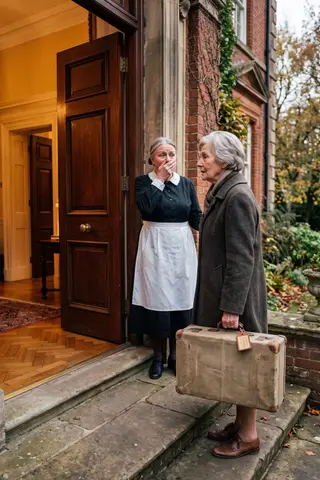
A thin, elegant woman with silver hair pulled into a severe, perfect chignon stood in the foyer. She wore a sharply tailored navy skirt and a white silk blouse with a cameo brooch pinned precisely at the collar. She looked down at my worn canvas suitcase—its frayed seams and cheap gray fabric looking like an insult against the gleaming parquet floor—and then slowly lifted her eyes to my face. The leather-bound ledger and the sheaf of paperwork in her hand dropped straight out of her grip, scattering white sheets across the welcome mat like fallen petals.
"Miss Eleanor?" she whispered, her voice cracking with a disbelief so profound it sounded like physical pain.
It was Clara. Clara, who had been the parlor maid when I was sixteen, the girl who had snuck me an extra wool blanket and a flask of hot tea through the pantry door the night I was banished into the dark. Now, she was the head administrator of the Sterling Trust, her hair silver, her posture still as straight as a ramrod.
"He's been waiting for you," Clara said, tears spilling over her lower lids and cutting tracks through the powder on her cheeks. "Your father passed away twenty years ago, Miss Eleanor. But his younger brother—your Uncle Jonathan—refused to close this house, refused to sell the land, and refused to let anyone else sit at the head of the table. He spent half his fortune hiring private investigators across three states, praying someone in elder care or hospital intake might catch your name and bring you home. He’s bedridden now, Eleanor—his lungs are full of fluid and his heart is failing—but his mind is as sharp as a butcher's knife."
Before I could process the words, before I could even draw a full breath of the familiar furniture polish and beeswax that filled the grand hallway, Clara caught my elbow with a hand that trembled violently and pulled me across the threshold. The heavy door clicked shut behind us, locking out the twentieth century, the split-level in the suburbs, the humming treadmill, and the cold March wind forever.
The End









