 The Seal Room
Chapter 6
No Open Lights
She knew what chlorine did. She had a certificate that said so, from a one-day pool safety course Merrick had paid for. It was heavier than air. It would lie on the water and thicken there, and the pup breathed nearer the water than she did.
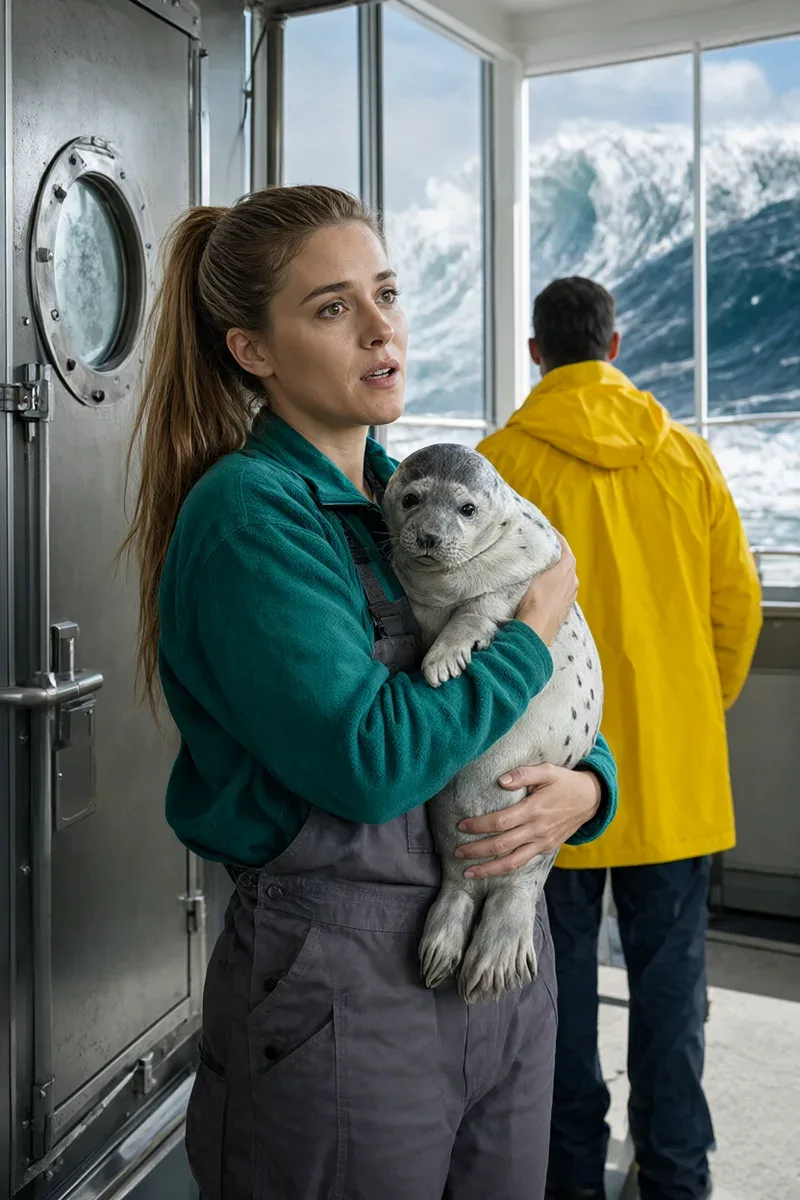
She zipped Pebble up to the nose inside the fleece, held a wet towel across her own mouth, and did things in the order she had laid them out. Headlamp. Bucket. Bottles. Her eyes were streaming by the time she had the tunnel wheel spun open.
The vault water went over the sill with her in a brown sheet and ran away down the pipe. She put her shoulder to the door, heaved it shut against the flow, and turned the wheel until it bit. The roar of the jets dropped to a mutter behind the steel.
She had shut the gas in. She had also shut herself out. There was no going back to the lights and the kettle and the tub of formula, and she had two bottles.
She leaned on the wall and coughed until her ribs hurt. The air on this side was cold and tasted of wet cement and nothing else. Pebble sneezed twice, indignantly, and pushed her head out.
“I know. Me too.”
The tunnel was a concrete pipe just wide enough for the hand truck. The old cables ran along it on iron brackets, furred with white salts. She counted her paces out loud, because the stencil on the door had given her a number, and a number could be used up.
At a hundred she passed a rusted sign: NO SMOKING. NO OPEN LIGHTS. At a hundred and sixty the water that had come through the door with her was still running beside her boots, keeping pace, and she noticed for the first time that she was walking very slightly downhill.
She thought about what stood at the far end. Two padlocks and a man in a yellow jacket. She had no plan for him. She had a bucket and a seal. But a hut beside a road was a place other people might pass, and the vault was not, and that was the whole of her reasoning.
At two hundred and ten paces the tunnel shook again. Grit rattled on her shoulders. She stood with one hand on a cable bracket until it stopped, and Pebble made the small grumbling noise she made when a bottle was late.
“Soon,” Wynter said.
At two hundred and seventy the floor tilted down more steeply and her boots went into water.
It was not the water from the vault. That thin stream ran past her and joined something much bigger, black and perfectly still. On the wall was a steel box marked SUMP PUMP, with a dead green lamp. The pump had kept this low place dry for sixty years on shore power, and shore power had ended at 9:40 that morning.
She waded in to her knees and raised the headlamp.
The tunnel went on down, and the water did not. It lay flat, and the curved roof came down toward it like a lid closing, until forty feet ahead there was only a dark crescent of air between the two, no deeper than a soup bowl. Past that the beam showed concrete and water, and then it showed nothing.
She could not tell how long it stayed that way. It might be ten feet. It might be a hundred.
Behind her was a door she could not open again. In her pockets were two bottles, and after those there was nothing. Pebble had gone quiet and was staring at the water with her whole body.
The End