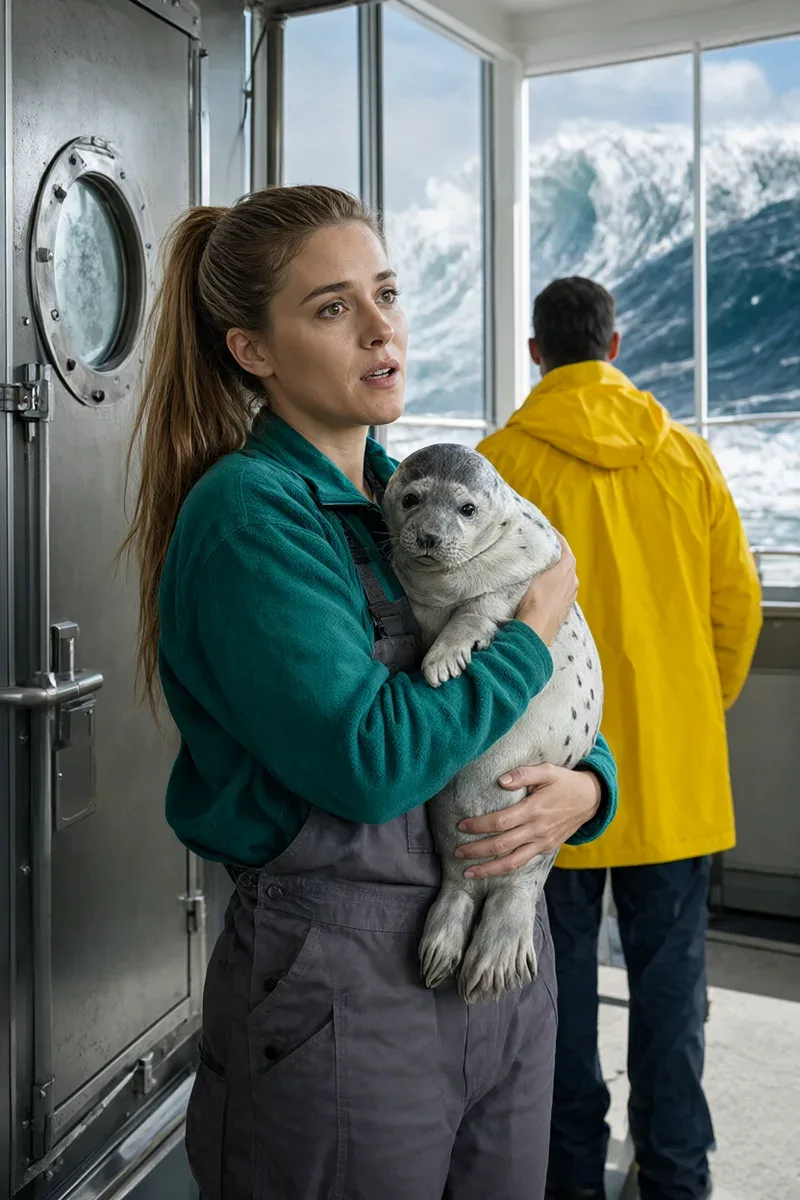
 The Seal Room
Chapter 4
The Brass Plate
At 11:40 by her phone the ground moved again, a short, hard aftershock that knocked the kettle into the sink. When it stopped there was a new sound in the room.
One of the plugs in the seaward wall had let go. The Navy had packed those holes around the cables with tarred rope sixty years ago, and now a jet of seawater as thick as her thumb was shooting from one of them, flat and hard, halfway across the floor.
She tried a towel. The jet took the towel out of her hands.
Within ten minutes the floor was awash to the ankles of her boots. She took the grease pencil from the clipboard and drew a line on the wall at the water's edge, and wrote the time beside it, the way she charted a pup's weight.
Her ears kept clicking. It took her a while to work out why. The vent pipe in the ceiling had a float valve that had shut when the sea went over it, so the room was closed like a jar, and every gallon that came in squeezed the air already there. That air would be pushing back at the leak. It would not push hard enough.
Air to breathe was not the problem yet. One woman and one small seal could last a day and more on what this room held. The problem was bolted to the battery rack, on a brass plate older than she was.
WARNING. SALT WATER IN BATTERY WELL PRODUCES CHLORINE GAS. EVACUATE COMPARTMENT.
The batteries stood on a plinth as high as her knee. At noon her second pencil line was a hand's width above the first.
So she got ready. The fish bucket under the sink was the kind the center used for herring, five gallons, with a screw lid and a rubber gasket. Into it went the binder, the brown envelope, the eleven tags knotted in a glove, and Pebble's shipping label, peeled out of its sleeve. She boiled the kettle while there was still power to boil it, mixed two bottles and put one in each fleece pocket.
Then she opened the tunnel door, just to know that she could. The wheel turned under one hand. Somebody had oiled it. Beyond the sill the headlamp showed a concrete pipe seven feet high running away into the dark, cable racks down one side, the tracks of the hand truck's tires in the dust, and air so cold it felt clean.
She shut it again. The waves were still coming every half hour, and she did not know what stood at the other end. A hut on a bluff ninety feet up ought to be dry. Ought was the word she kept getting stuck on.
On the wall by the tunnel door a black handset hung on a hook, heavy as a wrench, with a small crank on the box beneath it and a plate that read HUT. She had seen one like it in the maritime museum at Westport. Sound-powered, the card there had said: no batteries, only a wire and a voice.
She turned the crank and listened. There was a hollow hiss, like a shell held to the ear. She said hello into it four times and hung it up.
Pebble had woken and was looking over the zip of the fleece at the jet, her nostrils opening and closing.
“Half an hour,” Wynter told her. “We watch one more go over, and then we walk.”
The last pencil line said 12:20 when the box on the wall growled.
It was a dry, grinding rattle, and it took her a second to place it. It was the noise the crank made. Somebody at the other end of six hundred and forty yards of wire was turning the handle.
The End