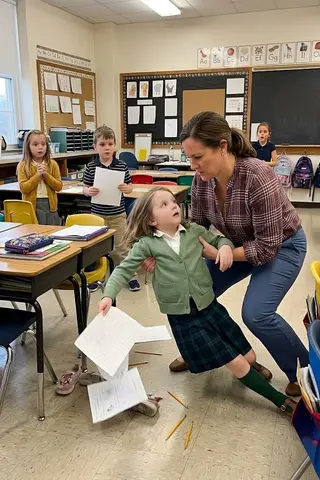
 The Quiet Second Grader Fainted in Class
Chapter 4
The Principal’s Office and the Protocol
The administrative conference room smelled of stale coffee, old paper files, and industrial carpet cleaner. Principal Thomas, a tall, silver-haired man whose normally warm demeanor had hardened into a steely, professional mask of bureaucratic focus, sat at the head of the scarred mahogany table. Across from him sat Mrs. Henderson, the school social worker and counselor, while Valerie sat slightly apart, her hands clasped tightly in her lap. Lila was resting in the adjacent resting room under the direct supervision of Mrs. Gable, wrapped in a warm fleece blanket and quietly sipping a paper cup of lukewarm apple juice.
“The caseworker from county protective services is twenty minutes away,” Principal Thomas said, his voice low and measured as he tapped a pen against the polished wooden tabletop. “They’ve pulled the initial family file based on our report. Arthur Mercer—Lila’s father—is a local contractor, self-employed, working out of a workshop behind their suburban split-level on Maple Ridge Lane. According to our emergency contact records, Lila lives alone with him. Her mother passed away when she was three years old. There are no local extended family members listed on file.”
Valerie felt a cold shiver trace down her spine. A single father, isolated in a suburban house, working construction, with absolute, unchecked authority over a fragile, silent seven-year-old child. The homemade brace details that Lila had whispered in the nurse’s office echoed in Valerie’s mind with terrifying clarity. It wasn't just physical abuse disguised as discipline; it had the chilling hallmarks of calculated concealment, of an authoritarian adult trying to mold and hide something on the child’s body before anyone outside could ask questions.
“When I examined her cardigan briefly while helping the nurse adjust her seating,” Valerie interjected quietly, her voice steady despite the nausea churning in her stomach, “there was a rigid horizontal ridge across her abdomen. It wasn't soft. It felt like flat timber or heavy plastic banding. When she tried to bend, the edges dug directly into her soft tissue. That’s why she was fainting—her blood pressure plummeted from systemic pain, shallow breathing, and restricted diaphragm movement.”
Mrs. Henderson nodded grimly, jotting notes down in a crisp yellow legal pad. “This matches classic patterns of severe control-based domestic isolation and physical maltreatment under the rationalization of 'home therapy' or punishment. Perpetrators often use pseudo-medical justifications to excuse extreme physical interventions, convincing the child that the pain is necessary, good, or deserved so that the child internalizes the guilt and refuses to speak out.”
“And that’s precisely why she was so terrified to tell us,” Valerie added, her chest tightening with sorrow. “She thought she was doing something wrong by moving. She thought the pain was her own failure to be 'straight' enough.”
The heavy frosted-glass door of the main office clicked open, followed by the soft, purposeful footsteps of a newcomer. A woman in a sharp navy blazer carrying a heavy leather briefcase stepped into the conference room. It was Detective Sarah Jenkins of the county juvenile division, accompanied by juvenile intake officer Marcus Vance. They hadn't waited for the standard social worker protocol; once the words homemade brace and forced physical binding had been transmitted through the secure school-police liaison channel, local law enforcement had immediately elevated the response level to an active emergency welfare intervention and potential felony child endangerment investigation.
Detective Jenkins didn’t waste time with pleasantries. She placed her briefcase on the table, flipped open the brass latches, and looked directly at Principal Thomas and Valerie. “We have enough probable cause based on the preliminary nurse logs and teacher statements to execute an immediate emergency protective custody hold. More importantly, we need to move quickly before school dismisses, because if Arthur Mercer senses that we’re asking questions or that Lila has spoken, he could pack up, flee the jurisdiction, or destroy evidence in that workshop. Principal Thomas, I need you to pull Lila’s complete enrollment file, medical waivers, and home address history right now. Valerie, I need you to write down every exact word Lila said to you in chronological order, verbatim if possible.”
The room shifted into hyper-drive efficiency. The theoretical horror of what had happened to Lila was suddenly intercepted by the cold, hard mechanics of the law, but Valerie’s mind remained anchored on the little girl sitting just through the door, drinking apple juice and wondering if her whole world was about to explode into chaos.
The End









