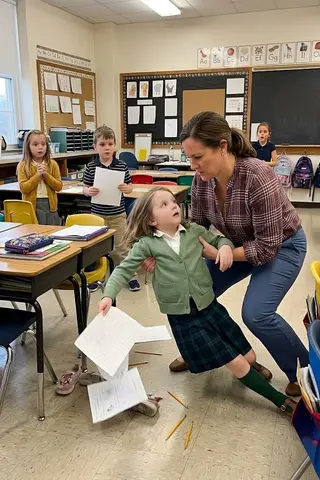
 The Quiet Second Grader Fainted in Class
Chapter 1
The Weight of Seven Years
The fluorescent lights of Room 204 hummed with a low, steady vibration that seemed to match the quiet anxiety radiating from the third row. It was a gray Thursday morning in October, the kind of day that settled over western Pennsylvania like a wet wool blanket, making the windows fog and the classroom feel entirely isolated from the rest of the world. Second graders scraped their plastic chairs across the checkered linoleum floor, clicking mechanical pencils, shuffling composition notebooks, and settling into the familiar, predictable rhythm of a morning math lesson. Ms. Valerie Kincaid stood at the front of the room, holding a stack of freshly printed worksheets, her eyes scanning the sea of small heads.
She wasn’t looking for trouble. She wasn’t looking for anything out of the ordinary at all. But then her gaze snagged on seven-year-old Lila Mercer. It wasn’t because Lila was making noise or drawing attention to herself. On the contrary, Lila caught Valerie’s eye precisely because she was working with every ounce of her small, fragile frame not to make any noise at all. Lila sat in her designated seat by the tall, drafty windows, her pale blue cardigan buttoned with meticulous, almost obsessive neatness, her hands folded flat and motionless on the laminate desktop whenever the classroom rules required stillness. She was the kind of child that inexperienced teachers praised as effortlessly well-behaved—the girl who never interrupted, never grabbed for crayons, never raised her voice, and never demanded an ounce of extra attention.
Valerie, however, had been teaching long enough to recognize the profound, heavy chasm between a child who was naturally quiet and a child who was actively, painfully careful. And Lila was profoundly, heartbreakingly careful. Valerie watched as the little girl shifted her weight in her chair once, then a second time, a microscopic movement that triggered a visible wince. Her small shoulders tightened rigidly toward her ears. Her knees pressed together beneath the desk with such force that her legs trembled. Every single time Lila made even the most minor adjustment, her face contorted for half a second—a micro-expression of pure, unadulterated agony—before she deliberately, mechanically forced her features back into a smooth, placid mask. This wasn’t ordinary second-grade fidgeting, the kind born of too much sugar or too little sleep. It looked, with terrifying clarity, as though every single position, every breath, and every heartbeat hurt.
Valerie checked the wall clock. It was 8:17 a.m. She looked back down at her attendance clipboard and marked Lila present, her red pen hovering over the square for a second longer than necessary. At 8:42, the class bent collectively over their math worksheets, the scratching of graphite filling the air. By 8:56, the faster students began marching up to the front to turn their papers in. Lila stayed in her seat, waiting until the very last possible moment, letting everyone else go first so she wouldn’t have to navigate the crowded aisle while other children were bumping past her chairs. When she finally stood up, she did something that made Valerie’s stomach tie itself into a cold, hard knot. Lila pressed both palms firmly against the edge of her wooden desk, locked her arms straight, and held her entire body weight up with her upper torso for three full seconds before she dared to take a single step.
Lila began to walk toward the teacher's desk. One foot. Pause. A micro-adjustment of her hips. Then the other foot. Pause. Around her, the chaotic, beautiful ecosystem of a second-grade classroom kept spinning on its axis. A boy in the front row whispered loudly about a wiggly tooth. Two girls near the reading corner quietly traded neon crayons. A stray yellow pencil rolled off the edge of a desktop, tapped sharply against the cold tile floor, and rolled to a stop against a metal chair leg. Not a single other person in the room seemed to notice the little girl who was meticulously measuring and agonizing over every single inch of distance she crossed.
“Lila, are you feeling okay this morning?” Valerie asked, keeping her tone light, casual, and entirely devoid of panic so as not to draw the collective gaze of twenty other children.
Lila stopped dead in her tracks. She looked up, and for a fleeting, terrifying split second, something deeply frightened crossed her features—a look far too old, too heavy, and too desperate for a seven-year-old child. Then, just as quickly as it had appeared, it vanished beneath a thin, practiced, heartbreakingly fragile smile.
“I’m fine, Ms. Kincaid,” Lila whispered, her voice breathy and thin. “I just need to focus on sitting up straight.”
The answer hit Valerie’s ears with a hollow, discordant thud. It sounded entirely too rehearsed, too polished, and far too practiced for a seven-year-old giving an impromptu excuse to a teacher. Valerie had heard children lie about every conceivable childhood infraction: they lied about stolen homework, playground shoving matches, missing pink erasers, and who started a petty argument at the water fountain. This was completely, fundamentally different. This sounded like a script. This sounded like something an adult had drilled into a little girl’s head, giving her specific words to deploy whenever someone asked too many questions about her physical state.
Valerie opened her mouth, intending to press further, to ask a different kind of question, to dig beneath the polished veneer of that defensive little smile. But she never got the chance. The sudden, drained color bled entirely out of Lila’s face, leaving her skin the gray-white of skim milk. Her lips parted in a silent, startled gasp. The math worksheets slipped from her nerveless fingers, fluttering like wounded birds before scattering across the linoleum tile. And then, completely and without warning, her knees simply gave way beneath her.
The End









