 The Quiet Second Grader Fainted in Class
Chapter 2
The Sound That Broke the Silence
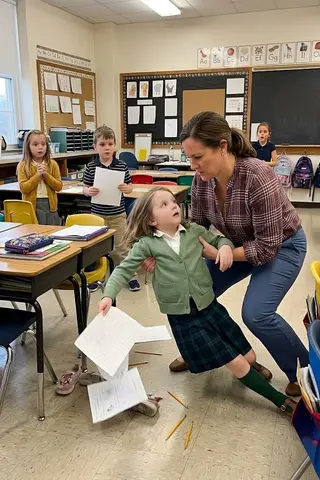
Valerie lunged forward with the desperate, instinctive speed of a mother protecting her own child, her shoes sliding slightly on the smooth classroom floor as she reached out and caught Lila under the arms just a fraction of a second before the little girl’s head could connect with the hard tile. The entire room froze instantly. The ambient noise of Room 204 vanished as if someone had flipped an invisible master switch. Twenty pairs of wide, unblinking eyes turned toward the front of the room. One child still held his crumpled worksheet frozen in both hands halfway through the air. Another little boy was awkwardly twisted halfway out of his molded plastic chair, his mouth hanging open. The boy with the loose tooth unconsciously pressed two fingers hard against his gums to stop his own breathing, while the stray yellow pencil beneath the reading table continued its slow, lonely roll until it gently kissed a chair leg and came to a dead stop.
“Please call the nurse right now,” Valerie instructed the classroom aide, keeping her voice carefully level, measured, and quiet. She knew how easily young children panicked; if their teacher sounded terrified, the room would dissolve into mass hysteria. But beneath her calm exterior, Valerie’s jaw was clenched so tightly that her back molars ached with a sharp, blinding throbbing sensation.
By 9:03 a.m., Lila was lying quietly on the narrow, vinyl-covered examination cot in the back corner of the school nurse’s office. The small room was perpetually saturated with the faint, clinical, sterile odor of antiseptic wipes and rubbing alcohol. Beneath Lila’s small frame, the thin protective paper sheet crinkled loudly every time she shifted even a fraction of an inch. A cold, black nylon blood pressure cuff was wrapped snugly around one of her impossibly thin, fragile arms while the school nurse, a no-nonsense woman named Mrs. Gable with graying hair pinned in a tight bun, checked the digital monitor screen and systematically scribbled notes into the official health office logbook with a black ballpoint pen.
“Her blood pressure is running a bit on the low side,” Mrs. Gable murmured, not looking up from her charts as the digital machine beeped softly. “It’s probably just mild dehydration. Kids this age forget to drink water when they get wrapped up in their morning routines, and with this chilly morning air, they don't feel thirsty.”
It was a completely reasonable, logical, textbook explanation. Valerie desperately wanted to believe it. She wanted to nod, accept the medical rationale, and walk back to her classroom to teach fractions. But then her eyes dropped down to Lila’s hands, and every instinct she possessed screamed that something was profoundly, horrifically wrong.
Lila’s small, pale fingers were gripping the edge of the stiff institutional blanket so tightly that her knuckles had turned completely bloodless and white, translucent against her skin. Furthermore, her pale blue cardigan—which had looked neat from a distance—was buttoned entirely wrong upon closer inspection. At the very bottom, one button had completely skipped its designated hole, leaving the hem skewed and twisted. Another button higher up pulled awkwardly and strangely across her middle, distorting the knit fabric, and a faint, rigid crease ran horizontally through the wool right across her stomach, as though something stiff, flat, and entirely unnatural had been tightly strapped or pressed against her torso beneath the layers of clothing.
Valerie glanced around the nurse’s office, taking in the entirely ordinary paperwork scattered across the desk: the yellow attendance sheet she had marked twenty minutes ago, the crumpled math worksheet with its neat handwriting, the nurse’s mundane health log filled with entries about mild tummy aches and playground scrapes. They were ordinary records of an ordinary Thursday in an ordinary American elementary school. But looking at them now, sitting in the antiseptic silence of the clinic, nothing about Lila Mercer felt ordinary anymore. The entire world had shifted on its axis in the span of ten minutes.
Valerie dragged a heavy metal folding chair across the floor, scraping it softly, and sat directly beside the examination cot. She leaned in close, keeping her voice as soft as a falling leaf.
“Lila, sweetheart, can you look at me and tell me what actually hurts?”
The little girl stared blankly up at the off-white acoustic ceiling tiles, her eyes glassy and distant. Her breathing was shallow, catching in her chest with tiny, shuddering hitches. For several long, agonizing seconds, she didn’t make a single sound, as if she were debating whether the air in her lungs belonged to her or someone else. Then, very slowly, as if her neck were made of dry glass, she turned her pale face toward her teacher.
“My dad said it wouldn’t hurt, but it does,” Lila whispered.
The nurse’s pen stopped dead against the paper. The scratching sound ceased instantly. In that single, frozen fraction of a second, Valerie felt the entire meaning of the morning transform into something dark, jagged, and terrifying. Lila hadn’t simply come to school feeling sick from a lack of water. Something had happened inside her house before the sun even came up that morning. And whatever it was, the seven-year-old child sitting on that cot wasn't just sick—she was utterly, paralyzingly terrified to explain the truth.
The End









