 The Quarantine Kennel
Chapter 8
Live at Seven
It took her eleven minutes to get down the tailings slope, and nobody looked up it once. Why would they? The fire was the other way.
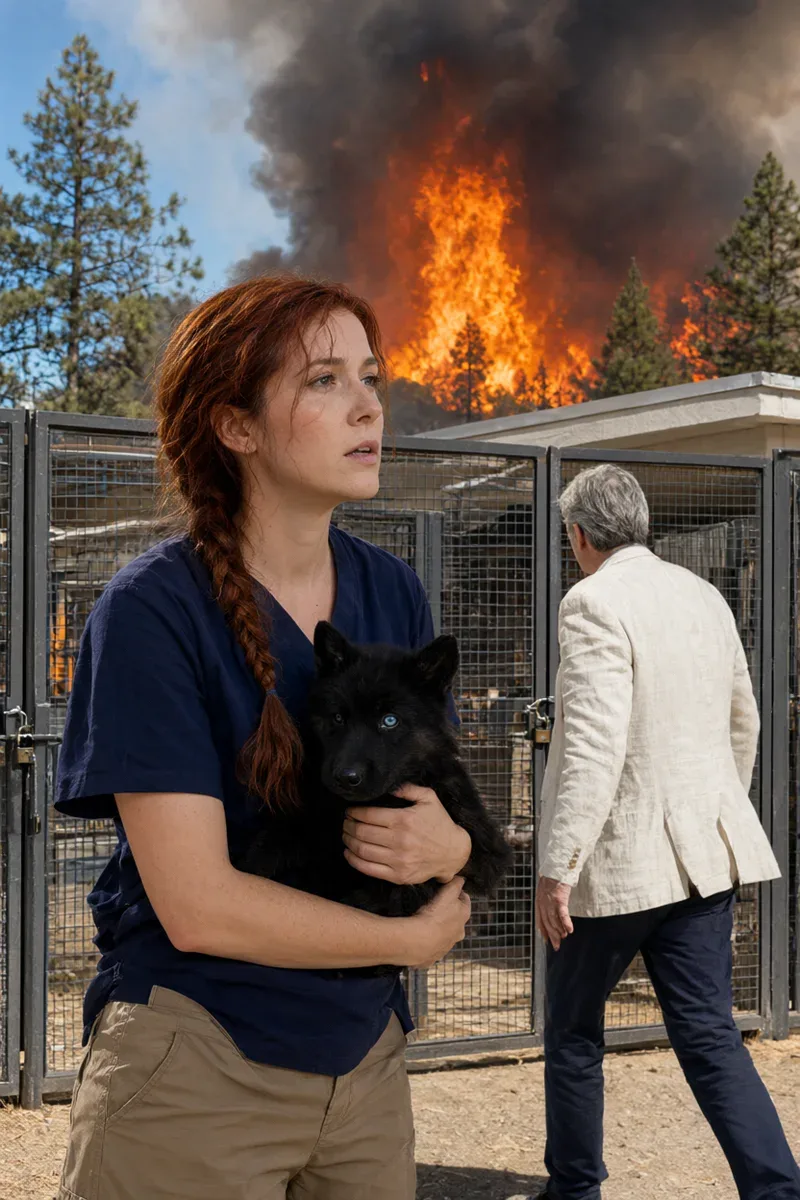
Her auburn braid was grey with ash and stiff with mine water. Her navy scrub top was torn at the elbow and her khaki work pants were black to the knee. She had a cat carrier in one fist and a wolf pup on a length of crate cord, and on her left, as far from the smell of people as the slip lead allowed, walked his mother.
She heard him before she could see his face. Thatcher had always known how to make his voice carry without seeming to raise it.
“She was twenty-six years old. She had been with us three years, and she was the best of us.” He stopped, and let them watch him stop. “When the order came, I counted heads at the bus myself. Liesel was gone. She had gone back for a wolf pup we were holding in quarantine. I went after her. I got as far as the kennel road, and the fire was already in the trees, and I called her name until my own staff pulled me away.”
A reporter asked something Liesel could not hear.
“No. Nothing. We lost Liesel, we lost the pup, and we lost every record in that building. Which is why this morning I am announcing the Liesel Stenmark Memorial Fund, and I have asked our donors to give as generously as she did.”
She kept walking. Sagebrush gave way to gravel. A man in headphones at the back of a satellite truck did not turn around.
A woman stood just off camera with her arms folded. She was forty-something, with black hair in a low knot and a grey windbreaker with gold letters on the chest. Liesel had met her once, five weeks ago, across the steel table where they had scanned a starved black pup for a microchip he did not have. Special Agent Sigrid Dufresne. She was listening to Thatcher the way people listen when they are taking something down.
And at the end of the row of engines was one whose green paint had blistered brown along its whole right side. The glass on that side was crazed white. A man sat on its back bumper with his elbows on his knees. His helmet was off, and his hair was her own auburn, cut short. Both his hands were wrapped in gauze to the wrists. He was not watching the cameras. He was looking at the gravel between his boots.
Soren.
All the arithmetic she had done for him in the dark went out of her head. She stopped walking.
It was Dime who settled it. After sixteen hours underground he smelled people and fried food, and he put his head back and howled, a cracked half-grown howl that went up over the whole flat.
Her brother's head came up.
He did not shout. He got to his feet as if somebody had hauled him up by the collar, and his mouth opened, and nothing came out. The cameraman nearest him looked to see what he was looking at. Then that camera came around, and the one beside it, and the lights swung off Thatcher Rookwood and found her instead.
Thatcher stopped in the middle of a word.
She had wondered, underground, what his face would do. At first it did nothing. It was a donor's face, tanned and pleasant, waiting to be told which expression was wanted. Then he saw the big wolf on her left, and the pale blue eye, and whatever had been running behind the face went out like a pilot light.
Nobody on the flat was speaking. She could hear the generators on the trucks.
“Thatcher,” Liesel said. This time her voice had no trouble carrying. “Tell them about Thursday.”
The End