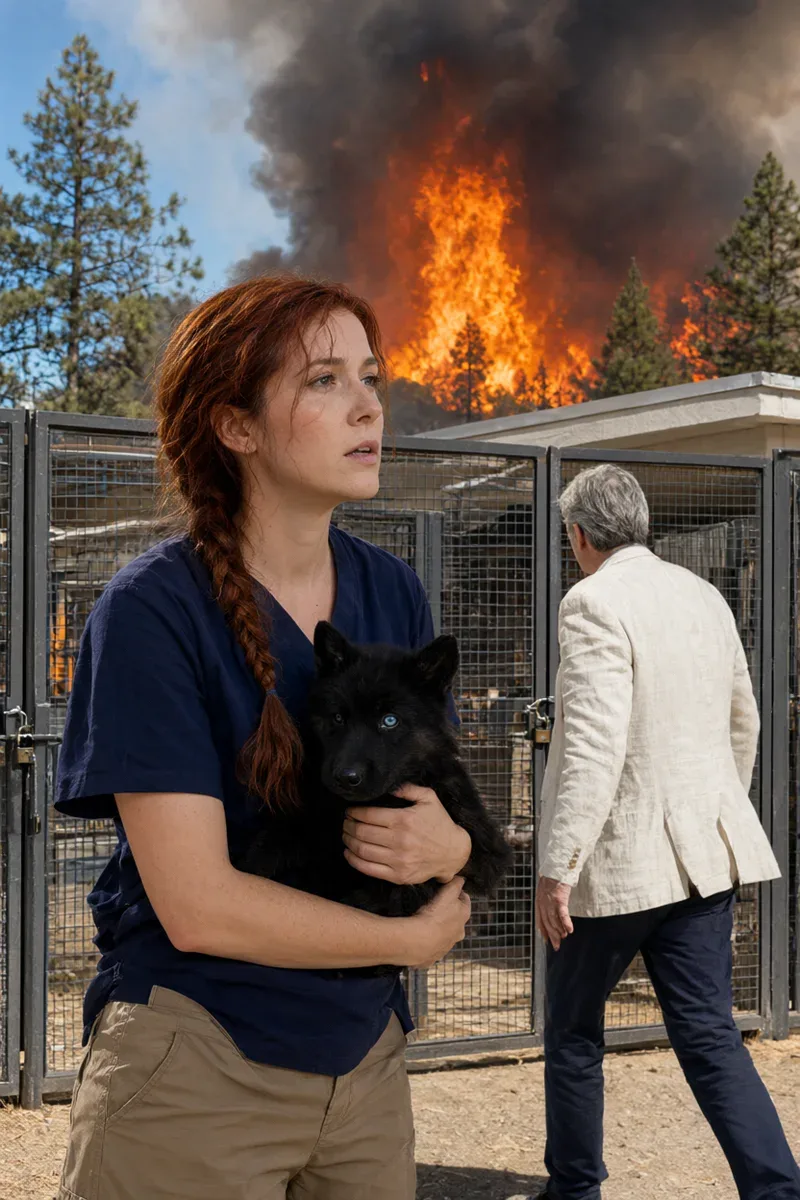
 The Quarantine Kennel
Chapter 1
The Evacuation Sheet
At 2:40 on the afternoon of the donor luncheon, the Tindall Fire jumped the river. By 2:55 it had the foot of Anvil Ridge, and the wind was driving it uphill at the sanctuary faster than a person could run.
Liesel Stenmark was twenty-six and had worked there three years. She was on the step of the staff bus, auburn braid stuck to her neck, navy scrub top grey with ash, when she counted crates in her head and came up one short.
Dime.
Six months old, black, thirty-eight pounds, one eye pale blue and the other amber. Seized five weeks ago from a breeder outside Elko, he was the only living evidence in a federal case. He was in the quarantine kennel at the far edge of the property, and the evacuation sheet, which Thatcher Rookwood had drawn up himself, did not list quarantine.
She ran back against everyone coming down. Above the pines the fire stood up like a wall, orange at its foot and black to the top of the sky.
The kennel was a steel-mesh run on a concrete slab, roofed in the same mesh. Dime was pressed into the back corner on his straw. She got him up in her arms and turned around.
Thatcher Rookwood stood in the gateway. He was fifty-five, silver-haired and tanned, in the cream linen suit he wore for donors, without a mark on it. She thought, stupidly, that he had come to help.
He swung the gate shut. He put a brass padlock through the hasp and snapped it, and tugged it once, the way a man checks a car door.
“Thatcher.” Her voice came out small. “What are you doing?”
“Thursday was never going to work for me, Liesel,” he said, and walked off toward the white SUV on the service road, not hurrying.
She screamed until her throat tore. The mesh did not even ring.
A green Forest Service fire truck came down the ridge road, the last vehicle out, and stopped at the bend with its nose to the perimeter fence, forty yards off. Her brother got out.
Soren was thirty-three and a crew boss, his yellow shirt black with soot. He ran to the fence and she watched him see all of it: her, the gate, the padlock. His hand went toward the compartment where the bolt cutters were.
The radio on his chest was shouting. She caught pieces. Spot fire across the road below the second switchback. Two minutes, Stenmark, maybe. Behind the windshield, six faces were looking at him.
He looked at the truck. He looked at her. He tore something off his pack and threw it over the fence, and it landed in the dirt ten feet short of the mesh.
“I'm sorry,” her brother said. She could not hear it. She read it off his mouth.
Then he got in and drove, and the red eye of the dash camera went with him down the hill.
The heat arrived before the flames. Liesel sat down against the gate, because her legs gave.
Dime was not beside her. He was in his back corner, digging. His claws rang on something that was not concrete.
She crawled over. Under the straw lay a square iron plate, scabbed orange with rust. For three years she had hosed around it and taken it for a drain cover. The pup had his nose jammed against its edge, whining, and the chaff along the crack was sliding down into it. Air was going somewhere.
She got the blade of the floor scraper under the lip and leaned on it. The plate did not grind. It rose easily, on hinges somebody had greased.
Cold came up into her face. Below her a ladder went down into the rock, and at the bottom, where there should have been nothing but dark, a string of work lights was burning.
The End