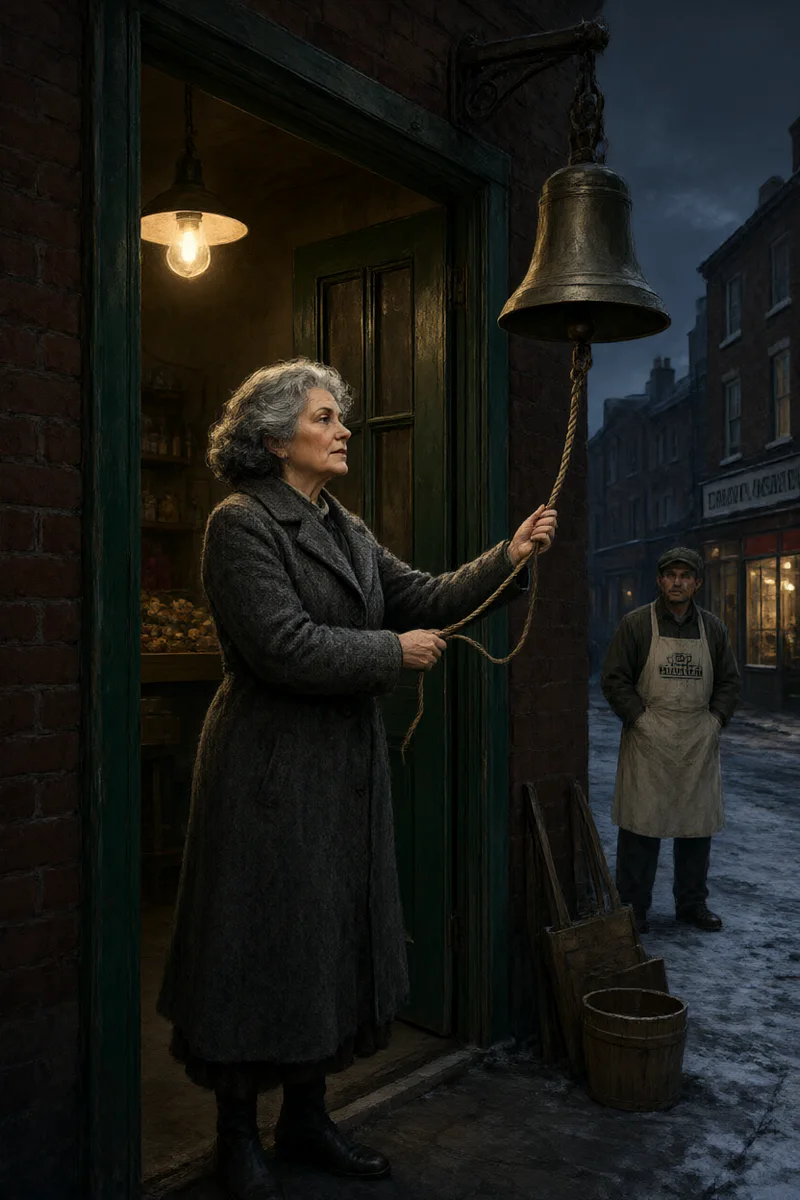
 The Firehouse Bell
Chapter 1
Bologna on Wednesdays
Every Wednesday at noon for the past twelve years, Hazel Penrose had eaten a bologna sandwich standing at the deli counter of Tibbet's Market, and every Wednesday Teddy Tibbet had sliced it for her himself and refused to let her pay. The election did not change that. If anything, people came in on Wednesdays now to watch.
“Your water plan,” Teddy said, laying the slices on white bread with the flat of the knife, “would cost this town forty thousand dollars a year it hasn't got.”
“Your water plan,” Hazel said, “would sell the pipes our grandparents dug to a company in Ohio that's never heard of us.”
“They've heard of us. They've seen our pipes.” He added mustard, too much, the way she liked it. “That's why they're offering so little.”
Behind her, two of the Ritter brothers laughed into their coffee. Teddy winked at them. He had been mayor of Ludlow Gap for three terms. He had been Hazel's friend since the first day of first grade, when she'd punched a boy named Lonnie Huff for taking his lunch, and he had been best man at her wedding and a pallbearer for her husband, Clay, six years ago. He had a round, mild face and a grocer's apron and ran the town the way he ran the store, on credit and handshakes.
Hazel had retired from the post office in March after thirty-four years. She had been the person who knew where everyone in Ludlow Gap lived, and who was behind on what, and whose son in the Navy had stopped writing. She had not meant to run for anything. Then the water company's letter came through her old window, and she read the offer, and she found she couldn't let it go.
Her campaign was a card table in the old feed store and her son-in-law, Dustin Mayhew, who was twenty-nine and had read a great many articles on the internet about elections.
“We need to go harder,” Dustin said that night, at the card table. “We're down. I can feel it. He's got the old-timers and he's got the deli.”
“We're not going harder,” Hazel said. “It's six hundred people, Dustin. I'll be seeing every one of them in the checkout line for the rest of my life.”
The election was Tuesday. On Thursday morning she went out to get the county paper off the porch, and it was lying on top of a sheet of white paper folded in thirds.
It was a photocopy of an old newspaper page, gone soft and gray in the copying. The headline across the top said LOCAL YOUTH SENTENCED IN DEATH OF CANE VALLEY GIRL. There was a photograph of a skinny boy in a borrowed suit with his hair slicked down, and she knew him at once.
Under it, someone had typed: DO YOU WANT A MAN WHO KILLED A SIXTEEN-YEAR-OLD GIRL RUNNING YOUR WATER? Paid for by Concerned Citizens of Ludlow Gap.
In 1981 she had been nineteen and a private first class at a supply depot in West Germany. Her mother's letters that year had said that Teddy Tibbet had gotten into some trouble with the law and gone away for a while. She had come home in 1984 and he was back behind his father's counter, and nobody ever said another word about it, and she had never asked. That was how Ludlow Gap did things.
She read the article through. Sharon Ellery, sixteen, of Cane Valley, struck on Route 7 at Shiloh Bend while changing a tire. Theodore Tibbet, nineteen, pleaded guilty to reckless homicide. Fourteen months.
Up and down Sycamore Street, she could see the white sheets on every porch.
Then she read the last paragraph, and the porch step seemed to tip under her.
The vehicle, a 1974 pickup truck, was registered to Wade Penrose, 21, of Ludlow Gap.
The End









