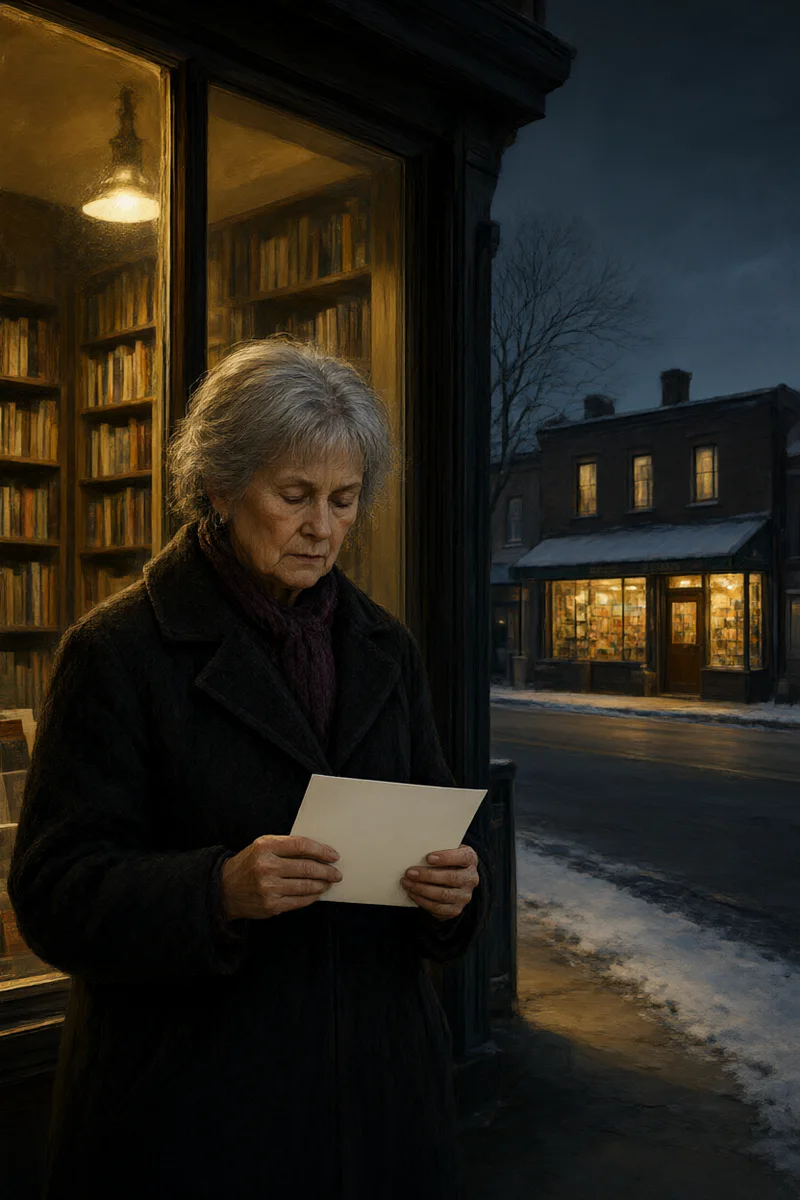
 A Friend
Chapter 3
The Ledger
She did not sit. She opened the ledger standing at his counter, with her coat on.
It was ruled in columns and filled in by several different hands. A date, a name, an amount. The first page was headed BOOKSTORE in Gus's square capitals, and under that, January, six years gone.
She had expected a handful of names at most. There were thirty-one on the first page.
W. Sato, $25. Rucker's Diner, $30. Tremblay, $40. Pastor Lindahl, $20. H. Finch, $50. Fire Dept. boot, $61.50. Mrs. Okafor, $10.
Ada stopped at that one. Mrs. Okafor cleaned rooms at the motel on the highway. Two winters ago she had asked whether she might take a cookbook and pay at the end of the month, and Ada had said, pleasantly, that she didn't run accounts.
She turned pages. The names came round month after month. Some dropped out and others came in. The shop teacher, until the high school closed. Dr. Aziz. The Legion post. A line that said only “jar at diner, $17.26.” At the foot of each page was a total in pencil, and beside it, most months, a second figure. “Short $55, G.T.” “Short $80, G.T.”
So forty dollars was not all of it. She did not look at him.
Halfway through, H. Finch's fifty dollars changed handwriting. It went on in a small careful script: “H. Finch (for Harold).” Harold Finch had died the spring before last. Ada had sent a card from the rack by her own register.
Mrs. Finch stood six feet away with her bag of washers. “He liked knowing it was there,” she said. “He read every western you ever stocked. I didn't see a reason to stop.”
“Why didn't anybody tell me?” Ada's voice was not carrying now.
They glanced at each other, the way a class does when the teacher asks who broke it.
“Well,” Dale Rucker said to his pipe. “You'd have said no.”
“You'd have given us a speech,” said Winnie Sato, who had come in at some point and was standing by the seed racks in her postal cardigan. “You're a proud woman, Ada. We like that about you, mostly.”
Mostly. Ada heard the whole six years in it. Every “How's business, Ada?” from someone who knew to the dollar how business was. Every time she had held forth at the diner about loyalty to Main Street, to a counter full of people who had put a twenty in a can that morning to keep her lights on. They had let her talk. They had gone home and, she supposed, been kind about it.
She closed the ledger and squared it on top of the can.
“Thank you,” she said. It was the gracious voice from the letters she had composed while shelving, and it sounded like a stranger's. “All of you. I had no idea. I'll see that it's returned.”
“Ada,” Gus said.
She was already at the door. The bell on his was cheaper than the bell on hers.
Back in the shop she did not take her coat off. She went down the cellar steps, moved the snow shovel and a box of unsold calendars, and reached in behind the furnace.
The paint had dried six years ago. CLOSING. EVERYTHING MUST GO. She blew the dust off it, carried it up, and propped it in the front window between the cookbooks and the local history, facing the street, where the hardware store could read it.
The End









