 A Friend
Chapter 2
The Seventy-Second Envelope
She did not sleep much. By two in the morning she had gone through six years the way you go through a drawer after a burglary.
Gus Tremblay, who had offered for her building five times. Gus, who stood in her shop every year or so pricing her ceiling with his eyes. Every month of those years he had been paying her mortgage, and every month she had cashed it and felt lucky.
She tried on reasons. He was keeping the store breathing until she was tired enough to sell. He was keeping the block from going dark, to protect his own windows. Or he was sorry for her, and that was the one she liked least. She had said buzzard into a microphone, in front of forty people, about a man who had been feeding her.
And he had stood there and let her.
For six years she had told herself Loomis Books was hanging on. She had told customers. She'd had opinions, loud ones, about people who ordered their novels off a screen. The store had not been hanging on. It had been carried, and she had been strutting about on top of it like a hen on a cart.
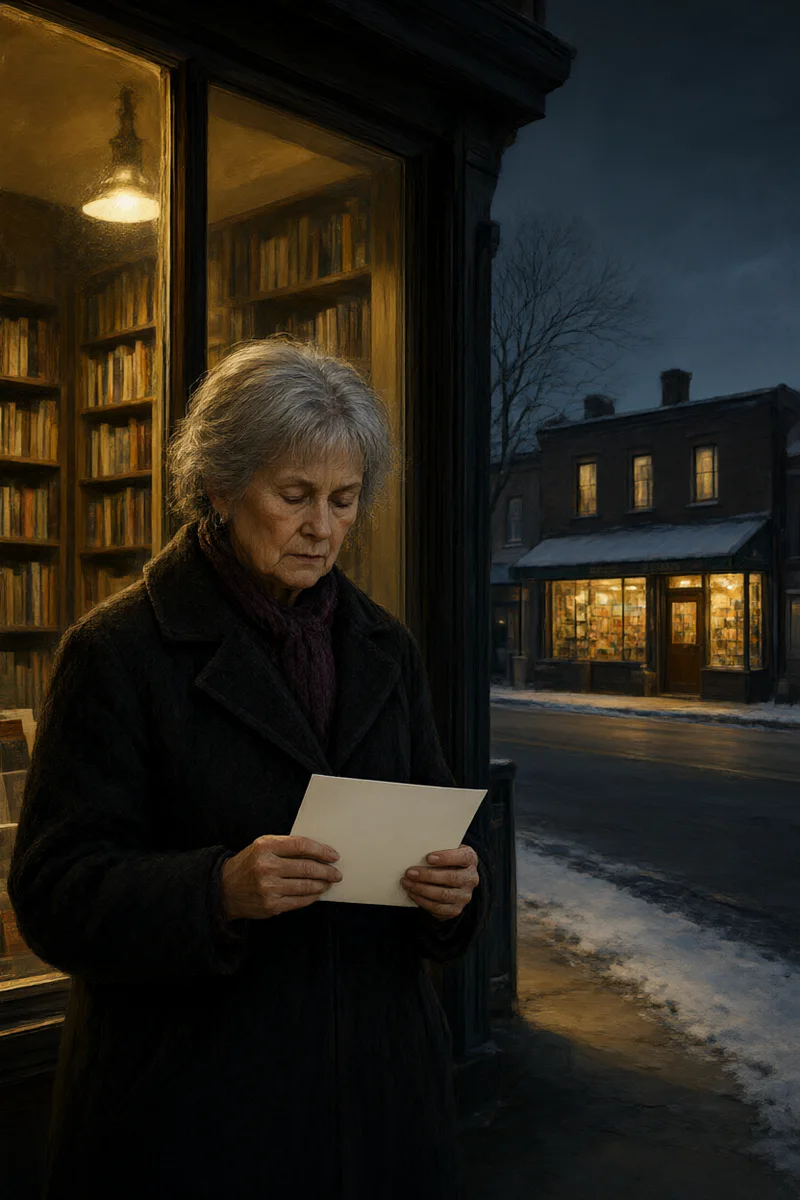
The envelope came with Saturday's mail, typed address, no return. She did not open it. She put on her coat and walked it across the street.
Tremblay Hardware smelled of cut keys and fertilizer. There were people in it: Dale Rucker from the diner with a length of pipe, old Mrs. Finch counting out washers, the Garrity girl, Posey, behind the paint counter in a store smock. Gus was at the register.
Ada laid the envelope on the rubber mat in front of him.
“Not here, Ada,” he said quietly.
“I'd say here is just right. I saw you last night. I sat in the laundromat like a fool and watched you sign it.” Her voice was carrying and she let it. “I don't know what you think you've bought. If it's my building, the answer is what it was. If it's my gratitude, you can have this one back, and I'll owe you for the other seventy-one.”
Dale Rucker had become very interested in his pipe.
“Forty-five thousand, four hundred and forty dollars,” Ada said. “I worked it out. I will pay it back if I have to sell every book and then the shelves.”
Gus took off his glasses and cleaned them on the apron. He looked tired more than anything.
“It's not my money,” he said.
“I watched you.”
“You watched me buy it. I've got the nearest thing to a safe, that's all.” He put the glasses back on. “Forty dollars a month of that is mine. Has been since the start. The rest I couldn't afford if I wanted to. You know what I clear in here.”
“Then whose is it?”
Nobody in the store was pretending to shop any longer. Mrs. Finch had her purse shut in both hands. Posey Garrity had come out from behind the paint.
Gus bent, with a grunt, and felt along the shelf under the register. He brought up a three-pound coffee can with a slot cut in its plastic lid, and set it on the counter. On top of it he laid a green ledger gone soft at the corners.
“You'd better sit down to read it,” he said. “There's a stool.”
The End









