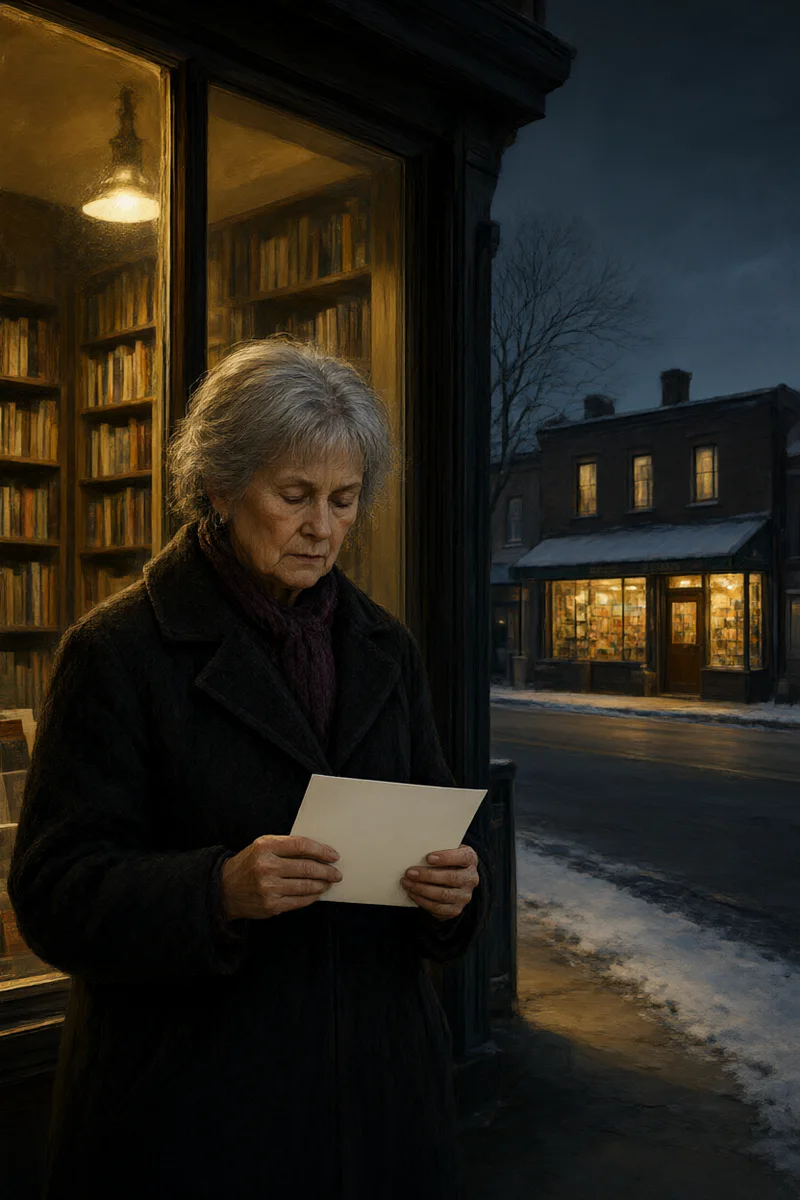
 A Friend
Chapter 1
A Friend
The envelope came on the first of every month, and for six years Ada Loomis had made a point of not wondering about it too hard.
It was always the same: plain white, her address typed, no return. Inside was a postal money order for six hundred and forty dollars, made out to Loomis Books. On the line where the purchaser signs, somebody had printed two words in block capitals. A FRIEND.
Six hundred and forty dollars was the mortgage on the building, to the dollar. The first one had arrived at the start of a January when she had already lettered a sign for the window, CLOSING, EVERYTHING MUST GO, and was waiting for the paint to dry. She had put the sign behind the furnace. She was sixty-three now and it was still there.
Pell's Crossing had lost the cannery, then the high school, then the county library branch, in that order. It had kept a diner, a hardware store, a post office and Ada. People told her the bookstore was the last nice thing on Main Street. Then they bought a birthday card and left.
She had theories about the friend. A college roommate who had married a dentist. A summer person from the lake. Somebody far off and comfortable, who would never miss it. She had composed thank-you letters to this person while shelving, quite gracious ones.
The seventy-first envelope came on the first of November, and with it, the same morning, came Gus Tremblay.
Gus owned Tremblay Hardware, across the street and two doors down. He was a wide, slow-spoken man who wore a canvas apron with a tape measure in the pocket, and he walked in without looking at a single book.
“I'll go to forty-one thousand for the building, Ada. You'd stay on. Same as I said before.”
“That's five times you've asked.”
“Roof's worse than it was the fourth time.”
“I told the whole town council in October what I think of you circling this street, Gus. I can repeat it.”
“Buzzard in an apron,” he said. “I was there.” He left, ducking under the bell.
It was the roof that did it. If she had a friend with six hundred and forty dollars a month to spare, she wanted to know whether that friend could be asked about shingles.
She tried Winnie Sato at the post office first. Winnie had been postmistress for nineteen years and could not tell a lie without rearranging her stamp drawer. “Money orders are private, Ada, that's federal,” she said, rearranging it.
So the envelopes were bought here. In town.
On the thirtieth of November, Ada closed early and sat in the laundromat across from the post office with a paperback she didn't read. She felt ridiculous. From the plastic chair by the dryers she could see Winnie's counter through the lit front window, as clear as a stage.
The pharmacist's wife came for stamps. A boy picked up a parcel. At ten to five, when the street lamps were coming on and Winnie had already turned the sign half round, a man crossed Main Street with something tucked under his arm. Winnie let him in and locked the door behind him.
Ada watched her count bills onto the counter, a thick uneven stack of them. She watched Winnie feed a form into the machine and slide it across with a pen.
The man bent to write two words on it. He took his time. When he straightened up, the light fell on a canvas apron with a tape measure in the pocket.
The End









