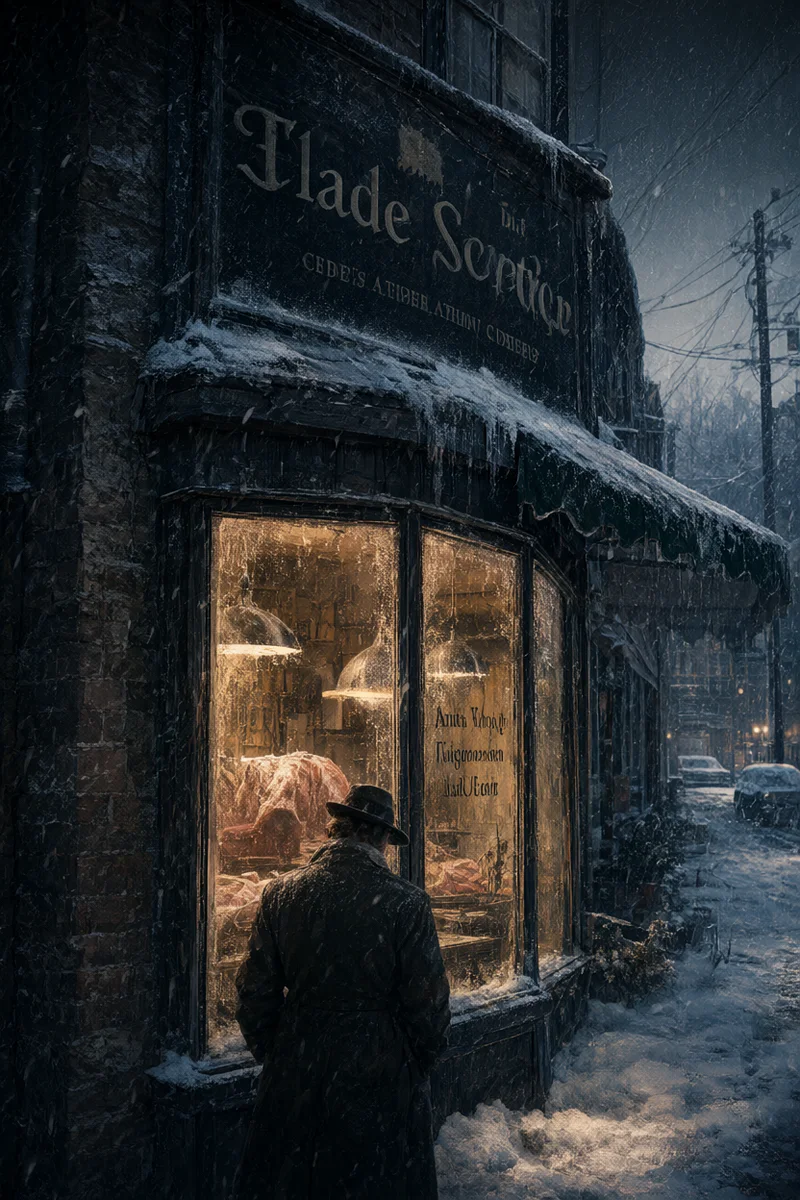
 The 38-Year Butcher Shop Secret: He Wrapped Nothing in Butcher Paper Every Christmas Eve
Chapter 4
A Father’s Lesson in Dignity
The shop door clicked shut, sealing out the winter wind, and the muffled murmur of holiday shoppers rushed back into the room. Gerald stared at his father, his chest heaving with a mixture of shock and lingering frustration.
“Are you out of your mind?” Gerald hissed, stepping past the cutting board. “That was a twelve-dollar roast! In this economy, we can’t just hand out prime cuts of beef to every stranger who walks through that door!”
Walter didn’t yell back. He didn’t even look angry. He simply walked slowly back to his station, picked up his sharpening steel, and began rhythmically sliding his favorite boning knife against it, creating a sharp, metallic hiss that cut through the noise of the shop. Shhh, shhh, shhh.
“Did you see her face, Gerald?” Walter asked softly, his eyes fixed on the gleaming steel blade.
“I saw that we just lost a day’s profit on a family we don’t even know!” Gerald retorted, crossing his arms over his chest.
Walter stopped sharpening. He laid the knife down flat on the wooden block, turned around, and planted both thick hands firmly on the counter, looking his son dead in the eye.
“Son,” Walter said, his voice dropping to a low, gravelly register that commanded absolute silence. “There is a massive difference between giving somebody food and making them feel like they need charity. You can hand a starving person a handout, but in doing so, you might strip away every ounce of dignity they have left. People don’t want pity, Gerald. They want respect. They want to feel like they belong.”
Gerald stood there in the sawdust, the words washing over him like cold water. He thought back to the woman’s face—the sudden shift from humiliation to profound relief when Walter acted as though the transaction was entirely normal. She didn't feel like a beggar receiving scraps; she felt like a customer whose order had simply been taken care of.
Walter turned back to his work, slicing through a side of pork with effortless precision. But before he picked up his next cut, he did something strange.
He grabbed a fresh sheet of white butcher paper, folded it neatly into a tight square around absolutely nothing, wound red string around it, and picked up his black marker. Across the top, in bold, unmistakable letters, he wrote: PAID.
He walked over to the refrigerated display case, opened the glass door, and slid the empty, weightless package right into the center, nestled neatly between two wrapped pork loins.
Gerald stared at it, completely bewildered. “Dad… what on earth are you doing? There’s nothing inside that paper.”
Walter smiled faintly, his blue eyes crinkling at the corners. “Just reminding myself, son. Reminding myself that there’s always room in this shop for somebody who can’t pay, and that kindness doesn’t need to announce itself from a rooftop to matter.”
That night, after the lights of Knox Meats were turned off and the town of western Pennsylvania settled into a silent, snow-blanketed sleep, Gerald looked at that empty package sitting in the dark refrigerated case. It was a joke, a symbol, a silent prayer wrapped in paper and string.
And from that day forward, through the economic recovery of the nineties, through the changing of the decades, and through Walter’s passing in the spring of 2004, Gerald kept the tradition alive. Every single Christmas Eve, without fail, an empty package marked PAID found its home in the display case.
Some years, Gerald used his own money to quietly slip extra hams or turkeys into the hands of struggling families through local churches. Other years, it was just grocery bags dropped anonymously on porches. But the empty package remained the shop’s beating heart—a quiet monument to a father’s lesson that had shaped Gerald’s entire life.
The End









