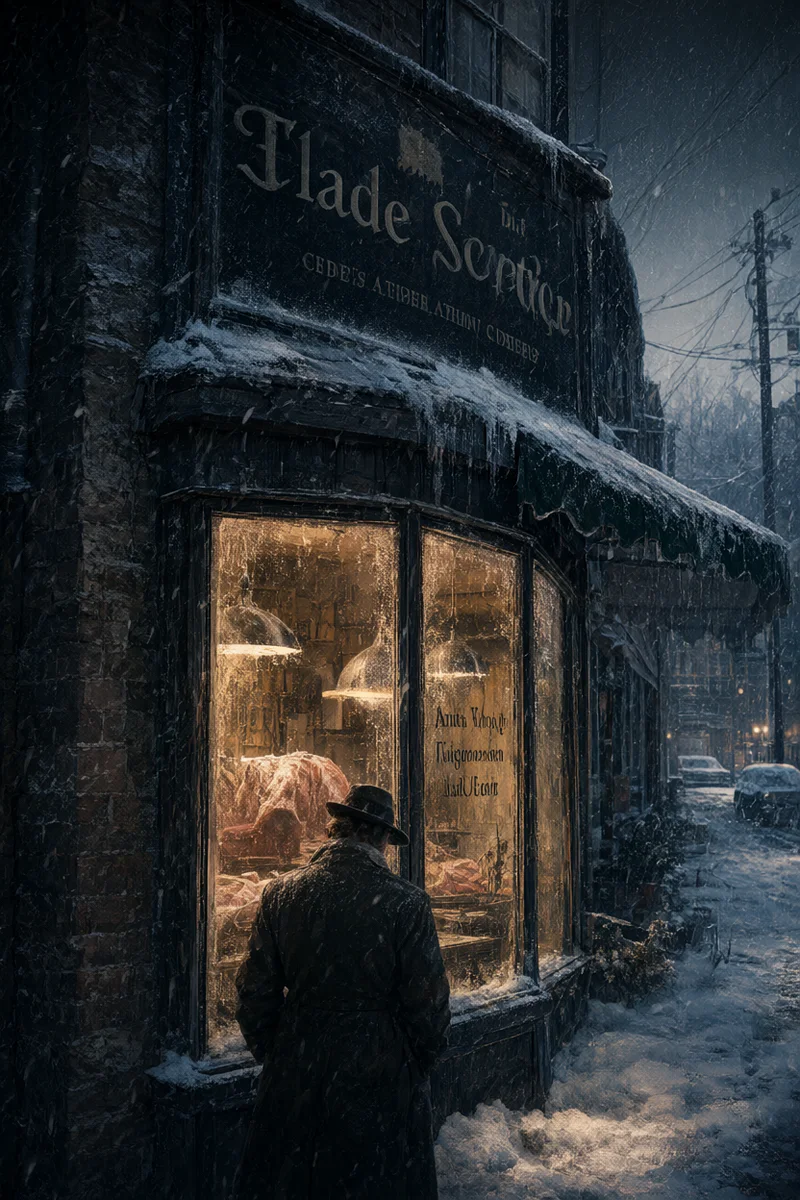
 The 38-Year Butcher Shop Secret: He Wrapped Nothing in Butcher Paper Every Christmas Eve
Chapter 2
The Bitter Winter of 1988
To understand the empty package, Gerald had to travel back in time through the layers of snow and memory to a winter that felt entirely different from any other. It was the winter of 1988, right at the tail end of the steel mill closures that had gutted western Pennsylvania and left families scrambling for survival.
Gerald was thirty-one back then, full of restless energy and eager to prove to his father, Walter, that he was ready to run Knox Meats on his own. Walter Knox was a mountain of a man with a booming laugh, a permanent smudge of flour and meat dust on his apron, and a heart so big it constantly threatened to bankrupt the business.
The winter of 1988 was punishingly cold. The sort of season where the temperature dropped below zero and stayed there, turning the roads into sheets of black ice and forcing local families to choose between heating their homes and filling their pantries.
It was December 23rd—the busiest day of the year. The shop was packed shoulder-to-shoulder with frantic holiday shoppers buying turkeys, hams, and expensive rib roasts. Amidst the chaos and the steam rising from heavy winter coats, Walter and Gerald worked in a blur of motion, slicing, wrapping, and shouting numbers to the waiting crowd.
Then, the bell above the front door chimed. A draft of freezing air swept into the shop, carrying a flurry of fine snow.
Gerald paused, his cleaver hovering over a T-bone steak, and looked toward the entrance. A woman had stepped inside, pulling the door shut behind her with mittened hands. She wasn't alone. Three small children clung tightly to her coat like ducklings following a mother hen.
Gerald noticed them instantly because they didn't behave like the other children in town. While other kids ran around touching the glass displays or begging for peppermint sticks from the jar by the register, these three children stayed glued to their mother’s side, completely silent, their big eyes wide and watchful.
The oldest was a girl of about seven or eight. She wore a heavy winter coat that was clearly a few sizes too small; the sleeves ended halfway up her forearms, leaving her red, chapped wrists exposed to the biting air. Her little brother wore two different gloves—one knitted green wool, the other a brown leather work glove that swallowed his tiny hand entirely.
The mother looked exhausted. Her face was pale, and dark circles bruised the skin beneath her eyes. She guided her children toward the meat counter, stepping carefully over the fresh sawdust sprinkled on the floor. For a long, agonizing minute, she stood in front of the glass display case, her gloved finger tracing the price tags written in Walter’s messy handwriting.
She wasn't looking at the steaks or the ground beef. Her gaze was locked entirely on the smallest, cheapest beef roasts tucked away in the corner of the case.
Gerald watched as she slowly slid her hand into the pocket of her threadbare coat. He heard the faint, metallic jingle of loose change shifting against fabric. She pulled her hand out, looked down at her palm, and quietly counted whatever coins she had managed to scrape together.
A heavy, heartbreaking sadness washed over her face. She closed her hand tightly around the coins, shook her head with a look of quiet defeat, and whispered something to the little girl beside her.
“Maybe after Christmas, sweetie,” the mother said, her voice cracking slightly.
She turned around, her shoulders slumping forward, and began to herd her children toward the door. They were going to leave empty-handed into the freezing Pennsylvania snow.
Gerald swallowed hard, feeling a sharp knot tighten in his throat. He looked over at his father, expecting Walter to call out or offer a cheap cut of trimmings. But Walter was already moving faster than his heavy frame usually allowed.
The End









