 The 38-Year Butcher Shop Secret: He Wrapped Nothing in Butcher Paper Every Christmas Eve
Chapter 1
The Last Christmas Eve at Knox Meats
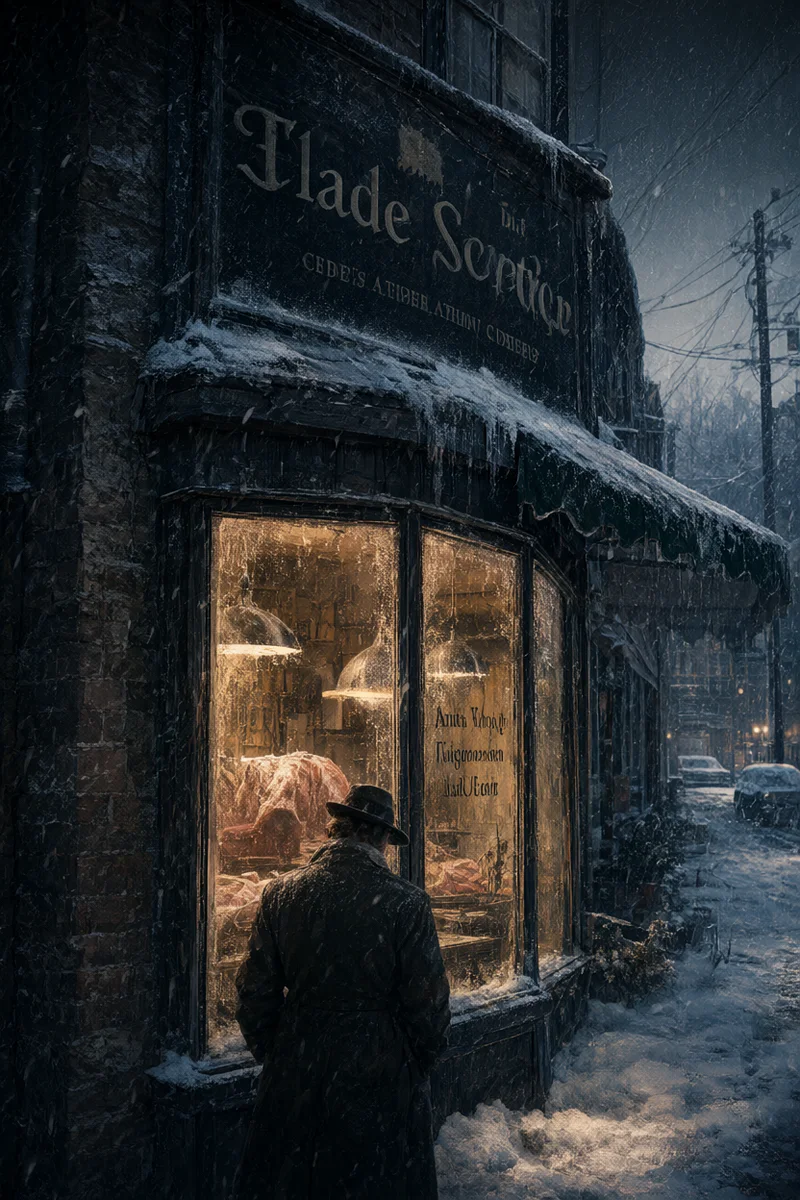
The snow outside Gerald Knox’s butcher shop in western Pennsylvania was falling in thick, heavy sheets, sticking fast to the frosted front windows and muffling the festive sounds of downtown. Inside, the shop smelled of rich sawdust, cold iron, and the faint, savory trace of cured hams and spiced beef. It was late afternoon on Christmas Eve, and the final rush of holiday shoppers had finally thinned out to a steady trickle.
Gerald stood behind the heavy oak counter, his hands resting heavily on the cutting board. At sixty-nine, his shoulders carried the permanent stoop of a man who had spent more than four decades trimming steaks, hauling sides of beef, and standing on cold concrete floors before the sun even cleared the horizon. His thick, calloused hands were steady, but his knees ached with a dull, familiar throb that reminded him winter had truly set in.
Beside him, twenty-four-year-old Mason, his part-time employee and culinary school hopeful, was wiping down the stainless steel prep table. Mason paused, wiping sweat from his forehead, and looked over at the refrigerated display case. Resting between two prime rib roasts sat a small, neatly wrapped square of white butcher paper tied securely with thick red kitchen twine. Across the top, written in thick, unhesitating strokes with a black permanent marker, was a single word: PAID.
Mason frowned, setting his rag down on the counter. He had seen that package sitting in the exact same spot at the exact same hour every single December twenty-fourth for the three years he had worked there.
“Mr. Knox,” Mason said, his voice cutting through the hum of the cooling compressors. “There’s nothing in there. It’s just an empty piece of paper.”
Gerald didn’t flinch. He didn’t look up immediately. He just stared at the package for a long, quiet moment before reaching out, opening the glass door, and sliding the package slightly to the left so it sat squarely in the center of the display.
“I know,” Gerald replied softly, his voice gravelly and low.
“Why do you do it every year?” Mason pressed, his curiosity finally getting the better of him. “Customers look at it. Some of them whisper. People think you’re losing your touch or keeping some weird superstition.”
Gerald closed the glass door with a soft click. He looked around the cozy, familiar shop—the vintage weighing scale that his father had bolted to the counter in 1962, the row of razor-sharp boning knives hanging neatly on a magnetic strip, and the handwritten sign taped near the cash register announcing that Gerald Knox would permanently retire after New Year’s Day.
His wife, Ellen, had been diagnosed with Parkinson’s disease three years ago. Day by day, the tremors had stolen her independence, turning simple morning routines into grueling trials. Gerald knew in his heart it was time. He needed to trade the pre-dawn butcher block for a quiet kitchen table where he could pour Ellen’s morning coffee and help her button her sweater. But as retirement loomed, the weight of thirty-eight years of memories pressed heavily on his chest.
“It’s not a superstition, Mason,” Gerald said quietly, leaning his forearms against the scarred wooden counter. “My father started it thirty-eight years ago. And when he passed, I picked up the pen. Nobody in this town ever knew why we did it. But tonight... tonight is the last time I’ll ever place that package in this case. And maybe it’s time someone understood why.”
Mason leaned in closer, his youthful face shadowed by the dimming winter light outside, completely unaware that the next few minutes would unlock a secret that had quietly anchored a family’s faith in humanity for nearly four decades.
The End









